Get Full Government Meeting Transcripts, Videos, & Alerts Forever!
Get email alerts on the Zoning Crypto Private Burials topic
No spam. Unsubscribe anytime.
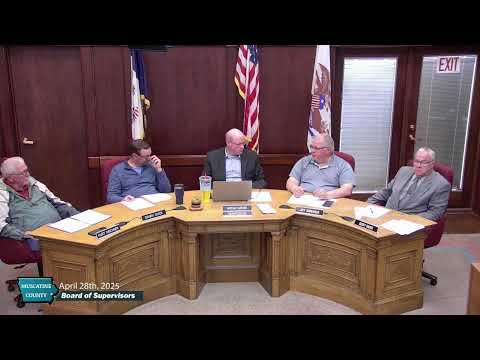
Muscatine County advances crypto/data-center zoning; tables private-burial rules after supervisors raise concerns
Summary
Supervisors approved on first reading a zoning change to allow cryptocurrency mining and data centers only by special-use permit in industrial zones, and indefinitely tabled proposed rules for private burial sites after a debate about future taxpayer liability and ownership responsibilities.
Muscatine County supervisors voted on April 28 to approve on the first of three readings an amendment to the county zoning ordinance that would define “crypto mining or production installations” and treat them, along with data centers, as special-permitted uses in I-1 (light industrial) and I-2 (heavy industrial) districts.
The measure was moved and passed on a roll call vote, with all supervisors voting in favor. County staff said the change is intended to confine such facilities to industrial areas and allow case-by-case review through the special-use permitting process.
County planning staffer Eric (county staff) told the board: “We are proposing adoption of an actual definition for crypto mining or production installations and data centers.” He said the zoning commission recommended the definition and the placement of those uses in industrial districts to address concerns about size, noise, heat and water use and to avoid locating such facilities in residential or light-use areas.
The zoning discussion then turned to a separate proposed amendment to define and regulate private burial sites. Under the draft, the county would define “cemetery” and “private burial site,” allow private burial sites only in the A-1 (agricultural) district by special use permit (and as an option in R-1 residential), and impose minimum standards: a 10-foot setback from property lines, a 25-foot setback from waterways, prohibition within regulated flood plains, and a recorded site plan that would appear in property records.
Staff said the recording requirement responds to unrecorded pioneer and private cemeteries the county had discovered and is intended to disclose burial locations on abstracts when land changes hands. Eric said recording site plans would ensure future buyers and officials are aware of the existence of private burial sites.
Supervisors questioned long-term taxpayer exposure and enforcement. One supervisor noted that pioneer cemeteries can become the county’s responsibility after a long period and asked whether private burial sites could become a similar obligation if ownership changes or the property goes to tax sale. Staff responded that private burial sites would remain private, not township cemeteries, and that public-health enforcement (for handling of remains) is a state responsibility.
Several supervisors said they were uncomfortable permitting earth interment on private property without stronger protections. Suggestions included requiring a maintenance or exhumation bond, or outright prohibiting in-ground private burials while preserving less intrusive practices such as scattering ashes. The board discussed drafting a narrower ordinance that would prohibit earth internment while allowing scattering of ashes with a simpler permit.
After extended discussion, the board voted to table the private-burial amendment indefinitely so staff can draft revised language. The board chair summarized the vote: “We have a motion by Jeff, a second by Kurt that I'm going to interpret as tabling this indefinitely.” The motion carried on a roll call vote with all supervisors voting aye.
What the board decided and why: The crypto/data-center definition and zoning placement move forward to additional readings so applicants would be limited to industrial zones and subject to special-use review. The private-burial proposal will return to staff for redrafting, following supervisor direction to consider stronger protections for taxpayers and future landowners or to prohibit in-ground private interment.
Next steps: The crypto/data-center amendment will proceed to further readings. Staff will return with revised language on private burial sites; the board indicated that revised language could include prohibiting ground interment or requiring stronger financial assurances and clearer recording requirements.
Speakers quoted in this article are recorded in the meeting transcript.