Get Full Government Meeting Transcripts, Videos, & Alerts Forever!
Get email alerts on the Transportation Public Safety topic
No spam. Unsubscribe anytime.
Public Works briefs council on moving monument and reconfiguring Riverside slip lane to improve safety
Summary
Public Works presented Resolution 2020531 to enable relocation of a monument and to reconfigure the slip lane at Riverside and Monroe to slow traffic, separate bicyclists from vehicles and accommodate a future cycle track; staff said the family supports relocation but ownership and funding details remain unclear.
Marlene Feist, Public Works, briefed the Spokane City Council on a proposed resolution (2020531) to facilitate relocating a monument in order to accommodate a safety improvement project at the Riverside and Monroe intersection.
"This project would be to change the island structures around here to accommodate the change in the slip line," Feist said, describing an existing slip lane in front of the Spokane Club that she said allows vehicles to travel fast and that the design would require a more deliberate right turn and provide separation between the bike lane and the travel lane. The change is intended to slow vehicle traffic and to pave the way for a protected cycle track planned with a later Riverside project in 2026 or 2027.
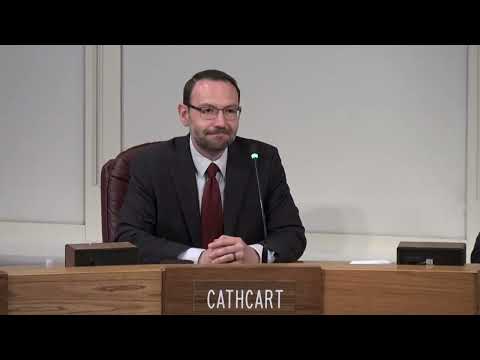
Council member Cathcart asked whether a simpler, lower-cost treatment such as a speed hump could achieve the same safety outcome; Feist said the design team believes the island reconfiguration is the most protective solution but that the city could revisit alternatives. Feist said the cycle-track elements would come in a subsequent project and that the island work could occur in late summer after council approval and coordination with the monument’s family.
Councilor MacKachar said the city has not had a broad, substantive public discussion about the monument’s history and suggested additional perspectives — including from veterans groups — should be brought forward. Council member Dylan said he was "very pleased to see the family was supportive," and emphasized that family support had been a major concern for him.
Council members and staff discussed ownership and funding. Feist said the staff record is unclear: the city provided $1,000 toward the statue’s creation in 1899 and dedicated the location as public right-of-way in 1904, "so I don't know that we know ... the family may have always owned it." Staff said they would work with the family to relocate the monument if council approves the resolution. On funding, staff said some internal funds are available but the specific account was not specified during the briefing.
No formal council vote on Resolution 2020531 took place at the agenda-setting meeting; staff described the item as a briefing and outlined next steps, including coordinating the relocation with the family and scheduling island construction for late summer, with cycle-track elements to follow in a later project.
Feist and council members noted the project is intended to be consistent with planned bicycle improvements along Riverside and to better protect pedestrians and bicyclists where the slip lane now encourages higher speeds.