
Committee amends and advances bill to expand school‑readiness tax credit for employer‑funded child care
Get AI-powered insights, summaries, and transcripts
Subscribe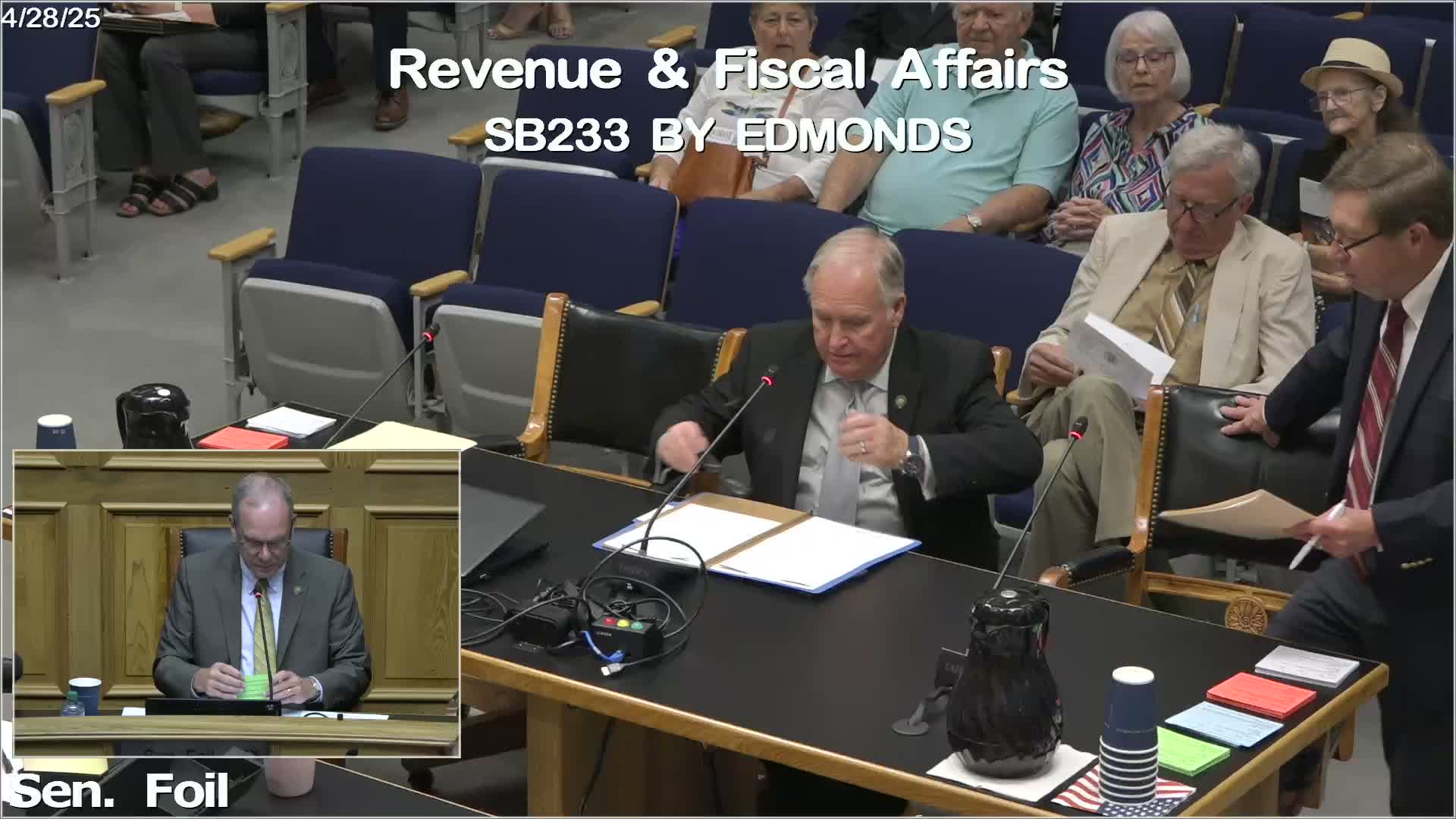
Summary
The committee reported Senate Bill 233 as amended, increasing credits tied to childcare quality ratings and adding a $5 million annual cap at the committee's request.
The City Senate Committee on Revenue and Fiscal Affairs on April 28 voted to report Senate Bill 233 as amended. The bill, sponsored by Senator Edmonds, renames and expands an existing school‑readiness tax credit to increase refundable credits for businesses that pay childcare expenses for employees and to raise caps on eligible purchases.
Senator Edmonds, sponsor of SB233, told the committee the measure "renames and expands the school readiness tax credit" and increases the refundable percentage businesses may claim based on childcare quality ratings. He said the program is intended to spur employer involvement in childcare to support workforce development.
Barry Irwin of Leaders for a Better Louisiana described the proposal as a way to "create a partnership and incentivize businesses to do more on the child care side by putting up their own money, where they'll get a match from the state." The bill raises the credit rate for five‑star providers from 20% to 50%, four‑star from 15% to 40%, three‑star from 10% to 30% and two‑star from 5% to 20%. It also increases the cap on equipment and construction expenses from $50,000 to $100,000 and raises the annual cap for purchased childcare slots from $50,000 to $100,000.
Committee members pressed several implementation questions. Senator Meisel and others asked whether the law would expand access beyond families eligible for CCAP (Child Care Assistance Program); sponsors and proponents said SB233 is intended to expand employer participation rather than replace CCAP. Senator Morris asked who administers the quality rating system; proponents said the Department of Education performs ratings based on staffing, safety, curriculum and credentials.
Luke Morris of the Department of Revenue said the program is dual‑administered: the Department of Education handles front‑end certification while Revenue ensures refundable credits are paid only after requirements are met. The Legislative Fiscal Office estimated the proposal could roughly double current program costs and presented a fiscal note projecting an increase (the LFO's analysis assumed a doubling of current costs and noted uncertainty tied to participation by businesses).
Committee debate focused on fiscal exposure. The committee adopted an amendment in concept to add a $5,000,000 annual cap on the program and gave staff authority for technical drafting; the amendment was identified as amendment set 951. Senator Meisel then moved to report the bill as amended; committee members registered no objections and SB233 was reported as amended.
The committee directed staff and proponents to provide additional information about the Department of Education's rating process, utilization of existing caps by businesses, and more granular fiscal data before the bill moves further in the process.