
Conference committee on House Bill 1020 debates water funding, line‑of‑credit split between chambers
Get AI-powered insights, summaries, and transcripts
Subscribe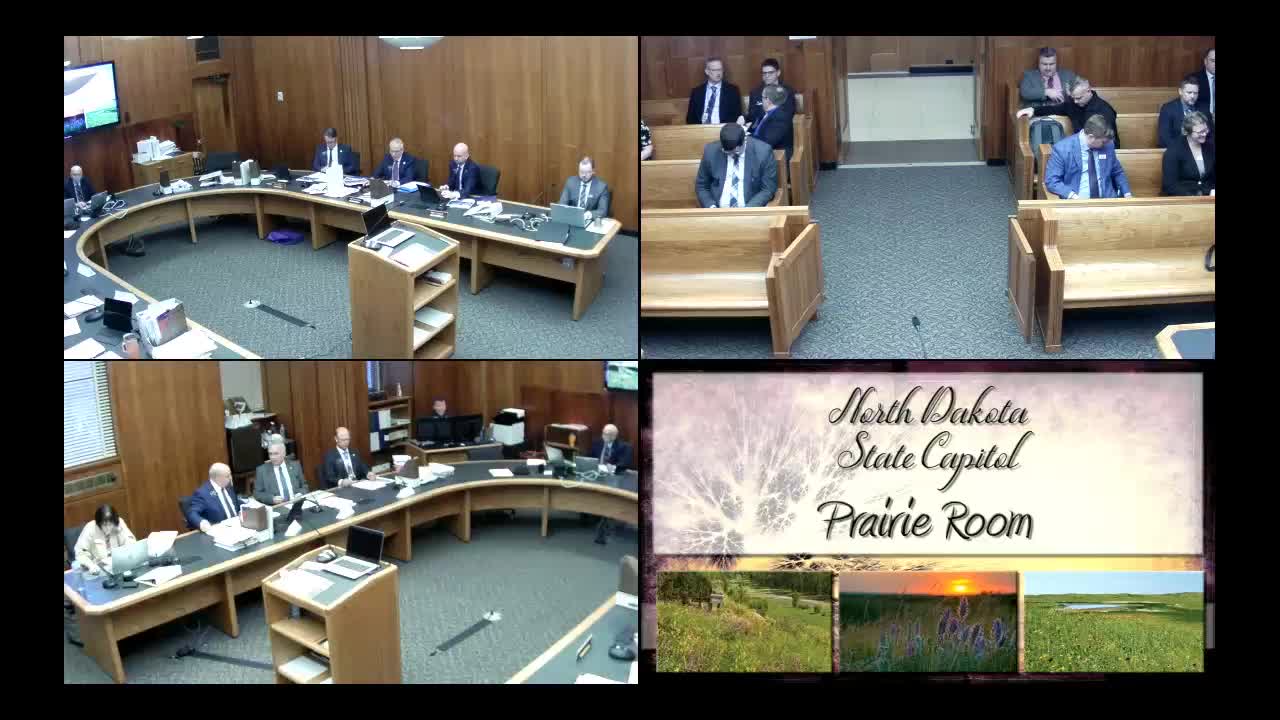
Summary
Lawmakers at a conference committee meeting on House Bill 1020 debated differences between the House and Senate funding plans for statewide water projects, focusing on the size and use of a line of credit, bonding for the Southwest Pipeline and allocations for major river basins and Bismarck.
A conference committee reviewing House Bill 1020 met to reconcile competing House and Senate funding plans for statewide water projects, with members debating the size and intended use of a line of credit, bonding for the Southwest Pipeline and targeted dollars for Red River, Mouse River and Bismarck.
Chairman Swiatek outlined the assemblies' starting positions and the changes since the House first transmitted its proposal. He said the House package originally “was looking at 806,500,000.0,” which included a line of credit and bonding, but that updated projections had reduced the package to about “657,700,000.0” after adjusting for oil‑price scenarios and other factors. He also described a 14‑year plan that the committee has used to estimate long‑term needs, saying projected needs totaled roughly $3,200,000,000 over that period.
The principal difference discussed was the chambers' treatment of carryover authority and bonding. The House position shown to the committee included a $200 million line of credit for carryover and $100 million in bonding; the Senate proposal presented a $100 million line of credit for carryover and $50 million in lieu of bonding. Members said those gaps make it difficult to finalize project funding until the committee narrows the range.
Senator Sorbach stressed uncertainty tied to oil prices and the resulting cash flow. He warned that if oil revenue falls sharply, “there's not going to be any new money next [biennium],” and said the committee must set realistic expectations for future sessions. Representative Deedee characterized the line of credit as “kind of almost like a safety net,” saying the higher carryover authority increases the pool of money available to meet different funding needs but may not be used unless revenue conditions deteriorate.
Senator Bechtel raised a question about Section 16 of the Senate draft, which would direct $50 million for the Southwest Pipeline project to be repaid from capital repayments now flowing into the State Water Resources Trust Fund. Bechtel said she opposed redirecting those capital repayments, arguing those payments — roughly $13 million currently and expected to grow as more users connect — should stay in the Trust Fund rather than be used to service bond or line‑of‑credit obligations.
Committee members described the Southwest repayments as a possible repayment source under the Senate language; others said that language likely carried over because bonding was included in the House plan and might not be appropriate if the committee adopts a line of credit instead. Members repeatedly said the line of credit might not be used if projects and cash flow proceed as planned, but that including it is a prudent contingency.
The committee also discussed geographic priorities: Chairman Swiatek noted the Red River project would affect roughly 60% of the state’s population on the eastern side and that the Bismarck area was being considered for roughly $14 million in targeted dollars, with an additional $3 million source still to be determined. Members noted tribal‑nation allocations were newly included compared with prior biennia and estimated tribal funding would add about $10 million to $15 million per biennium.
No formal motions or votes were recorded at the session; members agreed to continue negotiations. The committee planned to meet again to try to narrow the numerical gap on carryover authority and bonding so staff can plug final numbers into project worksheets and finalize funding allocations.