Young & Wright presents districtwide building condition survey, identifies mechanical systems and pools among top priorities
Summary
Architects from Young & Wright gave the West Seneca Central School District board an overview of a comprehensive five‑year building condition survey, turning over a searchable digital database, roof scans and an air‑conditioning feasibility study and flagging districtwide mechanical upgrades, playgrounds and pools as recurring needs.
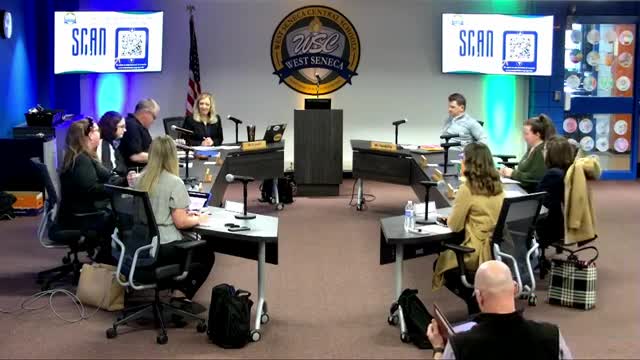
Young & Wright presented the results of a districtwide building condition survey to the West Seneca Central School District Board of Education at its Tuesday work session, outlining prioritized capital needs, handing over a searchable digital library of drawings and delivering an air‑conditioning feasibility study and roof‑scan plan.
The report, required in a basic form by the New York State Department of Education every five years, was conducted by Young & Wright over two months of on‑site work at the district’s nine schools plus Winchester Academy, the transportation facility and the Ebenezer building. "It is a very simple thing to accomplish what the state asks for, but it is very not helpful, to be honest, when you're looking to plan capital improvement projects down the road," said Alyssa Catlin, the firm’s building condition survey specialist.
The presentation showed a database of condition entries, photos and estimated replacement costs for each system on campus; each building produced up to roughly 300 entries in the district’s instance. "We were on‑site for a full 2 months," said Tori from Young & Wright, describing the team’s work and the district‑specific additions the firm makes beyond the state’s 86 evaluation categories.
Why this matters: the district can use the database to prioritize capital projects, apply for building aid and sequence work to align instructional goals with maintenance needs. Dr. Krueger said the district has scheduled a May 13 follow‑up meeting with Young & Wright for a deeper review of each building, inviting high‑school principals and head custodians to provide user perspectives.
Key findings and deliverables
- Scope and records: Young & Wright evaluated the state’s 86 categories and roughly 40 additional items the firm added (technology and security items such as intrusion detection and secure entrances, plus spaces like science labs and libraries). The firm created a digital drawing library and a FileMaker/Excel export of the whole database for district use.
- Common priorities: districtwide generator and mechanical system upgrades (unit ventilators, boilers, air handling units), playground replacements at elementary schools, parking lots/sidewalks and interior renovations (restrooms, cafeterias, libraries). Pools and pool‑related systems at middle and high schools were repeatedly flagged as items that need programmatic discussion because of maintenance costs.
- Costing and horizon: records include a labor‑and‑materials replacement estimate intended to provide a 7‑year planning horizon. Catlin cautioned that the sheet estimates are not full project budgets and do not include soft costs; she said a rough rule of thumb to convert the line‑item figures to a project budget is to multiply by about 1.5.
- Extra work paid for by the district: the team also obtained electrical panel arc‑flash testing data, scheduled roof scans (weather dependent) and completed an air‑conditioning study that evaluated what it would take to air‑condition individual rooms or entire buildings.
Board members and staff asked how the new survey differs from past work; the presenters said the current database‑driven approach is more detailed and repeatable. "There really is a lot of value in that because within 5 years, a lot can change for better or for worse," Catlin said, noting the value of having an explicit snapshot of systems over time.
Next steps and committee work
District staff and the facilities committee will use the database to rank priorities and develop a multi‑year capital plan. The board will consider how to balance "wants" (instructional renovations such as acoustic treatments in cafeterias or reconfiguring underused locker rooms) with "needs" (mechanical and life‑safety items). Dr. Krueger said the May 13 session will review both high schools in detail and then cover middle and elementary schools in subsequent reviews, with custodial and building users providing input.
What the survey does not do
Young & Wright noted limits of a single survey episode: they cannot see every historical repair (for example, a well‑hidden recurring roof leak). The firm relies on district staff knowledge to capture those issues. The team also reminded the board that replacement cost figures on the survey pages reflect labor and material on the day of the survey and are intended for short‑term planning rather than final bid numbers.
Board members thanked the presenters and scheduled the May 13 deep dive with Young & Wright to refine project priorities and budgeting assumptions.