
Midland staff present proposed 2026 budget; council urged to review personnel additions, capital transfers and water-rate plan
Get AI-powered insights, summaries, and transcripts
Sign Up Free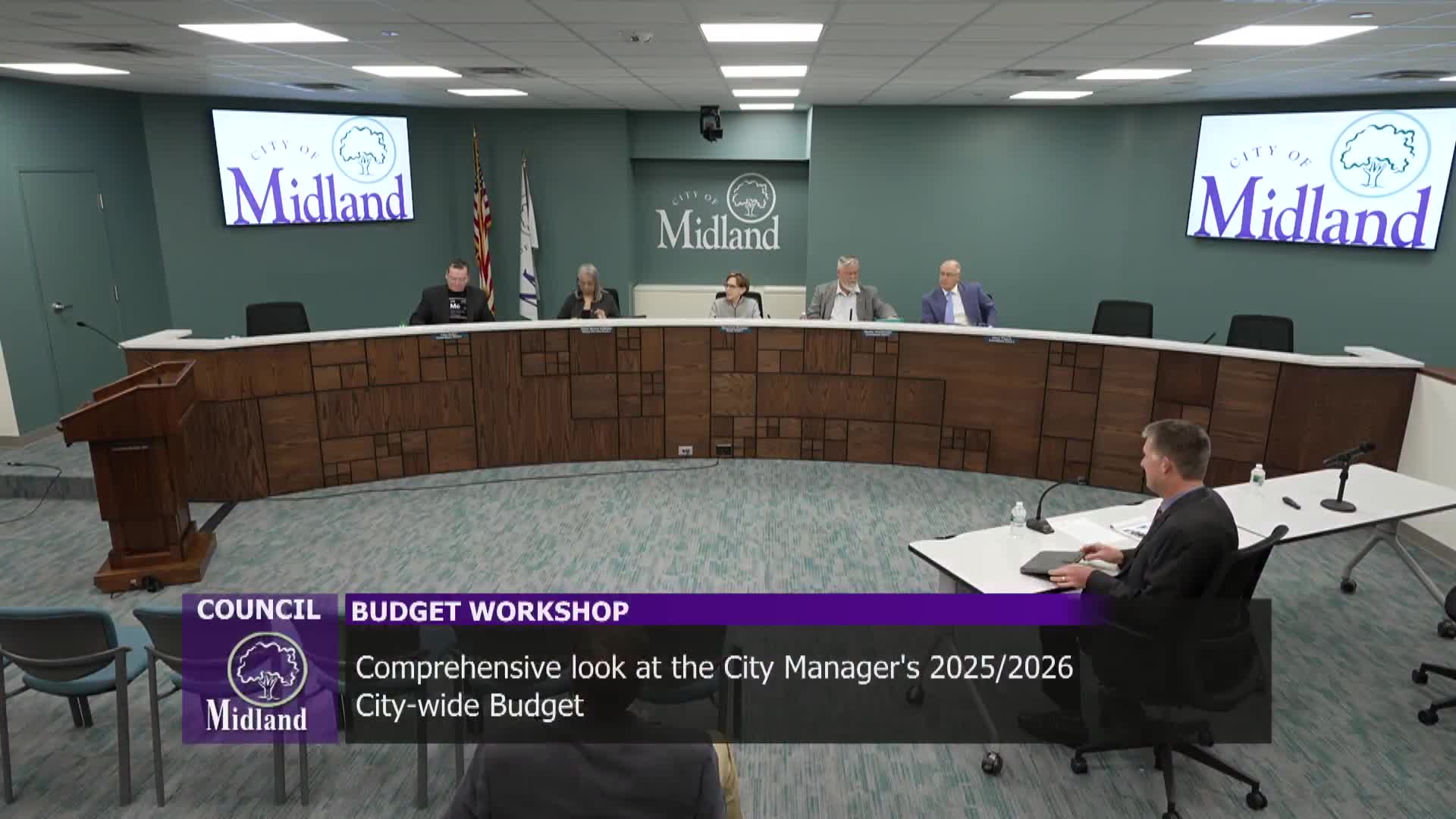
Summary
Midland City Council staff presented a proposed fiscal 2026 budget at a workshop on April 21, outlining personnel additions, capital transfers and planned infrastructure work while keeping the citys millage rate unchanged, staff said.
Midland City Council staff presented a proposed fiscal 2026 budget at a workshop on April 21, outlining personnel additions, capital transfers and planned infrastructure work while keeping the citys millage rate unchanged, staff said.
The presentation, led by Laura Merritt, staff member, walked council through departmental budgets, capital projects and revenue assumptions. Merritt said the budget maintains councils goals "to ensure economic sustainability, provide an outstanding quality of life and provide effective stewardship of community resources." She and other staff said the document assumes certain one-time and recurring transfers but does not budget for an anticipated additional PPT payment until it is received.
Why it matters: The workshop set the numbers staff will use in two upcoming public hearings (first hearing next week, second hearing May 12) and a planned adoption on May 19. The proposed plan funds new positions and capital work while relying on rising taxable values to hold the millage rate steady; staff warned that escalating materials and personnel costs could force cuts if revenues do not materialize.
Key details
- Millage and revenues: Mr. Kaye, staff member, noted the council has kept the millage rate steady for several years and told council, "I think this is the eighth year, if I'm correct, in a row, that the millage rate has been the same." Staff said taxable value growth, not a millage increase, is largely driving additional property tax revenue in the proposal. The packet shows a projected taxable-value increase used in revenue estimates (staff cited a 3.15% taxable-value increase for the year when explaining the difference between taxable value and the gross property-tax line).
- Personnel: The proposed budget adds seven new positions and changes six existing positions. Staff said those additions focus on two main areas: the Water Department (including a shared SCADA/data-control position, field construction observation and asset-management capacity) and a reorganized public-services structure that splits Parks & Recreation and Public Works into separate departments with their own directors. Merritt said the staff approach was to budget for personnel costs but not always to fix the precise organizational placement until further review and a full construction season.
- Pensions and millage allocation: The budget includes additional contributions to retirement obligations: staff listed an extra $500,000 for the MERS defined-benefit plan and $100,000 for the Police and Fire (Public Act 345) pension obligations. Merritt explained that the public-safety millage component must first cover the PA 345 obligations, then the remaining property-tax capacity funds general operations and the library allocation.
- Capital transfers and major projects: The draft includes transfers and capital commitments that council prioritized in January: $2,000,000 to the building fund, an additional $600,000 for building needs, $1,000,000 for stormwater work (and a large $40,000,000 state request related to EGLE projects mentioned by staff), and a $1,000,000 transfer to water projects contingent on additional PPT receipts. Staff also noted a $1,600,000 roof capital item for the library and later referenced a $4,000,000 transfer connected to library capital needs in the proposed year.
- Water and rates: Staff flagged that the Water Fund and road-rebuilding plans interact: rebuilding roads typically requires utility and subbase work and staff warned that continuing both without rate adjustments could deplete the water fund. Merritt and other staff said a water-rate discussion will appear at the council meeting next week, and that the budget does not include unconfirmed PPT receipts.
- Stormwater and state funding: The budget reflects potential large state funding for stormwater projects tied to EGLE; staff showed a large revenue/expenditure spike in the stormwater fund attributable to those expected but not-yet-finalized state funds.
- Facilities and service-center work: Staff identified the municipal service center and other city buildings as priorities for building-fund improvements and said the proposed building-fund transfers are intended to start addressing those needs, though staff said the available funds likely will not cover all required work.
- Other funds and programs: Staff reviewed multiple enterprise and internal-service funds: landfill operations (including gas-to-energy sales that primarily serve Dow), Barstow Airport capital and tree removal funded in part with ARPA, senior housing (Riverside and Washington Woods), Dial-A-Ride and transit grants, and operations such as the pool and the civic arena. Several departments reported one-time capital items in 2025 and smaller ongoing expenditures budgeted for 2026.
Discussion, direction and next steps
Council and staff discussed fee updates, sidewalk priorities and the cadence of the budget hearings. Staff encouraged council members to ask questions during department-by-department presentation points rather than deferring all questions to the end. Merritt confirmed the city does not budget for anticipated additional PPT receipts until they are received; if the city later receives the funds staff will propose a budget amendment to allocate them.
Councilmember Dyla Bridal praised staffs approach: "The thing that I really enjoy is you guys don't have the, we need to spend it or we're going to lose it attitude," she said, thanking staff for conservative planning.
No formal votes were taken at the workshop; the document presented is a proposed budget that staff will present again at the required public hearings and return to council for adoption (first public hearing next week, second required hearing May 12, adoption anticipated May 19). Staff repeatedly cautioned that legislative or grant changes and ongoing cost escalation (materials, contracts, personnel) could require adjustments after hearings or during the year.
Ending
Staff left the draft budget available for council questions and noted some presentation artifacts will be cleaned up for the public hearings. The council scheduled the standard two public hearings and a final adoption in May; staff said they will return with a more polished public presentation and any recommended adjustments after the hearings.