Get Full Government Meeting Transcripts, Videos, & Alerts Forever!
Get email alerts on the Stormwater Wetland Restoration 433 Reed topic
No spam. Unsubscribe anytime.
NFP board backs variance to allow stormwater treatment and wetlands restoration at 433 Reed Court
Summary
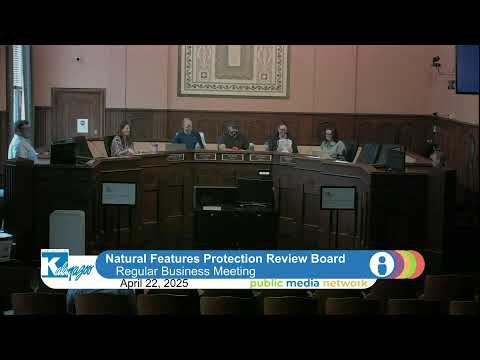
The Natural Features Protection (NFP) Review Board on April 22 recommended that the Zoning Board of Appeals grant relief from NFP wetland and water-resource setback standards so a stormwater-treatment and wetland restoration project can proceed at 433 Reed Court in Kalamazoo.
KALAMAZOO, Mich. — The Natural Features Protection (NFP) Review Board on April 22 recommended that the Zoning Board of Appeals grant relief from the board’s wetland and water-resource setback standards so a stormwater-treatment and wetlands-restoration project at 433 Reed Court can move forward.
City staff said the project, on land now owned by the Kalamazoo Brownfield Redevelopment Authority and proposed for transfer to the City of Kalamazoo Public Works Department, would treat runoff from about 12 acres of city streets that currently discharges untreated into Portage Creek. The board voted 5-0 to forward the request to the ZBA; recorded yes votes were Fredrickson, Fuller, Mergia, Leto and Martin.
The variance is needed because the project places engineered stormwater best-management practices (BMPs) inside the NFP code’s setbacks for wetlands and water resources. Nolan (city staff) told the board the current design would place treatment devices and bioswales inside those setbacks; the site would return to the NFP board for full site-plan review if the variance moves through ZBA and the development process.
Tom Palumbo, the project presenter, summarized the design as “environmental improvements, some stormwater improvements, floodplain improvements.” He said the work combines a mechanical treatment device near the street — a manhole-like unit meant to capture solids and floatables — with bioswales and reconnected stream channels across the roughly 4.2-acre parcel. Mark Kaiser of Kaiser and Associates said the project was developed as part of Natural Resource Damage Assessment funding tied to Superfund work on the Kalamazoo River basin and that trustees and federal partners (including the Fish and Wildlife Service and NOAA) are involved in funding and technical review.
Kaiser described how the project would divert most street runoff to the mechanical treatment device and then route treated flows through newly opened swales and a reconnected channel that will discharge back to Portage Creek at a rock outfall to the north. He said the device and swales aim to reduce trash, sediment and phosphorus loading to downstream reservoirs. The presenters noted the city holds a municipal separate storm sewer (MS4) general permit covering the outfall and that the device is intended to capture the “first flush” of runoff, when most pollutants are mobilized.
Project details discussed at the meeting included: a proposed public boardwalk and viewing platform with pedestrian access from the south side; an anticipated removal of six trees that staff said would be retained on-site and reused for in-stream habitat features; coordination with EGLE and the U.S. Fish and Wildlife Service on habitat and permitting; and prior interim soil removal tied to Superfund work (shallow PCB-contaminated soils were removed around 2012 and replaced with clean fill).
Board members asked about long-term maintenance. Presenters and staff said the city maintains mechanical treatment units where they are installed and that funds from the NRDA/trustee process would pay for construction; routine maintenance of bioswales and wetland areas would be handled by city divisions on an as-needed basis (trash removal, invasive-species control). Presenters said the mechanical device is designed to be serviced by city crews and that the city’s standard is to design such devices to remove roughly 80% of solids when properly maintained.
Public comment at the meeting included Ray Nguyen, a Kalamazoo resident, who said his family has lived in the city for many generations and that he supports the project: “I’m here to let you know that I support that initiative.” Other neighbors asked about fallen trees, wildlife impacts and site access; presenters said many fallen trees provide ecological value and that the design aims to increase habitat diversity while stabilizing streambanks.
After questions and discussion — including members noting this project differs from typical development-driven BMP placements because it restores and treats an existing untreated outfall rather than responding to new impervious surface — the board moved to recommend relief to the Zoning Board of Appeals. Nolan called the roll; the motion passed by a 5-0 recorded vote.
Next steps: the NFP board’s action is a recommendation to the ZBA; if the ZBA grants relief, the project would still proceed through permitting (EGLE, MS4-related reviews, and any historic-preservation and tribal-notification work required by the trustees) and return to the NFP board for full site-plan review. Presenters estimated bidding and construction timeline could be about 18 months out if permitting proceeds on schedule.
Votes at a glance: NFP Review Board recommendation to ZBA on variance for 433 Reed Court — Passed 5-0 (Fredrickson, Fuller, Mergia, Leto, Martin voting yes).