Get Full Government Meeting Transcripts, Videos, & Alerts Forever!
Get email alerts on the City Planning And Housing topic
No spam. Unsubscribe anytime.
Kalamazoo commission outlines 2026 priorities; home‑share feasibility, Imagine Kalamazoo 2035 advance
Summary
At a Committee of the Whole meeting April 21, Kalamazoo City officials reviewed outcomes from a recent commission retreat that will guide 2026 budget requests, discussed a city-led RFP and feasibility study for a home‑sharing program, and received an update on the Imagine Kalamazoo 2035 planning process.
Kalamazoo City Commission members on Monday reviewed retreat results that will shape department requests for the 2026 budget, discussed next steps for a city-run home‑share program feasibility study and request for proposals (RFP), and heard an update on the Imagine Kalamazoo 2035 planning process.
The retreat produced five priority outcomes — increasing affordable housing, improving community prosperity, decreasing violent crime among youth, supporting economic development, and increasing support for people experiencing homelessness — that staff will use to evaluate special requests coming into the 2026 budget process. Chief operating officer Laura Lam told commissioners that retreat priorities will be weighed alongside core, day‑to‑day budget items such as utilities and roads.
The home‑share agenda item combined a public comment in favor of flexible matching with staff details about the program’s status. Toby Hannah Davies, a city resident who said she has used home sharing in the past, urged the commission to allow flexibility in matching by age and needs. “It’s really important to have the people making the match determine the age group that they would like to have matched with them,” Davies said.
Sherilyn Parsons, community development manager, told the commission that a prospective community partner who had planned to champion the program has decided not to lead the effort. “That service provider has decided to step back,” Parsons said. City staff have thus taken RFP responsibility back to the city and are finalizing a feasibility study request. Parsons said the RFP will ask respondents to define likely beneficiaries, analyze the city’s housing stock at neighborhood and census‑tract levels, estimate start‑up and seed funding required for a pilot, and identify any city, state or federal regulations that would affect program launch.
Lam and Parsons described the model the city is seeking: two or more unrelated people sharing a home, matched to preserve housing stability in exchange for caregiving, companionship, help with home responsibilities, or defraying housing costs; and a formal agreement that protects both parties’ rights and safety.
Commissioners asked whether the feasibility study would consider needed home repairs and look at other cities’ programs. Parsons said the RFP will consider the condition of housing stock and local beneficiaries but noted the city cannot inspect private homes as part of the RFP. She said staff have spoken with other municipalities and that some prior programs did not survive the pandemic; she recommended a pilot year or two after a feasibility study to gather lessons learned.
Staff also reported on work tied to the retreat priorities: continued investment in public‑safety youth programming, requests to expand overt camera coverage in the Northside Cultural Business District and downtown, continued support for critical code repair programs to help residents keep homes, workforce and financial coaching partnerships for the Northside, and consideration of an entrepreneurial network/capital consortium to address gaps in business supports. Lam gave budget context, noting the city’s 2025 budget totals about $388 million, including roughly $240 million for water and wastewater, $16 million for roads and about $1 million for parks.
On homelessness, Lam said $500,000 from the 2025 budget was allocated for extreme‑weather responses; those funds were used for hoteling during extremely cold weather and to help Kalamazoo Gospel Ministries replace shelter mats and increase capacity.
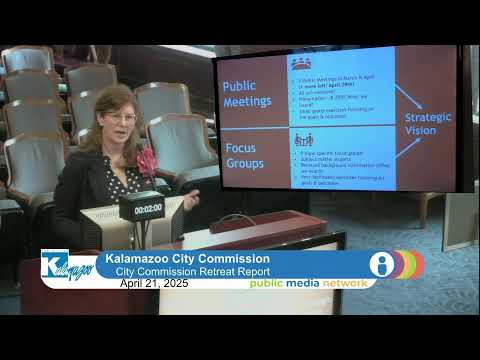
Deputy City Manager Rebecca Kik (Rebecca Kick in the transcript) updated the commission on Imagine Kalamazoo 2035. She said the “Imagine It” phase is complete, staff recorded about 2,400 contacts during early engagement and that the planning process will move into the “Planet” and then “Design It” phases. Kik said strategic goals and community input will guide a draft strategic vision later this summer and that the master plan and neighborhood‑level work will follow.
Next steps: strategies from the retreat will be translated into departmental special requests that enter the budget review process in May and June; a draft budget is expected to be released in November and formally considered in January.
Votes at a glance: commissioners approved a motion to excuse Commissioner Hoffman from the meeting by voice vote. Motion to excuse made by Commissioner Decker and supported by Commissioner Cooney; motion passed by affirmative voice vote.