Get Full Government Meeting Transcripts, Videos, & Alerts Forever!
Get email alerts on the Mobile Nuisance Vehicles topic
No spam. Unsubscribe anytime.
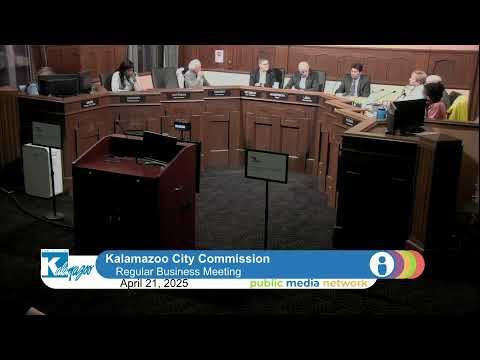
Commission approves first reading of ordinance to allow impoundment of vehicles tied to 'mobile nuisance' gatherings
Summary
The Kalamazoo City Commission on April 21 approved for first reading a proposal to amend Chapter 21 to allow impoundment of vehicles tied to repeat "mobile nuisance" gatherings after warning and limited court authorization.
The Kalamazoo City Commission on April 21 approved for first reading a proposed ordinance (Chapter 21, Article 3, new section 21‑28) that would authorize police to impound vehicles involved in repeat “mobile nuisance” gatherings.
The draft ordinance defines a mobile nuisance party as a static or moving social gathering that, by conduct, causes one or more listed harms — including unlawful obstruction of traffic, unlawful street parking, and unreasonably loud noise that disturbs neighbors. The ordinance establishes a process that begins with a warning letter to registered owners and can result in seizure and impoundment of vehicles that continue to be involved in subsequent incidents.
Police Chief David Boysen and Deputy City Attorney Sarah Van Heif presented the ordinance and described the department’s recent operational approach. Boysen said the department shifted from large overtime enforcement operations to a data‑driven strategy that identifies vehicles that repeatedly appear at disturbance sites, issues warning letters (in person when feasible, or by certified mail), and — where repeat violation occurs — seeks seizure orders from a judge to tow vehicles after the fact. Chief Boysen said staff identified 914 vehicles involved in the behavior in 2024, that 24 of those were rental vehicles, and that the department obtained 15 seizure orders and executed 14 tows after the fact.
“We found focusing on vehicles rather than on individual attendees is more effective, safer for officers and more efficient for the department,” Boysen said.
Deputy City Attorney Sarah Van Heif said the proposed ordinance clarifies the authority to impound vehicles when enforcement occurs after the event. The draft sets a 90‑day misdemeanor penalty for violations and describes three enforcement subsections: towing on‑scene where reasonable cause exists, after‑the‑fact seizure where a warning was previously served, and a process requiring judicial authorization before entering private property to retrieve a towed vehicle.
Commissioners asked operational questions about how long the enforcement window would remain open (staff said the warning/impound authority would be limited to a six‑month period from service of the warning letter), how license‑plate‑reader alerts would be used to flag repeat vehicles, and how private‑property seizures would be handled (authorities said the department would seek a search warrant where private‑property entry is necessary).
Public comment included a questioning of the approach’s emphasis. Amanda Charbonneau, who said she studied community policing, asked whether the problem was violence and safety or quality of life and property values and urged the city to consider alternatives such as providing safe gathering spaces and transit access. Chief Boysen and Vice Mayor Hess said the ordinance is a targeted public‑safety and quality‑of‑life measure intended to protect residents whose neighborhoods have been repeatedly disrupted; they cited past incidents where emergency access and resident sleep were compromised.
The commission voted to advance the ordinance for first reading. The motion was made by Commissioner Prado and supported by Commissioner Decker; roll‑call recorded unanimous support among commissioners present.
Ending: If the ordinance proceeds through second reading and final adoption, staff said enforcement will continue with warning letters, targeted impounds and judicial review for private‑property actions; the department also plans to use license‑plate readers and the mobile nuisance dashboard to track repeat offenders.