Get Full Government Meeting Transcripts, Videos, & Alerts Forever!
Get email alerts on the Consolidated Plan 2025 2029 topic
No spam. Unsubscribe anytime.
Kalamazoo approves HUD-required 2025–2029 consolidated plan and 2025 action plan; sets priorities for housing and neighborhood projects
Summary
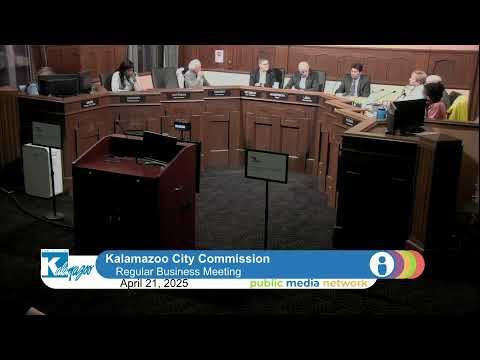
On April 21, 2025 the Kalamazoo City Commission voted to adopt the 2025–2029 consolidated plan and the 2025 action plan required by HUD, directing federal CDBG and HOME funds toward housing preservation, tenant stability, neighborhood projects and expanded public-service grants.
The Kalamazoo City Commission on April 21 adopted the city’s 2025–2029 Consolidated Plan and the accompanying 2025 Action Plan, the five‑year strategy required by the U.S. Department of Housing and Urban Development for entitlement communities.
The plan sets priorities for federal Community Development Block Grant (CDBG) and HOME Investment Partnerships funds and establishes proposed 2025 program activity. City staff told the commission the city currently receives roughly $1,500,000 annually in CDBG funds and about $450,000 annually in HOME funds and that HUD requires that the consolidated plan align each activity with one of HUD’s national objectives.
Julie Johnston, the city’s compliance specialist, summarized outreach and the plan’s priorities: two critical priorities — preserving existing single‑family housing and stabilizing affordable rental housing for low‑income households; four important priorities including safe rental housing and services for underserved groups; and several desirable priorities such as housing diversity and economic development. Johnston said the plan forecasts outcomes based on current funding levels and warned that reduced federal allocations would require re‑evaluation of those targets.
Key elements of the 2025 action plan include:
- Single‑family home repair programs to protect low‑income homeowners from displacement. Johnston said home repairs emerged from the community outreach as a critical need. - A proposed Neighborhood Initiatives Fund that would assign about $200,000 per year to one of the city’s five core neighborhoods on a rotating basis to address localized public‑improvement projects. - Expanded public‑service funding. Staff recommended widening public service support beyond previous allocations for youth development and said the city expects to assist roughly 1,250 people through grants to service providers over the five‑year period. - Tenant‑based rental assistance (TBRA) using both CDBG and HOME dollars, proposed as a 12‑month rental subsidy paired with financial‑self‑sufficiency supports; staff described a rough 2025 TBRA funding estimate near $330,000. - HOME CHDO set‑aside. HUD requires 15% of HOME funds be reserved for community housing development organizations (CHDOs); staff said that translated to roughly $65,000 annually and noted that a portion of 2024 CHDO funding remained unallocated and was included in the 2025 request.
The plan also outlines neighborhoods and organizations that participated in an extensive outreach campaign: an online survey, six neighborhood open houses, 24 events and meetings with service providers and community partners during summer and fall 2024.
Public commenters and community partners spoke in support of the plan while urging additional emphasis on down‑payment assistance and continued city support for infill new‑build programs. Beth McCann, executive director of Kalamazoo Neighborhood Housing, asked that the city consider restoring a down‑payment assistance program; she said 68% of the group’s recent buyers required DPA and the average assistance had been $10,750.
The commission voted to approve the consolidated plan and 2025 action plan. Motion to adopt was made by Commissioner Decker and supported by Commissioner Cooney. Deputy Clerk Moss recorded the roll call: Commissioner Decker — yes; Commissioner Paredle — abstain (stated the abstention was for a conflict with employer); Commissioner Wilson — yes; Vice Mayor Hess — yes; Mayor Anderson — yes; Commissioner Cooney — yes. The motion passed.
Ending: Staff said the plan must be submitted to HUD by May 15 and that HUD’s funding awards for the Clean‑up and HOME programs will affect final outcomes; the city will return to the commission for final approval of project contracts and allocations under the action plan.