Get Full Government Meeting Transcripts, Videos, & Alerts Forever!
Get email alerts on the Public Safety Oversight topic
No spam. Unsubscribe anytime.
Fire and police commission chairs describe oversight, appointment and complaint roles to Lansing Charter Commission
Summary
Representatives from the Fire and Police boards told the Charter Commission how each board handles chief appointments, complaint review and discipline, and recommended clarifications to the charter to align practice and law.
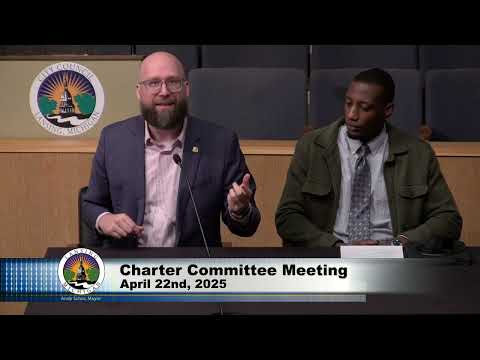
Representatives of the Lansing Board of Fire Commissioners and the Board of Police Commissioners explained April 22 how their boards operate, handle complaints and participate in chief appointments, and urged the Charter Commission to clarify ambiguous charter language.
“Both the police board and the fire board have a distinction in the charter of being advisory boards with additional responsibilities,” said Steve Purchase, chair of the Board of Fire Commissioners, summarizing how the charter gives the boards advisory duties plus specific authorities related to appointment and discipline.
Police board chair D.A. Jones and vice chair Sam Brewster described differences in how chiefs are selected under the current charter language: the fire board is written to approve a list of candidates from which the mayor appoints, while the police board’s process is written as a confirmation vote after the mayor appoints. In practice, those differences have not been strictly followed, presenters said, and boards sometimes participate in national searches or supply members to search committees.
Both boards said they produce annual reports to the mayor and City Council; the fire board said it retooled its report process to draft an independent evaluation rather than simply attaching the department’s report. The police board said its report covering 2023–2024 would be submitted soon and that the department prepares much of the draft.
On complaints and investigations, presenters outlined different capacities: the police commission has an investigator with subpoena authority who can undertake investigations and present redacted reports to commissioners; the police commission investigator was identified as Akidra Abrams. The fire board’s complaint process is administrative: complaints are investigated by the fire chief or a designee, and the results are reported to the board. Both boards said collective bargaining agreements and state law limit how much disciplinary authority boards can exercise in practice.
Several commissioners asked whether boards can override mayoral discipline decisions. Panelists said the charter’s language is strong — boards “shall act as final authority” in discipline matters on paper — but collective bargaining and state law have narrowed that role. Speakers suggested clarifying language so the charter reflects current practice and legal constraints.
Board members described other duties the charter assigns them, including drafting department rules and administrative procedures, reviewing critical incidents in closed session consistent with the Open Meetings Act, and advocating for department budgets through annual letters. They also discussed training: the police commission recently received training from the National Association for Civilian Oversight, and both boards maintain “board books” to orient new members.
The commission asked for additional written recommendations. Several presenters offered to submit specific charter language changes by e-mail for the Charter Commission’s consideration.
Quotes in this article are from present-day remarks by attendees during the April 22 Charter Commission meeting and were attributed to speakers who introduced themselves at the meeting.