Get Full Government Meeting Transcripts, Videos, & Alerts Forever!
Get email alerts on the Public Safety topic
No spam. Unsubscribe anytime.
Fire chief flags staffing strain and EMS changes as LFD unveils FY26 budget
Summary
Lansing Fire Department presented a FY26 budget with modest personnel increases and larger IT and operating cost growth, and emphasized staffing shortages, a pending state approval to deploy basic life support ambulances, and a recently accepted SAFER grant.
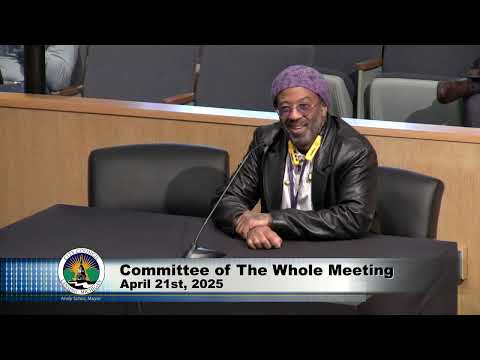
Chief Brian Sturdivant told the Committee of the Whole on April 21 that the Lansing Fire Department’s proposed FY26 budget includes modest personnel increases alongside larger operating and information-technology allocations, and that operational pressures from high emergency medical services (EMS) demand require new approaches.
“We had a 3.2% increase over last year with personnel, 12.4% increase with our operating budget, [and] 29.4% increase with our IT budget,” Sturdivant said, summarizing line-item changes in the proposed budget. He said total operating costs increased about 10.2% and total expenditures about 4.2% year over year.
The chief told council members that about 80% of the department’s call volume is EMS-related and that roughly 40–50% of those EMS calls are basic-life-support level. “We are eagerly anticipating” a state decision to allow LFD to deploy Basic Life Support ambulances after approval by the Tri-County Medical Authority, Sturdivant said; the department has the equipment and plans ready to go when the state issues protocol approval.
Sturdivant described two new service initiatives in the budget: a scheduled infant car-seat inspection/installation program conducted by trained LFD staff and expansion of the Lansing Fire Department Cadet Program. He also said the department recently was awarded and accepted a federal SAFER grant totaling $4,300,000, which alters hiring timing and the pipeline for vacancies.
Staffing and retention were a recurring focus of questions from council members. Sturdivant said 19 employees left the department in the past year, 10 of those due to retirement, and that the department is close to a staffing level that makes filling paramedic positions difficult. Councilman Jackson and others emphasized the long-term rise in call volume and warned that current staffing is insufficient to meet demand.
Council members raised several operational concerns: the use of mutual aid and one-way service arrangements with neighboring jurisdictions — DeWitt was cited as a frequent recipient of Lansing resources — overtime levels and their causes, and how future EMS deployments would be timed to new station construction. Sturdivant said the metro chiefs will pursue a collective conversation with DeWitt’s board of supervisors about shared-service limits and costs.
On the cadet program, Sturdivant said the inaugural class produced five cadets who transitioned into the department and one who was hired as a full-time firefighter; 26 applications were received for the first class. He said the SAFER grant required the department to adjust its immediate hiring pipeline and that the department is aligning cadet and school-based pipelines to improve recruitment of Lansing residents.
The department asked the committee to permit a data-driven, phased approach to restore staffing levels, citing a community risk assessment to be conducted through the Center for Public Safety Excellence and a 90-day data-collection plan once BLS ambulances begin operating.
Chief Sturdivant closed by thanking the committee and reiterating the department’s readiness to deploy BLS units once the state completes the approval process.
What’s next: the department awaits state approval for BLS ambulances, will collect deployment data for 90 days after launch, and expects the next cadet cohort to be timed with safer-grant hiring windows and school partnerships.