Get Full Government Meeting Transcripts, Videos, & Alerts Forever!
Get email alerts on the Holocaust Remembrance topic
No spam. Unsubscribe anytime.
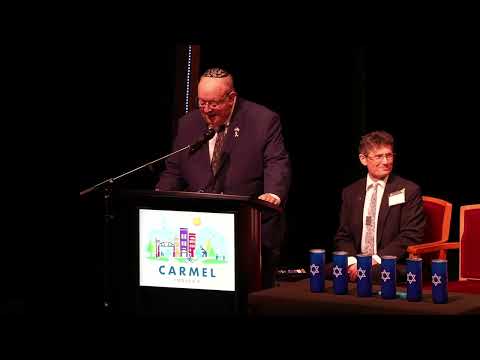
Carmel Holocaust Remembrance Ceremony emphasizes 'never again' as speakers warn of rising antisemitism
Summary
Religious leaders, an author and city officials gathered in Carmel in 2025 to honor Holocaust victims, urge education and warn of a global increase in antisemitic incidents; local performers and a recorded mayoral message were part of the ceremony.
At a Holocaust Remembrance Ceremony in Carmel in 2025, religious leaders, an author and city officials gathered to honor victims of the Holocaust and to warn that rising antisemitism demands ongoing education and vigilance.
Rabbi Benjamin Sendro of Congregation Shaare Tafila opened the ceremony, saying the gathering in Carmel was “to honor the 6,000,000 souls, Jewish souls, and countless others who were systematically persecuted and murdered.” He framed the event as a moment to remember and to commit to preventing future hatred.
The ceremony included a recorded message from Mayor Finkham, who said that keeping survivors’ stories alive “falls short of our full moral duty” and called for action beyond remembrance. The mayor’s recorded remarks urged support for Holocaust education and for speaking out against antisemitism and other forms of bigotry.
Graham Honecker, co-author of A Blessing Not a Burden and an associate athletic director at Butler University, addressed the crowd about continuing threats to Jewish communities. He cited a report attribution in his remarks, saying that 2024 saw a “340% increase in total anti-Semitic incidents worldwide compared to 2022,” and highlighted sharp increases in France and the United Kingdom. Honecker also referred to local incidents in Carmel—spray painting at the congregation in 2018 and a 2024 incident involving hateful symbols in a family’s yard—when urging continued public vigilance and education.
The program combined ritual and community participation. Sadie Cohen, a Carmel High School sophomore and Miss Cardinals Teen 2025, performed the Israeli national anthem Hatikvah and the U.S. national anthem. Cantor Melissa Cohen led Psalm 23, University High School’s choir sang Shalom Haverim, and Rabbi Justin Kerber led the mourner’s Kaddish and a closing benediction. Ceremony organizers conducted a memorial candle lighting to represent lives lost and survivors’ resilience.
Speakers repeatedly emphasized that the Holocaust began with words and dehumanization and warned that denial and extremist ideologies find new platforms. Multiple presenters urged attendees to support Holocaust education in schools and to call out hateful rhetoric in public and online spaces. Honecker described the dwindling number of survivors and the resulting responsibility for younger generations to carry testimonies forward.
The program also acknowledged institutions and individuals who work on Holocaust education and remembrance, including the Candles Holocaust Museum (Terre Haute) and community educators and filmmakers mentioned by Honecker. Organizers closed with an appeal to younger attendees to preserve survivors’ stories when survivors are no longer living to tell them.
The ceremony mixed local ritual, testimony and a call for continued civic and educational responses to what presenters described as a global rise in antisemitic incidents.