Get Full Government Meeting Transcripts, Videos, & Alerts Forever!
Get email alerts on the Community Equity And Services topic
No spam. Unsubscribe anytime.
Residents urge equitable neighborhood investment, apprenticeships, water affordability and transit fixes during council public comment
Summary
At the April 21 meeting residents and community leaders used the public-comment period to press council members on perceived inequities in district funding, ask for revived apprenticeship programs, urge action on lead-line replacements and water affordability, and request transit improvements.
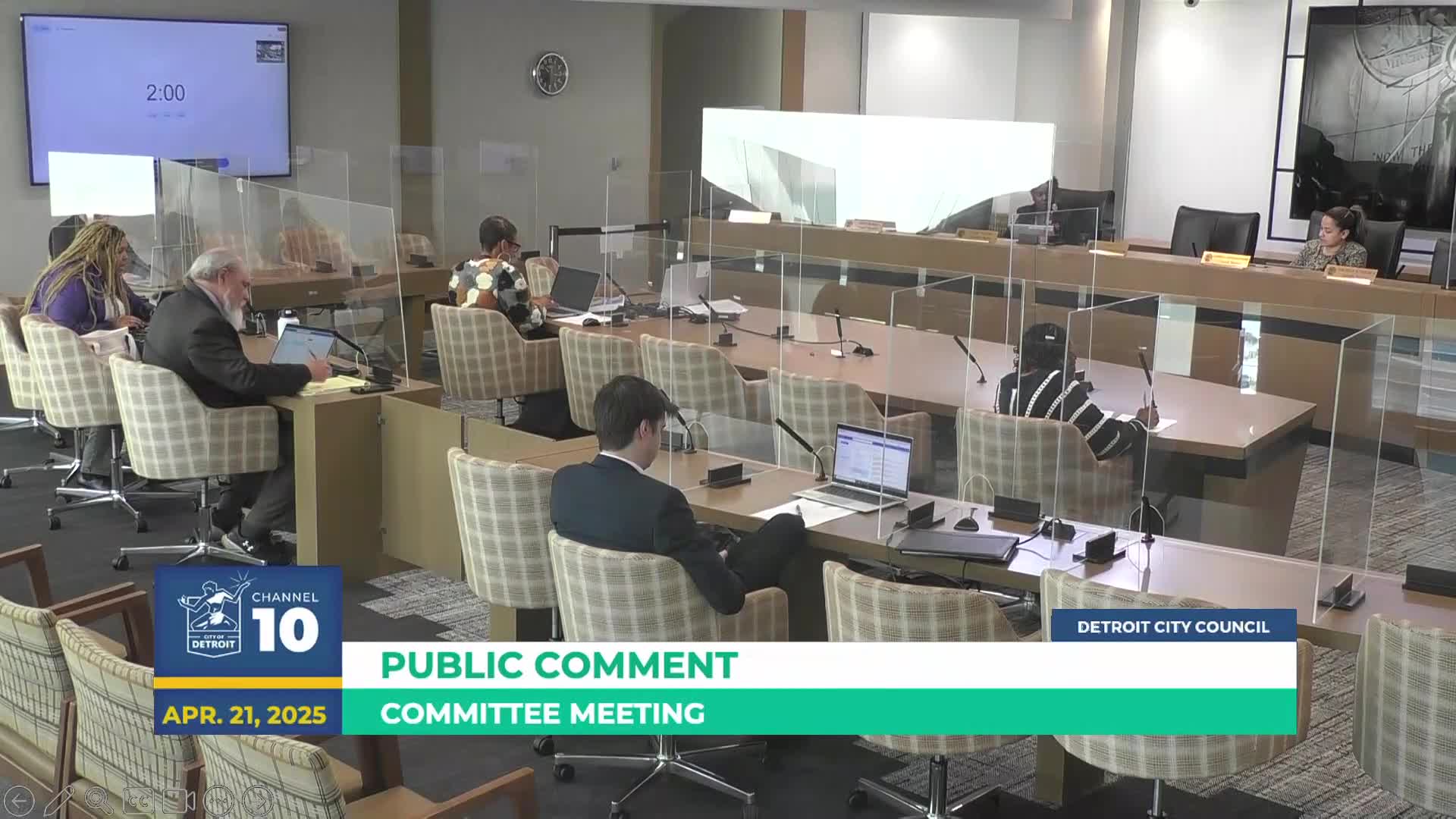
A wide range of residents and community leaders spoke during public comment at the Detroit City Council committee meeting on April 21, urging more equitable distribution of city resources and calling for expanded apprenticeship programs, better transit service and stronger water-affordability protections.
The nut graf: Speakers repeatedly raised two themes — that investment is concentrated in a few districts while other neighborhoods are underserved, and that city programs (including apprenticeships, lead-line replacement contracts and transit services) should prioritize Detroit residents.
Betty A. Varner, president of the DeSoto Ellsworth Black Association, said her neighborhood along the Fenkell corridor needs funding for corridor improvements and for a community park where fencing has been stolen. "We are in need of funding," Varner said, asking the council to help secure money to improve Fenkell and to restore the park’s fence.
William M. Davis, vice president of the Barton Neighborhood Association and a longtime city employee, urged the council to reinstate an apprenticeship program. "We used to have active apprenticeship programs," Davis said, and he asked the city to prioritize hiring Detroit residents for such programs.
Transit riders called for better service. Jamarius Jordan, introduced during another speaker’s remarks, listed practical improvements: more accurate arrival times, updated schedules, benches at stops, larger and clearer bus signage, and more reliable fare-scanning machines.
Several speakers raised housing and utility concerns. Cecily McClellan, speaking for We the People of Detroit and as a retired city employee, urged that lead-line replacement contracts and other water work benefit Detroit residents and called for a water-affordability ordinance to ensure residents can access water at affordable rates. McClellan said an estimated $150 million may be associated with lead-line replacement work over the coming years and asked that that work employ Detroit residents where possible.
Tahir Ahmed of the Coalition for Property Tax Justice said the organization has reversed foreclosures for thousands of homes and criticized public claims about authorship of a property tax reform ordinance. Other callers raised concerns about downtown public safety and visible homelessness (Stephen Horing), recycling and service distribution across districts (multiple callers), and accessibility and aging residents’ needs.
Member Mary Waters and other council members acknowledged the public comments, noted ongoing work across district offices, and encouraged residents to attend block-club and office meetings. Waters said the council is working across districts on issues such as truck traffic and air pollution and invited constituents to engage with staff and attend neighborhood meetings.
Ending: The committee closed public comment and proceeded to its scheduled sustainability discussion and the rest of the agenda. No formal council action on the public concerns occurred during the meeting; several speakers asked for follow-up and for the council to prioritize equitable investment and local hiring in upcoming program design.