Get Full Government Meeting Transcripts, Videos, & Alerts Forever!
Get email alerts on the Local Tax Study topic
No spam. Unsubscribe anytime.
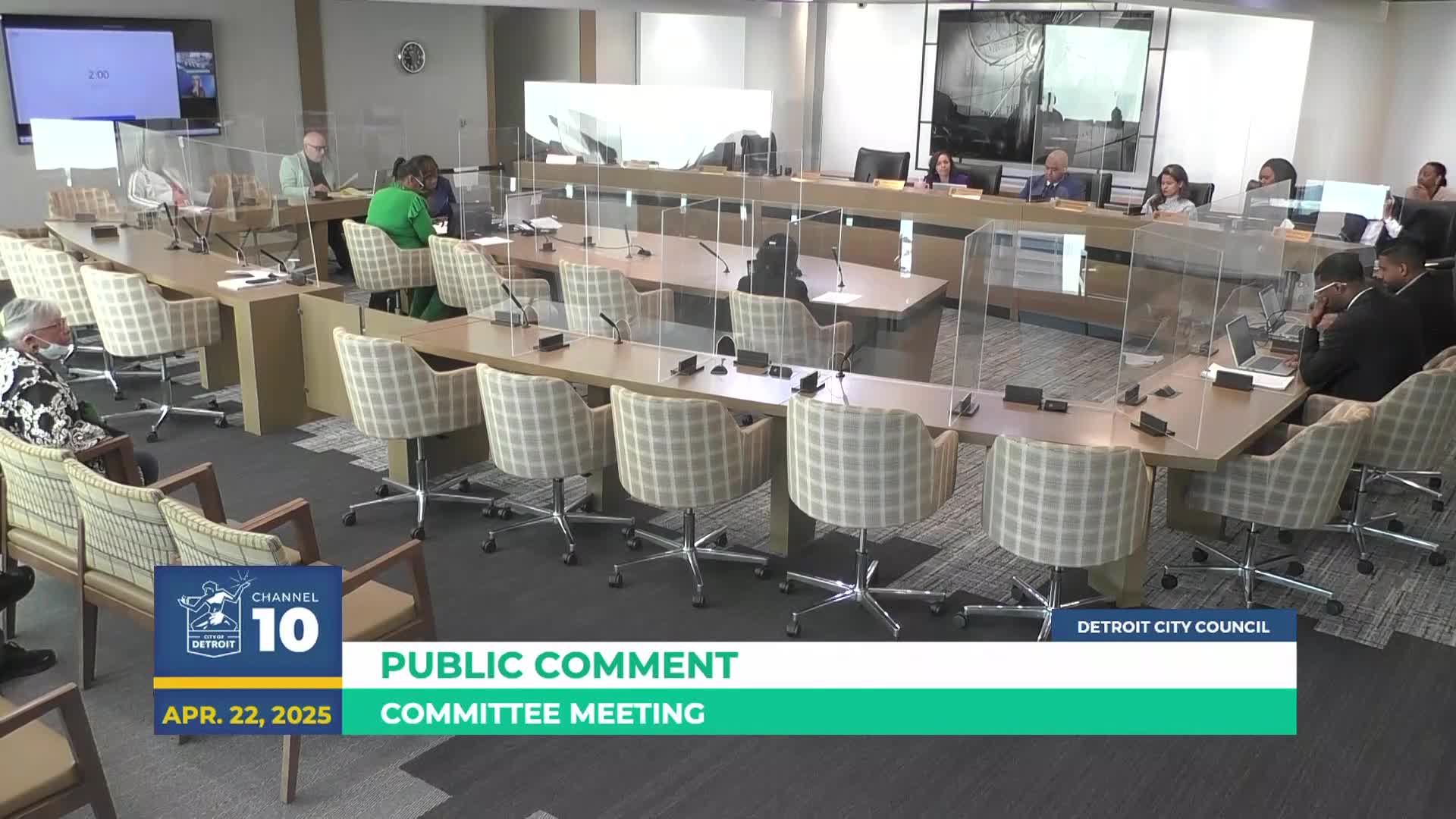
Detroit council approves study of a local-option “smart tax” to assess revenue options
Summary
Council approved a resolution to fund a study into a local-option sales tax (referred to in the meeting as a 'smart tax' or LOST study). The study will be done by the Citizen Research Council and is expected to cover legal, economic and implementation issues, with a goal to complete work quickly using this fiscal year's funds.
The Detroit City Council voted to approve a study to evaluate a local-option sales tax, often described in the meeting as a “smart tax” or local-option sales tax (LOST).
Council member Johnson moved the measure and described it as “merely a study” to evaluate implementation pathways, legal constraints and potential revenue. Director Whitaker told the council the Citizen Research Council (CRC) will be retained to carry out the work and that the contract has been routed through purchasing. Whitaker and colleagues said the study will examine legal barriers, likely revenue scenarios and how other localities structure similar measures.
During discussion, council members pressed staff to ensure the study covers constitutional and statutory constraints, tax exemptions (for example, food and prescription drugs) and comparisons to other cities that have adopted local-option taxes. Council member Young asked staff to include a legal primer explaining why a local-option sales tax may require statewide or constitutional steps that differ from other revenue options such as a land-value tax.
Public commenters also weighed in. Tuanu Reeves, a PhD candidate at the University of Michigan and member of the Economic Development Task Force, urged the council to support the research and said the study should include legal pathways and examples from other jurisdictions. Reeves told the council: “A local option, Smart tax, is an opportunity to moderate the federal cuts coming to the city and to build a more equitable, sustainable, and economically sound future for Detroit.”
Council members approved the resolution without objection. In discussion the administration said it would seek to complete the report quickly using funds allocated in the current fiscal year, with an internal target of delivering the study by June if possible. Council members asked that the study include legal analysis of constitutional issues, comparisons with other cities, and revenue estimates that test graduated levy levels so the council can judge whether the revenue would justify the effort required to enact the tax.
The approved resolution authorizes contracting with the Citizen Research Council to carry out the research and directs staff to return results to council for further action; the council attached a waiver to the item to permit the contract procurement to proceed.