Get Full Government Meeting Transcripts, Videos, & Alerts Forever!
Get email alerts on the Complete Streets Multimodal Projects topic
No spam. Unsubscribe anytime.
Lakewood refers new complete‑streets ordinance and citizen advisory board to committee amid heated Bunce Road debate
Summary
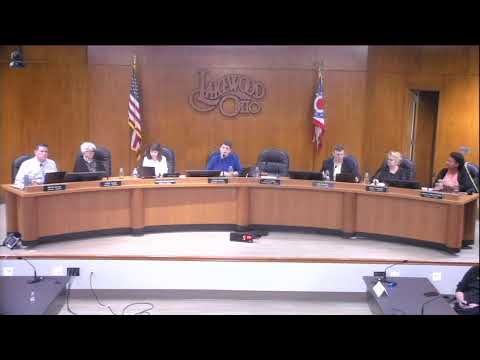
Council and the administration introduced a new Complete Streets ordinance and a companion ordinance to create a Complete & Active Streets Education and Advisory Board and referred both to committee on April 21; public comment focused on opposition to a proposed multimodal shared‑use path on Bunce Road.
Lakewood council leadership and the administration on April 21 jointly introduced a new complete‑streets ordinance and a companion ordinance to create a Complete & Active Streets Education and Advisory Board, and referred both measures to the Committee of the Whole and the Planning Commission for further review. The public discussion at the council meeting was dominated by residents’ objections to a proposed multimodal shared‑use path planned for Bunce Road, where neighbors said outreach was insufficient and raised safety, driveway conflict, tree‑loss and emergency‑access concerns.
President Keppel read a joint communication from council leadership and Mayor George that described the proposed ordinance as a mechanism to implement goals in the city’s Active Transportation Plan and the Safe Streets for All work adopted last year. The proposed ordinance (to enact section 901.23 of the Lakewood Codified Ordinances) would: require design teams to consider complete‑streets elements in planned transportation projects; create a tiered approach that treats major corridors and intersections (Tier 1) differently from smaller projects (Tier 2); and set up an accountability structure for public engagement and planning‑commission review on key Tier 1 projects.
Council moved to refer the communication and the draft ordinance to the Committee of the Whole and Planning Commission; the motion passed. A separate joint ordinance to establish a permanent Complete & Active Streets Education and Advisory Board (chapter 161) — intended to produce education, shorter‑term mitigation strategies, and community outreach in between capital projects — was also introduced and referred to the same committees at the meeting.
Public comment focused heavily on Bunce Road. Residents said the proposed shared‑use path alignment would remove every mature tree along parts of the corridor, add new conflict points at roughly 95 driveways and 16 intersections on the segment, and place pedestrians and cyclists closer to busy commercial driveways (commenters cited Gecko, Giant Eagle and other businesses). Speakers referenced national and state guidance in opposition, saying shared‑use paths can have higher intersection crash rates than separated facilities and asking whether the city had performed data‑driven traffic and crash analyses for the chosen alignment. Several speakers — including students from the area high school — said they avoid Bunce Road because it feels unsafe and prefer quieter residential routes.
Public commenters asked whether the planning process had meaningfully engaged residents before the design advanced. City staff and the director of public works said the project went through the city’s standard process, including a public comment period and a Planning Commission review; the director said the Planning Commission recommended the shared‑use path after public comment favored it and that some plan revisions were made following comments. Council members and residents pressed for additional small‑group or one‑on‑one engagements to resolve outstanding concerns.
Speakers and commenters raised several recurring issues: emergency‑vehicle access if buffers are narrowed; maintenance responsibility and snow removal for a 10‑foot asphalt shared path; tree canopy loss and the long lead time required to replace mature trees; the potential for increased conflicts at frequent driveway crossings; and whether a path that terminates at Route 90 or commercial driveways serves students and the public as intended. Some residents and petition signers said they viewed the process as top‑down and asked the council to delay or reconsider alignment decisions to allow more locally led audits (walk/bike audits), targeted traffic studies and further community design sessions.
At the council meeting the administration and council leadership said the proposed Complete Streets ordinance is intended to strengthen accountability, public input and compliance with the Active Transportation Plan as the city moves forward on multiple long‑term projects. Councilmembers emphasized that large‑scale infrastructure changes will require professional engineering, multi‑year sequencing, and funding decisions; they said the proposed advisory board is meant to help with education, rapid mitigation and ongoing community engagement between major capital projects.
Both the Complete Streets ordinance and the Complete & Active Streets Education and Advisory Board ordinance were referred to the Committee of the Whole and Planning Commission for joint hearings and public input. The council also recorded e‑comments and in‑chamber testimony about Bunce Road that will be part of the committee record.
The record shows persistent public concern about the chosen Bunce Road alignment and strong requests for additional neighborhood engagement, safety data, and a clearer maintenance plan for any shared‑use path. Council and staff said they would continue committee‑level review and follow up with public meetings and planning‑commission hearings as the ordinances are refined.