Get Full Government Meeting Transcripts, Videos, & Alerts Forever!
Get email alerts on the Wastewater Infrastructure topic
No spam. Unsubscribe anytime.
Malibu council narrows rebuild sewer study, signals preference for Hyperion tie-in and asks staff to seek engineering funding
Summary
Malibu City Council and staff spent the April 23 work session reviewing five wastewater options to serve beachfront parcels damaged in the Palisades fire and directed staff to pursue further analysis and early engineering work on a connection to Hyperion.
Malibu City Council and staff spent the April 23 work session reviewing five wastewater options to serve beachfront parcels damaged in the Palisades fire and directed staff to pursue further analysis and early engineering work on a connection to Hyperion.
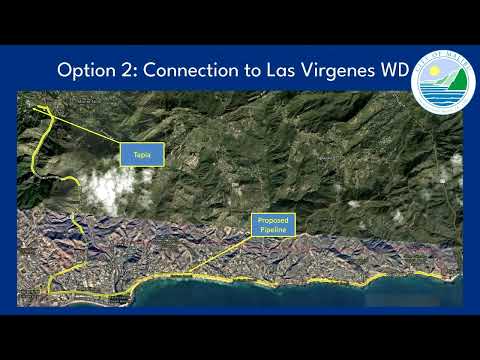
The city’s public works presenter, identified in the record as Rob, laid out five alternatives: (1) connect affected Pacific Coast Highway parcels to the city’s Civic Center water treatment plant via roughly 32,000 linear feet of pipeline (listed cost $188,000,000; schedule about 65 months; about 461 parcels affected); (2) a long pipeline to Las Virgenes/Tapia (about 58,000 linear feet; $261,000,000; ~69 months); (3) build a new Malibu wastewater treatment plant (listed cost shown in slides as about $232,000,000; schedule about 82 months); (4) connect to the Los Angeles Hyperion Water Reclamation Plant (about 27,500 linear feet; $124,000,000; ~65 months); and (5) replace or repair on‑site septic systems (estimated $100,000–$150,000 per septic system; new seawalls if required were estimated separately at about $500,000 in Rob’s presentation).
Why it matters: staff’s analysis showed very different capital costs and multi‑year schedules for each choice and included estimates of cost per parcel. Council members and residents repeatedly raised the near‑term problem of how homeowners could rebuild within the next months to years if the sewer option chosen required five‑plus years to construct.
Key details from the presentation and discussion
- Rob: “The pipeline to actually do it turned out to be 32,000 linear feet, and it has 461 properties,” and later summarized the options and their schedules and costs, noting material lead times and construction challenges on PCH.
- On regional regulation and onsite systems, staff member Yolanda summarized recent guidance from the Los Angeles Regional Water Quality Control Board and the city’s Local Agency Management Plan (LAMP). She said the board’s interpretation requires advanced or secondary treatment for many beachfront on‑site wastewater treatment systems under the city’s LAMP.
- Mark Gold, chair of the Blue Ribbon Commission water working group, urged the city to evaluate sewer alternatives in tandem with undergrounding and other resilience measures: “If Malibu determines to go forward with a sewer system, then build the sewer system in conjunction with undergrounding all sorts of other infrastructure on PCH so that you're not doing it separately and tearing up PCH twice.”
Public comments and concerns
Dozens of residents, property owners, engineers and consultants spoke during the public comment period. Common themes included: concern about the time and cost of constructing regional sewer lines; fear that homeowners may be forced to pay large, up‑front costs for new septic systems and seawalls if sewers are delayed; and suggestions for interim measures such as portable treatment units or temporary low‑pressure systems.
What the council directed or agreed (next steps)
- Council members signaled consensus around exploring Option 4 (a Hyperion tie‑in) as the primary path to study further while continuing work on viable alternatives (including Las Virgenes/Topanga and on‑site strategies). At one point the mayor asked for consensus and said, “let's go with number 4.” This was treated as a direction to staff, not a formal adopted ordinance or vote.
- Staff (Rob) was asked to bring a formal funding item to the first regular council meeting in May requesting authorization to hire an engineering consultant to prepare design and feasibility work. Rob acknowledged he will “proceed forward on bringing an item to council first meeting in May to get a consultant on board.”
- The council agreed that the city’s Wastewater Advisory Committee and existing experts should work with staff; members discussed an ad hoc approach and asked staff to place related items on the next agenda so the council can create a task force/ad hoc committee if desired.
No formal vote on sewer option adoption
No ordinance or binding vote adopting a sewer build option occurred at the work session. Council discussion produced a consensus direction to prioritize further work on the Hyperion connection and to return with scope and funding proposals for engineering and financing analysis.
Ending
Staff will return to council with a funding request for a design/feasibility consultant at the first regular meeting in May and coordinate the Wastewater Advisory Committee and outside experts to produce a clearer feasibility, cost, timeline and funding plan. Residents asked the city to address interim solutions and seawall resilience while long‑lead infrastructure is planned and built.