Get Full Government Meeting Transcripts, Videos, & Alerts Forever!
Get email alerts on the Medical Emergencies topic
No spam. Unsubscribe anytime.
Committee sets amendment deadline for bill to create statewide stroke and heart‑attack care network
Summary
House Bill 27 would extend Alaska's trauma system approach to time‑sensitive medical emergencies such as heart attacks and strokes; the committee set an amendment deadline and heard public and medical‑system support.
The House Finance Committee on April 25 took public testimony and set an amendment deadline for House Bill 27, a measure to expand Alaska's trauma system model to cover time‑sensitive medical emergencies, including heart attacks and strokes. The committee set an amendment deadline of 5 p.m. on Tuesday, April 29.
Nut graf: Supporters, including emergency medical providers, life‑flight operators and the American Heart Association, told the committee HB 27 would standardize designations for hospitals and transport protocols, collect statewide data and help get patients to the best available care faster — a critical factor in outcomes for stroke and cardiac events.
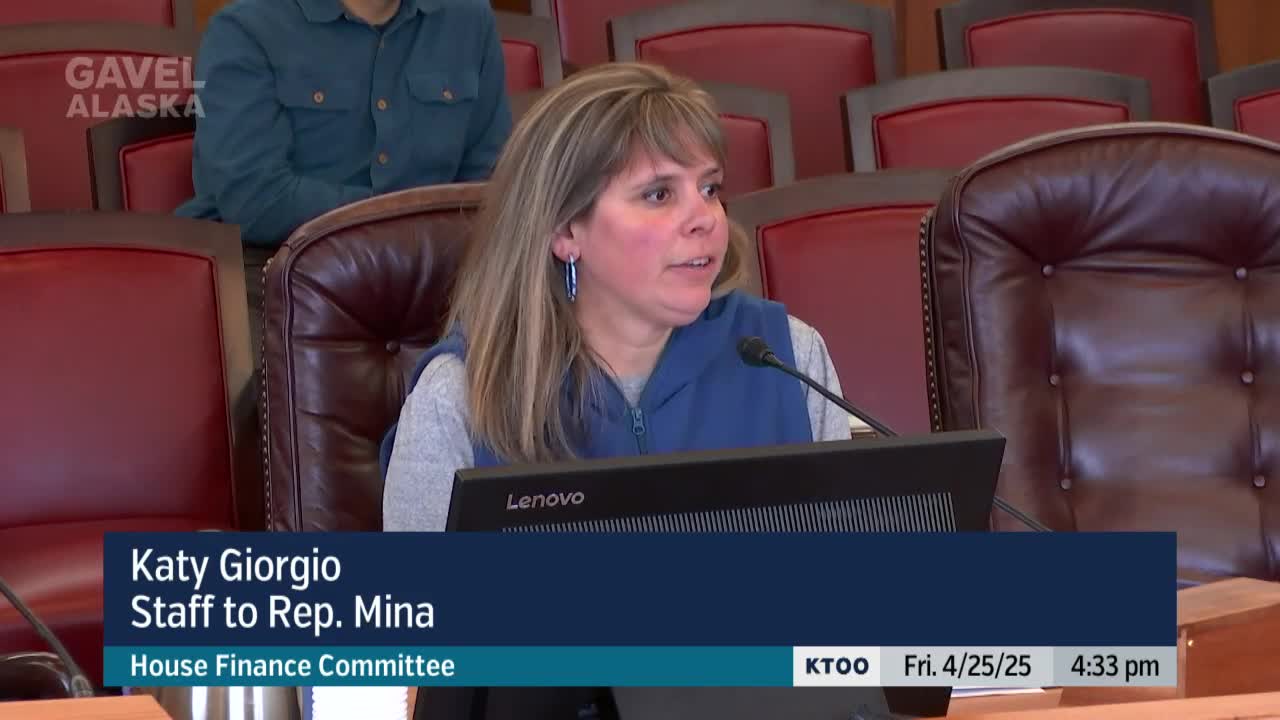
Katie Georgiou, staff for Representative Genevieve Mina, summarized the bill as creating a voluntary facility designation scheme and protocols for prehospital care and transport, modeled on the existing trauma system housed in the Department of Health. "House Bill 27 is about systems of care, for Alaskans experiencing heart attack and strokes," Georgiou said in her recap.
Public and professional testimony was uniformly supportive. Brian Webb, an emergency services practitioner from Anchorage, urged the committee to "pass HB 27 and build our statewide time‑sensitive medical emergencies model just as we did for trauma," saying centralized data and designation would improve resource targeting and reduce permanent disability. Dr. Timothy Peterson, a physician and Southeast Alaska medical director for regional EMS, told the committee, "We don't have a system like the trauma system," and described geographic and weather‑related transfer delays that can cost lives.
Jamie Morgan, senior region lead for government relations at the American Heart Association, said nationally recognized systems of care "ensure that Alaskans receive timely and effective treatment during these critical medical emergencies," and cited research showing that modest reductions in stroke mortality at scale translate to thousands of lives saved nationally.
The committee did not take any votes on HB 27 during the meeting. It set the amendment filing deadline for 5 p.m. April 29 and noted the bill will return to committee for amendment consideration. Department of Health staff and the bill sponsor were present during public testimony; a letter of support from Guardian Life Flight was placed in the record during the hearing.
Ending: The committeescheduled the bill for further work; proponents said the measure aims to reduce morbidity and mortality by directing patients to facilities that meet recognized stroke and cardiac care standards.