
Planning commission backs code changes to allow new housing in existing buildings, tightens parking and envelope limits
Get AI-powered insights, summaries, and transcripts
Subscribe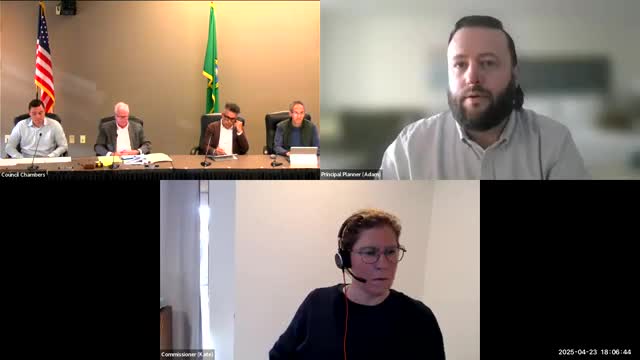
Summary
The Mercer Island Planning Commission voted to recommend city code changes to implement Washington’s House Bill 1042 (RCW 35A.21.440), approving amendments that preserve existing parking counts, permit limited exterior site changes and allow certain rooftop features while keeping height and zoning limits.
The Mercer Island Planning Commission on April 23 voted to recommend amending city development regulations to comply with House Bill 1042 (RCW 35A.21.440), a 2023 state law that requires cities to allow addition of new dwelling units in existing commercial and mixed-use buildings in specified zones.
The change would add a new section to Mercer Island City Code chapter 19.06 to implement the state law for the city’s planned business (PBZ), commercial office (CO), business (B), MF-2 and town center zones. Staff said the code must be amended by June 30 to avoid state preemption. The commission’s recommendation will be packaged as a written report for the City Council; staff said the council’s first reading is scheduled for June 3 and a second reading and adoption for June 17.
The commission’s recommendation includes several specific amendments the commission debated and approved. Commissioners voted to: (1) require retention of existing parking quantity when dwelling units are added, replacing discretionary language that had allowed the code official to decide whether parking could be reduced; (2) allow modest site and exterior features tied to residential conversions, subject to limits; and (3) permit unenclosed rooftop features (decks, stairs, railings) under specified limits while keeping the building subject to the zone’s maximums.
Adam Zack, the city’s principal planner, framed the state requirement for the commission. "The state has told us that we cannot require additional parking spaces for the addition of the new dwellings in the building," Zack said during the presentation, adding: "We can only require the retention of existing parking spaces." That limitation from state law set the boundaries for the commission’s parking debate.
Chair Jared Thompson moved to make the wording mandatory rather than discretionary on parking enforcement. "My motion is simply to change the discretionary 'may' for the code official to 'shall,'" Thompson said during deliberations; commissioners agreed the city could require retention of the existing number of spaces though it cannot demand additional spaces for the added units.
Commissioner Niese (motion) and the commission adopted a set of five specific categories of exterior/site changes that may be allowed without disqualifying a conversion from a modest density bonus. The list—adopted as an amendment—covers: (1) exterior features to comply with ADA or life-safety requirements; (2) landscape and hardscape alterations such as small patios; (3) exterior fenestration changes for access and ventilation; (4) awnings for weather protection or solar shading; and (5) exterior features to accommodate necessary mechanical or utility work, provided gross floor area would not increase by more than 5% and the project would not exceed underlying zone requirements.
Commissioners also debated and then approved a narrower but contested sixth amendment that allows unenclosed rooftop features. That motion states unenclosed rooftop features such as decks, stairs and railings may be added provided they do not increase existing height by more than the lesser of the maximum allowed in the subject zone or 20 feet; the motion also permits elevator or stair access for rooftop features within that limit. The rooftop provision passed 3–2 after extended discussion over whether it would expand building envelopes beyond what the council intended for this state-driven density allowance.
Commissioners also approved staff’s proposed parking language (moved by Vice Chair Tara Gibson) and a small clarifying amendment to require retention of the existing "quantity of parking spaces," which passed unanimously. Planning staff and commissioners emphasized that all amendments and any additional edits would need legal review before being forwarded to the City Council.
The commission’s formal recommendation—approved in the final vote—directs staff to prepare a written recommendation for the council with the adopted amendments. Zack told the commission the next procedural steps are staff preparing a signed recommendation, a first reading at council on June 3 and a second reading and adoption on June 17, subject to any legal or technical revisions requested by council.
The commission’s deliberations repeatedly distinguished policy choices the city may make (for example, site changes allowed within the existing building envelope) from what the state law forbids (requiring additional parking spaces for new dwelling units). Commissioners urged limiting changes to the minimum necessary to comply with state law while preserving neighborhood protections—one recurring point was that allowing more dwelling units should not reduce off-street parking supply overall.
The commission’s action is a recommendation to the City Council, not final code text. Staff will return the draft with legal review and the commission’s amendments for council consideration this spring.