
Franklin aldermen press staff for lower-cost road fixes as $75M CIP window looms
Get AI-powered insights, summaries, and transcripts
Subscribe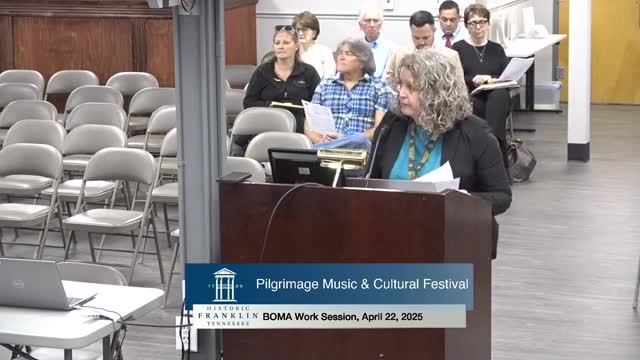
Summary
At an April 22 work session the Franklin Board of Mayor and Aldermen spent more than an hour debating the capital investment plan (CIP) prioritization, with repeated calls to focus on road bottlenecks, pursue smaller “spot improvements,” and align projects with likely external funding.
Franklin’s Board of Mayor and Aldermen spent a large portion of its April 22 work session debating how to spend roughly $75 million in near-term capital capacity, repeatedly returning to traffic chokepoints and whether the city should favor full-build projects or lower-cost interim improvements.
Staff told the board it has “about $75,000,000 of capacity as it is right now,” and proposed ranking projects in two tiers: an initial allocation up to that amount and a secondary tier if additional capacity emerges, for example through a partnership with the Tennessee Department of Transportation (TDOT) on Mack Hatcher projects. Paul, a staff member, told the board, “you at least have the 75,000,000 to work with.”
Board members pressed for more data and for options that reduce immediate cost while still improving congestion. Several aldermen said the city should prioritize corridors where city investment is likely to achieve the most leverage from state or federal partners; others warned about spending scarce city dollars on projects that cross into state highway responsibility.
Most urgent: Franklin Road and intersection fixes
Alderman Brown and others urged raising the priority of Franklin Road, citing persistent PM and daytime congestion where local lanes narrow near churches and intersections. Paul agreed Franklin Road is “definitely an issue today and will be for a while,” but noted the city has had limited success securing TDOT funding for that corridor. Board members repeatedly asked staff to scope lower-cost intersection or turn-lane projects that could provide relief for a decade rather than funding multi‑million-dollar full-build projects immediately.
Traffic counts and alternatives
Staff offered traffic-count context during the discussion: about 15,000 vehicles per day on south Carothers near Falcon Creek; Carruthers and Mallory around 20,000 vpd; Franklin Road about 17,000 vpd. Board members said staff rankings did not always reflect those counts and asked for a packet that pairs current traffic counts with the staff ranking for each candidate project.
Debate over large, single projects vs. spread investments
Several aldermen questioned whether expensive single projects should consume a large share of the CIP. The Carruthers Parkway (Falcon Creek to Highway 96) project was discussed as an example: board members cited estimates in the $26–30 million range and asked whether multiple intersection upgrades could produce better city‑wide benefit than spending a large share of the 10‑year CIP on one corridor. One alderman observed that the $30 million estimate is “almost half of the $75,000,000” currently available to the board for the 10‑year window.
Staff offered to return with lower‑cost alternatives and spot‑improvement concepts for Franklin Road, Carruthers, Boyd Mill, Eddie Lane and other high‑ranked items. Paul said the board’s current lists show the most expensive versions of each project for planning purposes and that staff can “price that out for you” if the board prefers scaled options.
Parks, fire station, and multi‑use tradeoffs
A number of aldermen highlighted parks projects — including Jim Warren Park and the new Pearl complex — and the board discussed phasing options. Parks staff explained Jim Warren currently hosts five fields used by about 14 schools for lacrosse and that the Pearl’s opening could shift programs and free capacity, allowing phased work at Jim Warren instead of a single large investment.
Board members also discussed a proposed Fire Station 3 and upgrades to Fire Station 2. While the station projects received support, multiple aldermen said transportation improvements are the most urgent community concern.
Next steps and data requests
Staff summarized the items requested by the board: (1) traffic‑count data paired with staff rankings for each road project; (2) scope-and-cost options that present lower‑cost spot improvements and phased project alternatives; (3) further analysis of TDOT partnership opportunities related to Mack Hatcher Southeast and Northwest; and (4) potential funding strategy options to maximize federal/state matching where available. Paul and Eric (City Administrator Eric Stukin) told the board they would return with these options and a second tier of projects for further direction.
The work session did not include any formal motions or votes on projects; aldermen asked staff for additional data and cost options so the board can prioritize within the $75 million capacity and preserve leverage for potential TDOT partnerships.