
Staunton Council adopts FY2026 budget and five-year CIP, raises real-estate tax to $0.91; debate over a smaller 1¢ alternative fails
Get AI-powered insights, summaries, and transcripts
Subscribe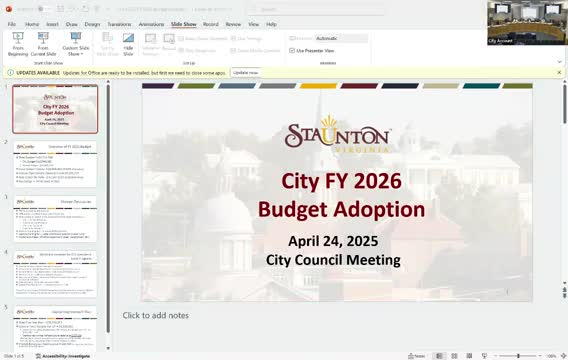
Summary
After a lengthy debate, Staunton City Council on April 24 adopted a $164.5 million FY2026 budget and five-year capital improvement plan and approved a real-estate tax rate of $0.91 per $100 assessed value; an alternate motion to set the rate at $0.90 failed in a separate vote.
Staunton City Council approved the fiscal year 2026 budget and five-year capital improvement plan (FY2026–FY2030) on April 24 after extended discussion about infrastructure needs and the tax burden on residents. The total all‑funds budget approved for FY2026 is $164,535,789; the city operating budget is $112,846,002.85 and the school budget is $51,689,504. The council set the real-estate tax rate at $0.91 per $100 of assessed value.
Finance and budget staff presented the proposed budget summary to council. Key items included a proposed transfer to schools of $18.9 million (a 9.55% increase), annual debt-service transfer of roughly $6.5 million, and a recommended 3% cost-of-living adjustment for municipal employees. Staff also built in a 10% projected increase in health insurance premiums and a small number of new positions tied to an upcoming courthouse opening (two deputies and two custodial positions), restoration of a traffic position and a water-distribution position previously frozen, and phase 1 of a police career development plan.
Council discussion focused on a large unfunded capital backlog, estimated at approximately $134 million, and specific near-term capital needs including design work for the wharf/tunnel infrastructure; staff estimated design costs in the $350,000 range with additional stormwater fund resources available for that work. To begin replenishing capital reserves, the proposed budget would establish a new annual infrastructure reserve equivalent to 2¢ on the real-estate rate ($657,030). Councilors debated whether to adopt the full 2¢ increase (bringing the rate from $0.89 to $0.91) or a smaller 1¢ step.
Councilor Oberholtzer moved an amendment to fix the tax rate at $0.90 per $100 (reducing the additional infrastructure reserve by roughly half). That motion failed on a recorded vote (ayes: 2; nays: 5). Council then adopted the budget ordinance as proposed, setting the real-estate tax rate at $0.91. The final roll call for the adopted budget was 6–1: Ayes — Campbell, Shepherd, Overholtzer, Park, Vice Mayor Arrowood and Mayor Edwards; No — Woods.
The approved five-year capital improvement plan totals $78,729,917 across funds; the FY2026 enterprise capital plan included $10,500,000 largely funded from fund balance. The budget package contained no new changes to fee schedules or signage beyond prior rate adjustments in water, sewer and stormwater adopted earlier.
Why it matters: The adopted budget raises revenues to replenish capital reserves and fund existing operations and school transfers while responding to an extensive backlog of infrastructure needs. The vote reflected a majority preference for a larger, more immediate step to address capital shortfalls; one councilor favored a more incremental approach.