Lewisburg board coalesces around 2.4% tax increase to shape 2025–26 budget
Loading...
Summary
Board members discussed revenue and expense options for the 2025–26 general fund budget and directed staff to prepare a proposed final budget using a 2.4% tax increase and a transfer to capital projects for the next meeting.
The Lewisburg Area School District board on Thursday discussed options to balance the 2025–26 general fund budget and signaled consensus to present a 2.4% tax increase proposal at the next meeting.
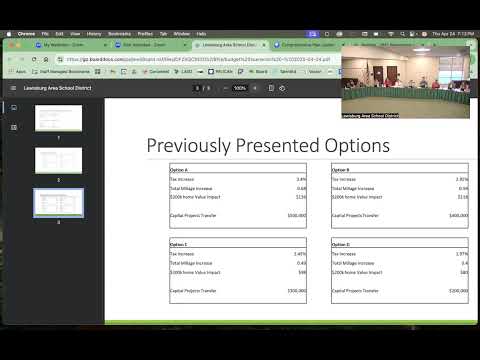
Board members reviewed revenue constraints and expense levers during a continuing budget discussion led by a district staff presenter identified in the record as Kyle. Kyle explained that most revenue streams—state basic education aid, special-education funding, Title I, earned income tax and most other state-driven items—are essentially fixed, with property tax being the primary local variable the board can change to increase revenue. On the expense side, Kyle noted that some obligations, such as charter school tuition and bond debt service, are effectively fixed; salaries, benefits, contract services, transportation and supplies are adjustable but would alter operations if reduced. Kyle also presented several model scenarios that paired tax-rate options with the size of a transfer to the capital projects fund, including: 0% (no transfer, $214,000 deficit in the model), a 2.4% option tied to the March CPI (roughly $288,000 transfer in the presenter’s slides), and a flat 3% option (about $414,000 transfer).
Why it matters: the size of the tax increase determines how much the district can move into capital projects this year while still meeting operating obligations and reserve expectations.
Board members repeatedly balanced two considerations: limiting the immediate tax burden on households—noting seniors and Social Security recipients who may see only COLA increases in income—against rising costs the district faces, including healthcare, energy and compensation. Several members said the district usually errs on the conservative side of statewide indices and that recent years produced larger-than-expected surplus transfers (one speaker recalled a transfer of approximately $1.64 million in a recent year). The board also discussed pending external issues that could affect revenue next year, such as potential state-level changes to cyber-charter tuition and court-driven school-funding adjustments; timeline and eligibility for reimbursement of recently incurred capital costs were described as variable (staff estimated a two- to four-month lag for invoiced facility-grant reimbursements).
Multiple trustees said a 2.4% tax-rate option struck a balance between limiting taxpayer impact and preserving capital-project capacity. Justin (recorded in the meeting as a participating board member) and others said they were comfortable asking staff to prepare a proposed final budget using a 2.4% increase for formal consideration at the next board meeting. No formal vote on a final tax rate was recorded in the transcript; the recorded action is direction to staff to prepare the 2.4% scenario for the upcoming vote.
Clarifying details from the discussion: the district’s capital-fund balance was described as “just under $1.957 million” after projects and before reimbursements (speaker in the record); reimbursements from the Facilities Improvement Grant and other sources were described as staggered and not all expected immediately. Kyle said the district’s model shows about $209,000 per 1% tax-rate change as a rough rule of thumb for transfers to capital projects.
What’s next: district staff were instructed to prepare a draft final budget showing a 2.4% tax-rate increase and the corresponding transfer to capital projects for the board to vote on at the next meeting. The board preserved the option to use fund balance if necessary but emphasized aiming to avoid a larger spike in taxes next year.