Get Full Government Meeting Transcripts, Videos, & Alerts Forever!
Get email alerts on the Behavioral Health Investment Benchmark topic
No spam. Unsubscribe anytime.
OCA work group debates how to measure and time a behavioral health investment benchmark
Summary
Office of Healthcare Affordability staff on Wednesday outlined options for a statewide behavioral health investment benchmark and sought input from work group members on how to measure and phase in any requirement.
Office of Healthcare Affordability staff on Wednesday outlined options for a statewide behavioral health investment benchmark and sought input from work group members on how to measure and phase in any requirement.
OCA staff framed the policy task as choosing between expressing the benchmark as a share of total medical expense (TME) or as a per member per month (PMPM) amount, and deciding whether the final benchmark should emphasize annual incremental improvements, a long‑term goal, or a combination of both. Staff also previewed a claims‑based code set and recommended rules for counting non‑claims payments toward behavioral health spending.
The benchmark framing matters because it affects what the requirement would reward and how progress is tracked. “In addition, setting the benchmark based on TME communicates that increased spending on behavioral healthcare should reallocate the healthcare spending pie, rather than contribute to an increase in total spending,” said Debbie Lindas, healthcare delivery system group manager at the Office of Healthcare Affordability (OCAH). Lindas presented the staff recommendation that OCA’s focused benchmark include outpatient and community‑based claims and certain non‑claims payments that can be plausibly attributed to behavioral health, such as practice infrastructure and population‑health payments made to behavioral‑health providers.
Staff described tradeoffs between the two main measurement approaches. A PMPM metric, staff said, can better reflect the cost of service delivery and align with payer accounting practices; Rhode Island’s benchmark, cited repeatedly by members, is framed as a PMPM change. A percent‑of‑TME approach aligns with OCA’s statutory language and with how OCA set its primary care benchmark. “A percent of TME approach may be easier to implement and communicate than a per member per month approach,” Lindas said, while acknowledging many survey respondents preferred PMPM.
Work group members generally supported measuring both ways for transparency. Several participants urged a combined structure — short‑term incremental targets coupled with a longer‑term investment goal — similar to OCA’s primary care benchmark. Mary Jo (OCA staff) noted how the primary care benchmark’s annual percentage‑point increases translate into year‑over‑year growth rates for service categories and used a hypothetical baseline of 3% of TME for outpatient behavioral health to illustrate impacts at 7% and 14% annual growth rates.
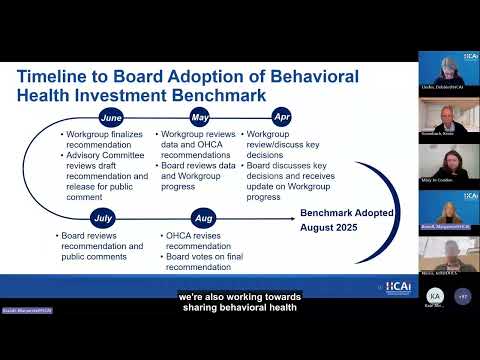
Members pressed staff on data gaps and operational details. Multiple participants said existing claims and payer submissions undercount behavioral health spending and called for OCA to share the planned baseline data. Staff said OCA expects to collect baseline claims data from commercial and Medicare Advantage payers in 2026 covering the 2025 performance year and aims to share preliminary spending data with the work group in May, draft benchmark recommendations for public comment in June, and present recommendations and public comment to the board in July with a vote sought in August.
On non‑claims spending, OCA proposed rules to limit how much of certain practice transformation, IT infrastructure and other non‑claims payments can be allocated to behavioral health. The proposed method would cap the behavioral‑health share of those non‑claims categories at the same share that behavioral‑health claims and capitation represent of overall claims and capitation payments (for example, if behavioral health is 6% of total claims and capitation, then at most 6% of practice‑transformation payments could be attributed to behavioral health).
Staff also proposed including payments made to subclinical behavioral‑health roles (for example, peer support specialists) under social‑care integration when those payments are directed to behavioral‑health providers, while excluding payments by plans for third‑party referral platforms or internal plan staff who only link members to services.
On claims measurement, staff previewed a draft code set — compiled from the Milbank Report, Department of Managed Health Care and Medi‑Cal code lists — that will be distributed to work group members for review. “We will be sending out that draft code set later this week for your review,” said Debbie Lindas. The code set workbook groups diagnosis, service, setting and national drug codes into reporting tabs and includes an expanded primary‑care taxonomy intended to capture integrated behavioral health services delivered in primary‑care settings.
Members raised a range of technical questions: how to handle screenings and assessments that are billed alongside E/M visits; how to capture collaborative care and other integrated models; the role of Z codes for social drivers of health (ICD‑10 currently) and the need to maintain crosswalks if ICD‑11 is adopted; and how to treat outlier PMPM values. Staff said they will send the draft code set and specific review questions, and that OCA plans an annual review of the code set as data are collected.
Next steps and reporting: staff reiterated the proposed timeline. OCA will brief its advisory committee, seek stakeholder comment on the draft benchmark in June, present data and a draft recommendation to the work group in May, and aim to present final recommendations and public comments to the Health Care Affordability Board in July with adoption considered in August. OCA also said it will publish annual reports tracking progress toward whatever benchmark is adopted.
Although the group discussed implementation and alignment with the primary care benchmark, no formal votes or board decisions were taken at this meeting. Work group members asked OCA to prioritize sharing baseline spending data before finalizing a metric and emphasized the need for interim reporting and flexibility to revise the benchmark as data improve.
OCA asked members to submit written feedback on the code set and other measurement choices after they receive the draft materials later this week.