Get Full Government Meeting Transcripts, Videos, & Alerts Forever!
Get email alerts on the Homelessness Policy topic
No spam. Unsubscribe anytime.
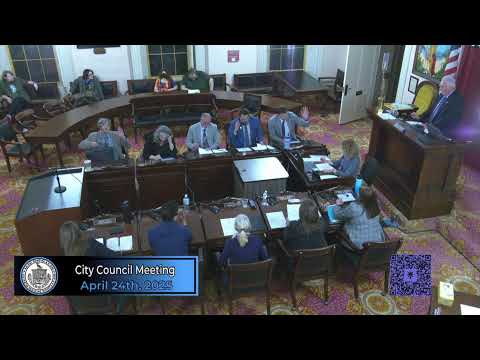
Council approves first passage of amended camping ordinance after heated public comment
Summary
City Council approved first passage of amendments to Salem's camping ordinance (Ch. 24 §31) after a lengthy public-comment period and committee debate; the amendments narrow some protections and add a regulatory process for campsite health and safety determinations, prompting opposition from unhoused advocates and supporters of expanded services.
The Salem City Council voted on April 24 for first passage of amendments to Chapter 24, Section 31 of the city's camping ordinance, following hours of public comment that included residents, unhoused people and advocates who urged the council to reject changes they said would criminalize survival.
The amendments under consideration revise the ordinance's definitions and enforcement procedures. The council's public-health, safety and environment committee (co-posted with the committee of the whole) considered the changes and recommended adoption as amended for first passage; the committee vote was 4–1 in favor of the amended language. Councilor Cohen presented the committee's recommendation to adopt the amendments with the exception of a proposed modification to the list of personal property considered "eligible property." Councilor Stott successfully moved to retain the original broader list of eligible personal property (including clothing, hygiene products and toiletries) rather than accept a redlined removal suggested in earlier edits.
During public comment, more than a dozen speakers told the council the proposed changes would make homelessness more dangerous. Pamela Geyser, a Salem homeowner, urged the council to "vote no on the amendment to section 24‑31 of Salem's camping ordinance, and instead focus resources on informing all of our neighbors [about] basic human necessities." Skyler Clark, a resident who said they are experiencing homelessness, warned that cutting notice from 72 to 12 hours and removing an explicit list of allowable personal property would let police sweep people even when shelter beds are not available.
Council supporters of the amendments, including Councilor Cohen and Councilor Marcello, described the ordinance as a tool that, when combined with the city's shelters and outreach services, can help get people out of dangerous situations. Cohen, reading from committee minutes, said the amendment preserves a city's obligation to offer shelter before displacement and argued that the ordinance provides local outreach teams and the Community Impact Unit options when other interventions fail.
The amended language gives the city solicitor and certain department heads (police, fire, health, inspectional services) authority to develop regulations to determine whether a campsite represents a public-health or public-safety hazard; those regulations, according to committee discussion, are expected to be completed and posted before the next council vote may occur. Several councilors and public commenters said the changes are a compromise; others said the amendments rollback protections adopted last year. Councilor Davis described the proposed approach as "really gross" and "shameful," while Councilor Marcello and Councilor Watzenfeld emphasized the limits of municipal authority and called for more state and federal support for housing and behavioral-health services.
The council adopted the committee's recommendation for first passage as amended; the amendment approved by the council removed the mayoral office's proposed strike of the clothing/hygiene items from the eligible-property definition. The transcript records committee-level votes and the council's first-passage action; specific council roll-call tallies for the final first-passage vote are not specified in the public transcript excerpt. The ordinance will return to the council for second passage at a later meeting, and the solicitor's promised implementing regulations will be published for public review before that vote.