Get Full Government Meeting Transcripts, Videos, & Alerts Forever!
Get email alerts on the Arts Council Grant Reform topic
No spam. Unsubscribe anytime.
Michigan Arts and Culture Council narrows grant lines, reduces match to increase rural access
Summary
The Michigan Arts and Culture Council told the committee it consolidated nine grant programs into three for FY25, lowered cash-match requirements to 25% for many applicants, and changed the review process to a compliance-based system to improve access for rural and underserved organizations.
A representative for the Michigan Arts and Culture Council briefed the committee on program changes intended to simplify grant administration and improve rural access.
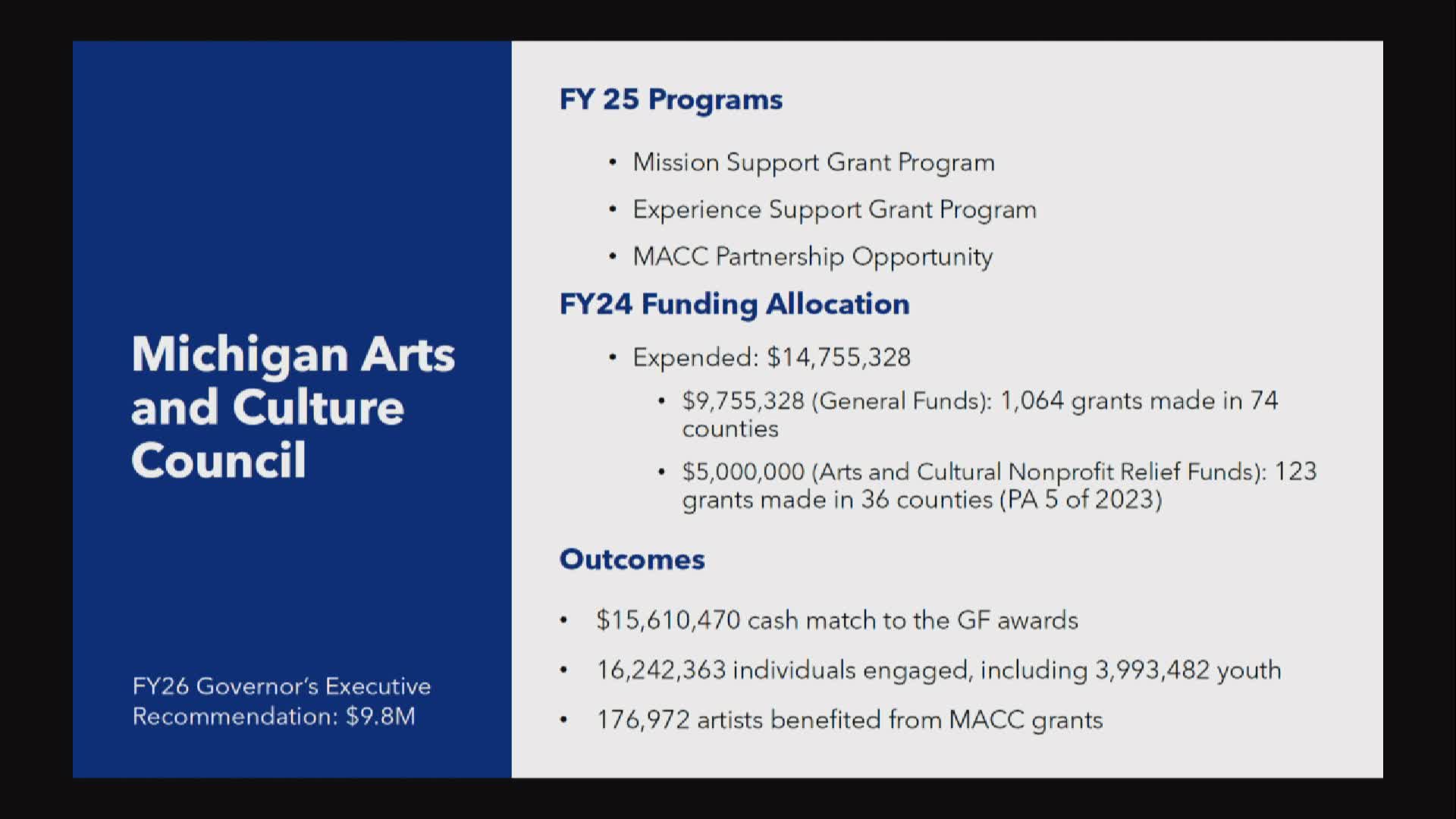
"The Michigan Arts and Culture Council was established in 1966," the presenter said, describing the agency’s role in distributing arts and cultural resources statewide. The council told members that it streamlined its programs in FY25 from nine to three large program lines: mission support for nonprofit arts organizations, experience support for arts-related projects in non-arts organizations, and a partnership program for statewide or regional providers.
The council representative explained steps taken to improve rural access: the cash match requirement was reduced to 25% from a previous 1:1 match, and the agency removed a tiered award system in favor of a single-maximum award level for eligible applicants. The council also simplified application requirements, replacing longer narratives and peer review with a compliance-based process (UEI, EIN, IRS filings and state charitable registration) and shorter project synopses.
Committee members asked whether subgrants and regrants were tracked; the presenter said MEDC and the council track how regranting partners distribute funds and that a posted report will show how pass-through dollars were deployed at the local level. The council said FY24 funding (including general funds and nonprofit relief dollars) totaled roughly $14.7 million, with about $9.7 million in general fund grants to more than a thousand awards across 74 counties and roughly $5 million in nonprofit relief distributed to about 123 organizations across 26 counties.
"We also changed the program too. Instead of having the huge narrative ... it's now rolled into one, and it's compliance based," the presenter said, adding the changes aimed to reduce barriers for smaller rural organizations that previously struggled with larger narratives, peer review and 1:1 matches.
The committee did not act on arts funding during the briefing; members asked for follow-up documentation and county-level breakdowns.