
Board approves $1.4 million to join state Equitable Building program; staff say region stands to attract up to $60 million in project investment
Get AI-powered insights, summaries, and transcripts
Subscribe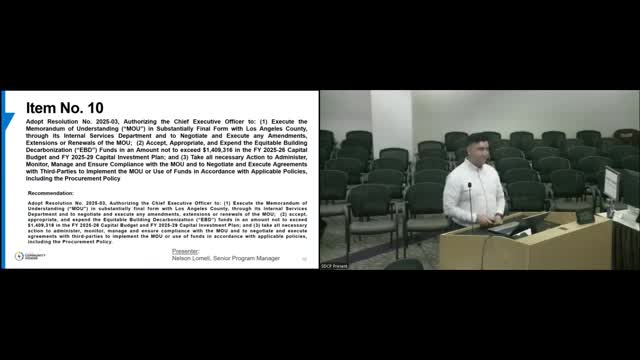
Summary
San Diego Community Power adopted Resolution 2025-03 to execute an MOU with Los Angeles County to participate in the California Energy Commission’s Equitable Building Direct Install (EBD) program, authorizing $1,400,000 for outreach and coordination to support up to an estimated 1,500 homes in SDCP’s service territory.
The San Diego Community Power board on April 24 adopted Resolution 2025‑03, authorizing Chief Executive Officer Karen Burns to execute a memorandum of understanding with Los Angeles County and accept $1,400,000 from the California Energy Commission’s Equitable Building Direct Install (EBD) program.
The board action authorizes SDCP to use $737,000 of the funds for outreach and education through SDCP’s Power Network (pass-through agreements to community‑based organizations), and $663,000 for SDCP staff time to coordinate program rollout and integrate SDCP pilots and regional programs.
Why it matters: LA County was selected as the Southern Region administrator for the statewide EBD award. The Energy Commission awarded $328,000,000 for the Southern Region (part of a statewide $567,000,000 program). SDCP staff said the Southern Region award could decarbonize an estimated 8,000 homes across the SoCal region and that SDCP’s service territory could see roughly 1,500 homes participate, which staff estimated could represent up to $60,000,000 in installed upgrades in SDCP’s service area.
Program details presented to the board
- Nelson Lomeli, senior program manager, described the EBD program as a no‑cost direct‑installation decarbonization program for low‑ and moderate‑income households in disadvantaged communities. He said eligible measures include electric heat pumps, electric water heaters, electric ranges, weatherization (air sealing, insulation), HVAC upgrades, minor health-and-safety repairs (lead or asbestos remediation), and electric panel upgrades when needed.
- Eligibility: the program targets low‑ and moderate‑income households in disadvantaged communities using CalEnviroScreen 4 and AB 1550 definitions. SDCP staff noted the program is open to single‑family homes (including renter units with landlord authorization), multifamily properties, and includes a 5% set‑aside for manufactured and mobile homes.
- Budgeting and timing: staff said LA County estimates an average of about $40,000 per home in this program for the Southern Region but cautioned actual costs depend on the scope of upgrades for each household. LA County and the coalition are targeting a program launch in July; the EBD award covers a five‑year implementation period.
Board discussion and community outreach
- Directors asked about tenant protections, temporary relocation during work, and how community‑based organizations (CBOs) would participate. Lomeli said the Energy Commission guidelines include tenant protections that prohibit eviction for participation-related activity and that CBOs will play a central role in outreach and application assistance. Jen Lebron, SDCP’s director of public affairs, confirmed the Power Network RFQ is open and that organizations do not need 501(c)(3) status to participate (fiscal sponsorship models are acceptable).
Board vote
- The motion to adopt Resolution 2025‑03 was moved by Vice Chair Laszlo Reimer and seconded by Director Yamani. Roll call: Director Ensuza — Yes; Alternate Director LaCava — Yes; Director San Antonio — Aye; Director Suzuki — Yes; Director Yamani — Aye; Vice Chair Laszlo Reimer — Aye; Chair Paloma Aguirre — Yes. The motion carried unanimously.
What to watch
- Staff said SDCP will work with LA County and coalition partners to identify targeted addresses using the CEC’s targeting tool, pass through outreach funding to local CBOs, and coordinate SDCP pilots (for example, demand‑response or Smart Home Flex pilots) with EBD installations to maximize customer bill and resilience benefits.
- Staff said they will return to the board with further implementation details and outreach plans as the program administrator releases application and enrollment guidance.