Get Full Government Meeting Transcripts, Videos, & Alerts Forever!
Get email alerts on the Medc Work Projects topic
No spam. Unsubscribe anytime.
MEDC, Michigan Strategic Fund report outlines FY25 work projects, program impacts
Summary
MEDC and the Michigan Strategic Fund told the Appropriations Committee that work projects remain open for multiple years, summarized activity across core programs including business attraction/community revitalization (BACR), and reported FY24–FY25 figures for investments, jobs and small-business support.
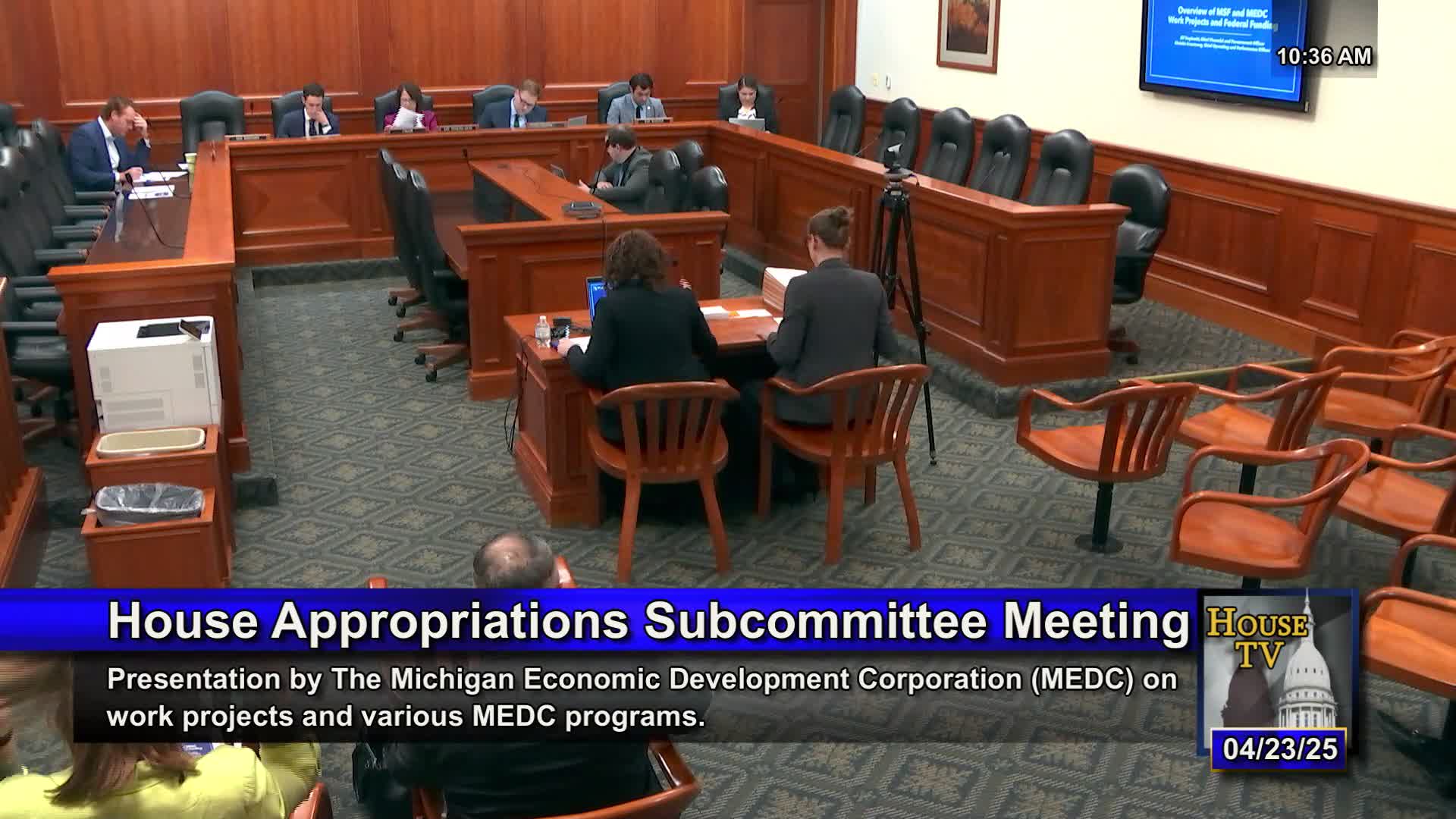
The Appropriations Committee on Labor and Economic Opportunity heard an update from the Michigan Economic Development Corporation and the Michigan Strategic Fund on the status of FY25 work projects, program outcomes and oversight.
"According to MCL 18.145, a work project is a 1 time nonrecurring effort designed to achieve specific goals," said Jill Trepkoski, senior vice president, chief financial and procurement officer at the Michigan Economic Development Corporation. "A work project remains available until either the project is finished or 48 months after the last day of the fiscal year in which the appropriation was initially made. Any remaining balance will revert back to the State."
The update matters because the MEDC/MSF centralizes several economic development line items and many awards are paid over multiple years based on performance milestones. Trepkoski said the agency manages active work projects across business attraction, placemaking, small-business support and legislatively directed grants, and that funds appear in states of expended, outstanding obligation, committed, and unobligated depending on project stage.
MEDC reported 12 new work projects in FY24 covering business attraction, placemaking and small-business support; three of those were federally funded, four were restricted, and five were general fund. Trepkoski told the committee that about 20% of active work-project funds have been expended, 53% are outstanding obligations, and 26% are committed.
On the Business Attraction and Community Revitalization (BACR) line — MEDC’s core appropriation for business attraction and community revitalization programs — staff summarized year-to-year program outcomes. Trepkoski said the Michigan Business Development Program and Michigan Community Revitalization Program have helped finance projects that the agency reports committed to create more than 7,200 jobs and leveraged approximately $2.7 billion in private investment across 54 communities. She noted that in FY2024 the Community Revitalization Program invested about $30.1 million and leveraged about $213.1 million in private investment in eight communities.
Staff presented specific project examples to show how MEDC tools are used: a Michigan Business Development Program grant of $900,000 helped Silbon Corporation expand a semiconductor supply-chain operation; a $25,000 match-on-main grant helped launch Sheboygan Coffee Roasters and supported four jobs alongside a separate rehabilitation grant for the building.
MEDC framed its programs as performance-based. Trepkoski reminded the committee that "award recipients must have executed agreements recorded in the accounting system before funds can be disbursed," and that agreements include clawback provisions if investment or job commitments are not met.
Committee members asked how funds from multi-year line items are tracked. Trepkoski explained that work projects can remain open for up to 48 months and that older project years (for example FY22–FY24) can remain in various stages while milestones are met and funds are spent. She said the 2021 work project had been fully expended by the end of last year and that MEDC typically manages two to three open work-project years at a time.
The update also touched on agency staffing and federal awards. MEDC reported 342 FTEs across civil-service and corporate positions, and indicated that federal dollars make up roughly 2.4% of MSF’s ongoing budget through several awards, including the Department of Interior Historic Preservation Fund and National Endowment for the Arts partnerships.
The committee did not take formal votes on program allocations during the briefing; staff said reporting and compliance processes remain central to disbursing incentives.
Several members thanked MEDC staff for the briefing and asked for follow-up details on specific subgrant tracking and work-project balances.
MEDC said it will post and update a public report on FY25 legislative directed grants twice yearly, and staff offered to provide additional breakdowns on subgrants and county-level distributions on request.