
San Diego Community Power receives quarterly legislative and regulatory briefing; staff flags federal tax-credit risk and state battery funding opportunities
Get AI-powered insights, summaries, and transcripts
Subscribe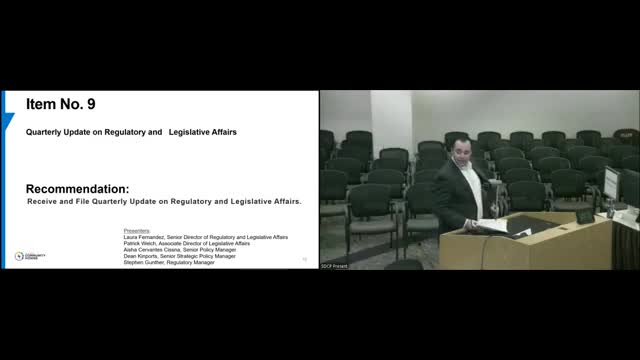
Summary
At its April 24 meeting, San Diego Community Power staff told the board about state and federal actions that could affect procurement, battery programs and customer affordability, and briefed the board on several CPUC proceedings affecting community choice aggregators.
San Diego Community Power received a quarterly update on April 24 on state and federal legislative activity and ongoing regulatory proceedings that could affect its customer programs and power procurement.
The board heard that staff is supporting SB 540, a bill by Sen. Becker to expand the California Independent System Operator (CAISO) into a regional Western market, which staff said could lower generation costs and improve grid reliability. Patrick Welch, associate director of legislative affairs, told directors the regional market “would result in $700,000,000 in cost savings across the state for generation, increased grid reliability, and also increased resiliency.”
Why it matters: the item outlined a set of near-term fiscal and policy risks and opportunities for community choice aggregators (CCAs). Staff described state-level funding streams that could support local battery and home-electrification programs, and federal-level budget negotiations that could reduce clean-energy tax credits that CCAs and local developers rely on.
State policy and program highlights
- Staff said they are actively pursuing state funding to support local battery incentives. The team described two CEC-related opportunities: a proposed Distributed Electricity Backup Assets program with a $180,000,000 request in the governor’s budget to support programs like SDCP’s Solar Battery Savings program, and a separate $280,000,000 battery fund that the California Public Utilities Commission (CPUC) has not yet disbursed. Welch said the coalition of CCAs is working to “unlock that funding so that residents in San Diego can benefit.”
- The board was also told the California legislature and governor are working toward a June 15 state budget deadline; staff are advocating that energy-efficiency and distributed-backup funding be preserved as part of affordability efforts.
- Staff flagged a cluster of energy-storage safety bills under consideration at the state level and said SDCP’s power services team is monitoring several measures “to make sure that they appropriately balance new safety protocols with our ability to continue to procure the batteries,” in Welch’s words.
Federal policy and tax-credit risk
- Welch briefed the board on federal budget reconciliation work and potential changes to the Investment Tax Credit (ITC) and Production Tax Credit (PTC). He noted a legislative proposal (H.R. 2838, cited in the briefing) that would phase down the ITC/PTC for solar and wind over five years and explained staff are engaging San Diego’s congressional delegation to preserve those credits. He described the situation as fluid and said SDCP has been coordinating with national CCA trade groups and the Local Energy Aggregation Network.
Regulatory proceedings and CPUC activity
- Ayesha, SDCP’s senior policy manager and regulatory lead, briefed the board on the CPUC’s long-term gas planning proceeding (an order instituting rulemaking to implement SB 1221). She said the CPUC will use the proceeding to establish pilot decarbonization zones by Jan. 1, 2026, and that regional energy networks and CCAs may play a role in implementing neighborhood decarbonization pilots. Ayesha noted SDCP’s interest in accessing gas distribution planning data to inform long-term load planning as gas lines are decommissioned.
- SDCP staff also described a CPUC petition for modification the agency filed jointly with Clean Power Alliance and Mission:data to require San Diego Gas & Electric (SDG&E) to restore customer connections to legacy home area network (HAN) devices. Staff said SDG&E has stopped supporting HAN connections to smart meters; the petition asks the CPUC to clarify that customers must be allowed HAN pairings at least until utilities roll out next-generation, Wi‑Fi enabled meters. SDCP staff estimated the CPUC process would take about 6–12 months and said the number of customers affected was “not specified.”
- Steven Gupther, regulatory manager, briefed the board on the CPUC’s new rulemaking to revisit the Power Charge Indifference Adjustment (PCIA) and related Energy Resource Recovery Account (ERRA) issues. He said the proceeding is split into an expedited Track 1 focused on resource adequacy (RA) market price benchmark methodology and a broader Track 2 that could reexamine the PCIA framework. SDCP, through CalCCA, filed comments arguing any methodology changes should be applied prospectively and not retroactively to 2025 true‑ups. Staff said a proposed decision in Track 1 is expected within weeks and SDCP is modeling rate impacts.
Board questions and discussion
- Directors asked about the likelihood of federal tax-credit changes and whether SDCP had engaged CCAs in other states; Welch said SDCP staff have met with CCAs from Ohio, Vermont and New Hampshire in Washington, D.C., and are broadening outreach to business and market-focused groups to find additional messengers.
- On HAN devices, directors pressed staff for an estimate of affected customers and guidance for customers in the interim; staff said they did not have an exact number and that the petition is now in the CPUC decision phase.
What’s next: staff said they will continue advocacy on state budget items and federal tax-credit preservation, will monitor storage-safety bills and the PCIA rulemaking, and will report back as proceedings advance.