
County committee backs DHCA budget increases, approves three licensing and enforcement hires pending revenue scenarios
Get AI-powered insights, summaries, and transcripts
Subscribe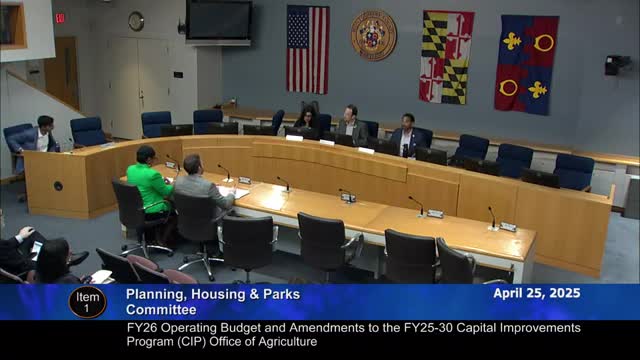
Summary
Montgomery County’s Planning, Housing and Economic Development committee on April 22 reviewed the Department of Housing and Community Affairs’ FY26 operating proposal, endorsed the County Executive’s recommended stage‑two fee increases for multifamily and short‑term rentals, and approved three of five requested DHCA positions while asking staff for detailed revenue scenarios.
Montgomery County’s Planning, Housing and Economic Development committee on April 22 reviewed the Department of Housing and Community Affairs’ proposed FY26 operating and CIP changes, endorsed the County Executive’s recommended stage two fee increases for multifamily rental and short‑term rental licensing, and approved three of five requested DHCA positions with staff directed to provide detailed revenue scenarios and alternatives.
The committee heard that DHCA’s overall operating request would increase $5.2 million (6.7%) over FY25, driven largely by general‑fund staffing and program enhancements. The County Executive’s budget proposes raising the multifamily rental‑licensing fee from $76 to $100 per unit, the short‑term rental registration fee from $325 to $500, and the common‑ownership communities (COC) per‑unit fee from $6.50 to $10. DHCA staff said the three fee changes together are projected to generate about $2.3 million in additional revenue for FY26.
Why it matters: committee members said the fee changes are intended to move DHCA programs toward self‑supporting operations while paying for wage adjustments, indirect costs and newly requested staff. But members also raised concerns that the fee increases could impose disproportionate burdens on tenants and homeowners and asked for more transparent calculations tying each proposed fee to the positions or services it would support.
DHCA staff and finance officials described the fund‑structure choices they had evaluated — an enterprise fund, a special revenue fund and a restricted‑fund account — and said the executive favors a restricted‑fund approach because an enterprise fund requires a large starting reserve. “The biggest impediment to doing an enterprise fund is that you have to have a significant surplus each year,” said Pophan Salem, Director of Finance and Administration, DHCA. Salem told the committee that requirement would have forced substantially higher fees and additional complexity to stand up an enterprise fund immediately.
Committee action and next steps: after extended deliberation, the committee voted to include in the recommended budget the following three DHCA positions (as described in the packet) and asked staff to produce revenue scenarios that show (a) fee impact if all three are funded, (b) fee impact with only some funded, and (c) projected revenue these positions could generate over time: - Manager 3, Licensing (multifamily) — intended to support multifamily licensing operations and reduce reliance on contractors; - Program Specialist 2, Licensing (short‑term rental focus) — to support licensing, annual surveys and enforcement work; - Program Manager 2, Code Enforcement — to review re‑inspection results and manage corrective action follow‑up.
The committee placed one other requested hire — Program Manager 1 for the Office of Landlord‑Tenant Affairs (Ulta) — on the reconciliation list (reduction) rather than approve it in the recommended budget; the committee asked DHCA to return with further information about service needs and any non‑revenue benefits the Ulta manager would provide. Committee members described the Ulta manager as a quality‑of‑service and case‑management position that is not expected to generate direct revenue.
On the COC fee and staffing request, the committee declined to support the executive’s $3.50‑per‑unit increase to the common‑ownership communities fee. Instead the committee recommended a single Program Manager 2 position for the Office of Common Ownership Communities be funded as a three‑year term and paid from the fund balance for the fee account; the panel said the fund balance can cover the position initially and gave staff time to return with longer‑term options. That recommendation carried as the committee’s preference and will be reflected in the reconciliation process.
What was left unresolved: committee members asked for detailed spreadsheets and scenario modeling from DHCA and County Finance to show the fee‑revenue math: how much of the fee increases pay for new positions versus pay adjustments and indirect costs for existing staff; how revenues will track under different hiring choices; and what the fee assumptions would be if some positions are not approved. DHCA agreed to provide those scenarios before final council action.
Committee directions and clarifications: DHCA staff said the short‑term rental fee second‑stage increase is designed to fund positions already onboarded in FY25; members warned that fees should be explicitly tied to positions if positions are the justification for the increase. The committee also directed DHCA and OMB to examine alternatives — including term positions, phased hiring and the implications of moving services currently funded by the general fund into a fee‑supported restricted account — and to return with analysis of the net general‑fund impact.
The committee’s recommendations will be forwarded to full Council as part of the budget reconciliation process.
Ending note: members emphasized communication gaps between executive and council staff during the budget process and asked for earlier consultation on fund‑structure choices in future cycles. The committee did not finalize any fee regulation changes; the recommendations are advisory to the full Council and the County Executive’s regulatory process for setting fees.