
Granite superintendent outlines boundary study as enrollment falls; parent committee to weigh school-closure options
Get AI-powered insights, summaries, and transcripts
Subscribe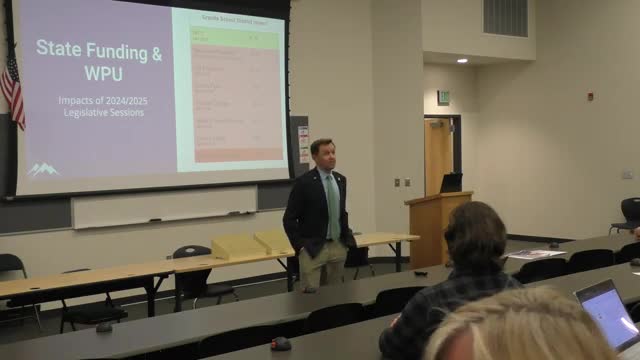
Summary
Superintendent Ben Morrisley said Granite’s enrollment decline and a new boundary study could narrow the district’s list of neighborhood schools under consideration for closure and that parents will help shape recommendations.
Superintendent Ben Morrisley of Granite School District said declining enrollment and high local housing costs have prompted a yearlong boundary and population study that could narrow the district’s list of schools under consideration for closure.
At a town-hall meeting, Morrisley said the district contracted an independent demographer, MGT, and “we've received over 400 comments thus far” on the study. He said the district will form a parent-and-teacher committee in June to develop recommendations for the board, with formal board action not expected until at least November or December; any school closures would be implemented the following fall.
Why it matters: Granite’s enrollment has fallen sharply from a peak of about 78,000 students in the 1990s to roughly 53,000 students projected for next year, Morrisley said, a drop he attributed to lower birth rates and housing costs that push young families to other counties. He described the decline as “about 2 to 3,000 students every year.” That erosion has left some neighborhood schools with only a few dozen students living inside their boundaries, raising questions about class-size equity and the district’s use of facilities.
Morrisley described the district’s allocation rule for classroom staffing: the district divides a school’s total elementary enrollment by 27.25 to determine teacher allotment (28.25 for secondary). He used Oak Bridal Elementary as an example where next year’s allocation would be “8 and a half teachers,” which can lead to split classrooms and fewer grade-level teacher options for families. “A school like…Oak Bridal…was allocated for next year because of its projection 8 and a half teachers,” he said.
The study process and timing: The district opened the boundary study in February and posted materials, including the MGT 40-page demographic report, on graniteschools.org. Morrisley said MGT would not project beyond five years and that the next step is to “converge a parent and teacher committee that will then inform decision making for the district.” He told attendees the committee will include two parents and a teacher from each community. After June’s narrowing of options, the district will produce proposals in the fall for public comment; the board aims for a November–December decision and implementation in the 2026–27 school year if closures are adopted.
Open enrollment and program priorities: Morrisley noted open-enrollment rules under Utah law allow students to attend non‑neighborhood schools when capacity exists. He said some schools draw substantial shares of students from outside their boundaries — “Skyline High School attracts over a thousand of its student population from outside” and Wasatch Junior is “about 40% open enrollment.” That dynamic affects neighborhood-school counts and the district’s closure calculus. The superintendent said the district intends to leave capacity in receiving schools so families who want special permits can continue to apply.
Use of closed-school properties: Residents asked what happens to closed-school land. Morrisley said state law requires the district to convey surplus property at fair market value and gives the local municipality a first right of refusal. He described past attempts by South Salt Lake to purchase Granite High property and said some closed sites have been leased or transferred under long-term agreements — for example, Spring Lane’s building will be demolished and converted to a park under a long-term lease with the city. He also acknowledged past sales the district now regards as mistakes, citing a sale to a charter operator decades earlier.
Community impacts and next steps: Morrisley emphasized the district’s intent to manage transitions and help families. He said, when closures occur, the district holds welcome events and open houses for receiving schools to ease transitions. He repeated that the study is community-driven and that parents will have a central role in shaping recommendations.
Ending: The superintendent invited residents to continue providing input online and said he will post his contact information for follow-up conversations.