House passes bill changing land-division limits; lawmakers debate infrastructure and farmland risks
Loading...
Summary
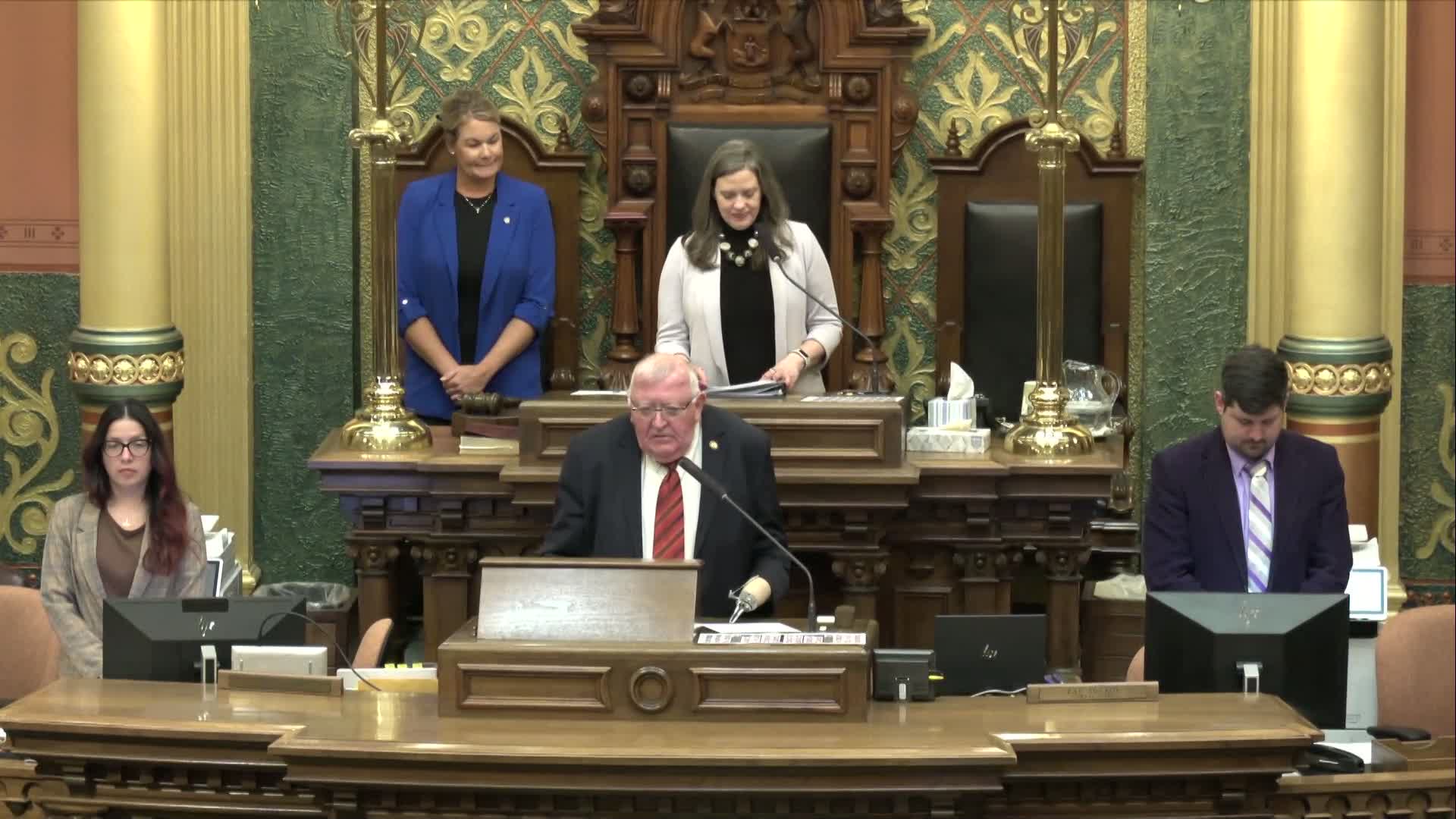
The Michigan House of Representatives on April 16 passed House Bill 4081, a measure amending the Land Division Act to allow local jurisdictions to authorize more parcel splits on a single parent parcel within a 10-year period, by a vote of 96-6.
The Michigan House of Representatives on April 16 passed House Bill 4081, a measure amending the Land Division Act to allow local jurisdictions to authorize more parcel splits on a single parent parcel within a 10-year period, by a vote of 96-6.
The bill’s sponsor and supporters said the change is a limited tool for expanding housing supply; opponents said it could let developers create residential lots where roads, water, sewers and other infrastructure are not adequate and could lead to loss of farmland.
Representative DeBoer, the bill’s floor advocate, described the measure as a local option: "This just allows them to provide additional lots in a 10 year window on a parent piece of property to take 1 simple step in the direction of making housing more affordable in the state of Michigan." DeBoer said local rules on lot size, setbacks, road frontage, survey requirements and wastewater would still control whether lots could be created.
Representative Skaggs rose in opposition and cautioned that the bill "has several unintended consequences. It brings about a lack of comprehensive local, county, and state oversight, can lead to damaging environmental consequences, insufficient infrastructure for the people that want to live in these homes, and threatens the health, safety, and welfare of the public." Skaggs specifically referenced the quick review process under sections of the Land Division Act and said that bypassing comprehensive site-plan review could shift costs for roads and utilities to new parcel owners and the public.
After debate, the clerk opened a roll-call vote. The clerk announced the final tally as 96 aye votes and 6 nay votes; individual recorded votes partially noted in the transcript included Representative Biggole voting yes and Representatives Wirtz and Brooke recorded voting aye. With a majority voting in favor, the bill passed.
Majority floor leadership then moved and the House ordered the bill to take immediate effect. Members rose in support and the motion for immediate effect was ordered.
Votes at a glance: House Bill 4081 — Amendment to the Land Division Act; final passage 96–6; immediate effect ordered. House Resolution 56 — Declaring April Scottish American Heritage Month; adopted by voice vote. House Resolution 57 — Declaring National Public Safety Telecommunicators Week; adopted by voice vote. House Resolution 58 — Declaring April Autism Awareness Month; adopted by voice vote. House Resolution 59 — Declaring Black Maternal Health Week; adopted by voice vote. House Resolution 60 — Declaring Community College Month; adopted by voice vote. House Resolution 61 — Declaring Holy Week; adopted by voice vote. House Resolution 62 — Declaring County Government Month; adopted by voice vote. House Resolution 63 — Declaring Child Abuse Prevention Month; adopted by voice vote.
What the bill does and what supporters said Supporters framed the bill as a limited, locally controlled tool to create more buildable parcels and ease housing costs. DeBoer emphasized that local jurisdictions retain authority over lot size, setbacks, water and wastewater requirements and other land-use controls. "It gives them an opportunity to expand beyond the 4, which it is today, to as many as 10," DeBoer said, referring to the number of allowable splits under current law.
Concerns raised on the floor Opponents pressed that the change would erect a faster, narrower review path that could circumvent existing site-plan or subdivision reviews. Representative Skaggs warned about potential costs and environmental effects and specifically mentioned infrastructure — roads, water, sewer and internet — and impacts on farmland and wetlands, saying those burdens could be passed to buyers and local governments if review is curtailed.
Next steps and implementation Because the House ordered immediate effect, the bill will take effect as provided under the House motion (the transcript records the motion and that immediate effect was ordered). The transcript does not record subsequent steps such as enactment by the Senate or gubernatorial action; those are not specified in the record.
Reporting note This report is based on the House floor transcript of the April 16, 2025 session. Quotations and vote tallies are taken from the transcript, and details not stated on the record are described as not specified.