Get Full Government Meeting Transcripts, Videos, & Alerts Forever!
Get email alerts on the Transportation Mobility Infrastructure topic
No spam. Unsubscribe anytime.
Asphalt industry urges steady funding, highlights recycling, standards and workforce needs to House transportation committee
Summary
The Asphalt Pavement Association of Michigan told the House Transportation and Infrastructure Committee that steady, long-term funding is needed to preserve jobs and maintain pavements, while outlining MDOT’s statistical specifications, recycling practices and capacity constraints including aggregate and workforce risks.
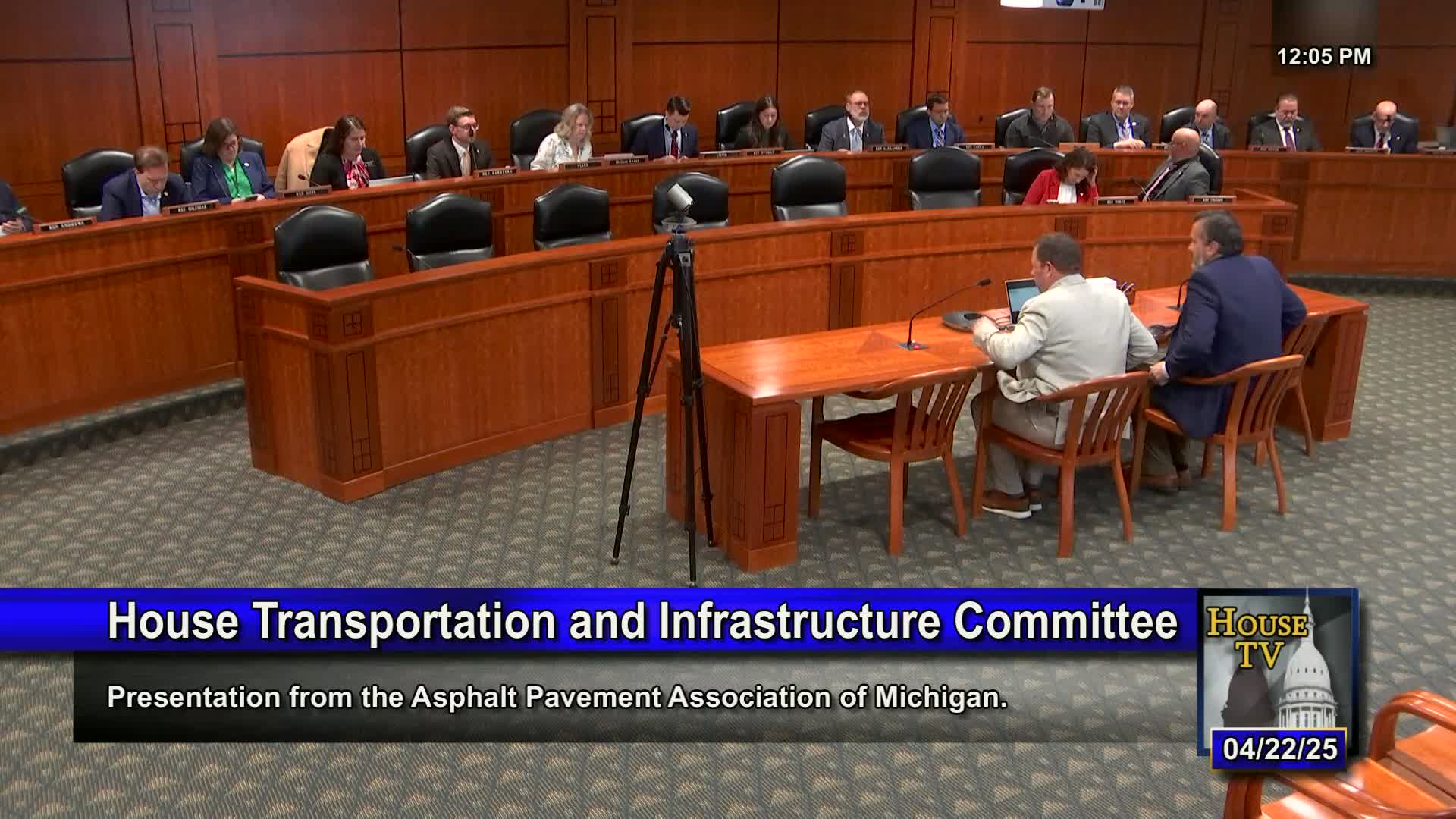
The House Transportation and Infrastructure Committee heard a presentation from the Asphalt Pavement Association of Michigan that urged lawmakers to back long-term, predictable road funding and described industry practices on standards, recycling and workforce capacity.
The association’s executive director, Brett Stannum, told the committee that Michigan produces roughly 15,000,000 tons of asphalt mixtures a year — the equivalent of about 25,000 lane miles — and that the industry directly and indirectly employs about 30,000 people and generates about $5,000,000,000 in annual spending in the state. "MDOT's specification is statistical based," Stannum said. "It not only requires you to hit target but also to be consistent. So you have an upper limit and a lower limit and statistically you have to stay between that." He added, "Asphalt pavements are the most recycled product in America."
Why it matters: the presenters said stable funding allows owners to execute timely maintenance and avoid more costly reconstructions later. Stannum and Kurt Brukink, the association board president and West Michigan area manager for Reith‑Riley Construction, warned that a funding ‘‘cliff’’ would force layoffs and could hollow out a trained workforce that is costly and slow to replace.
Key points from the presentation
• Industry scale and jobs: The association said the asphalt sector supports roughly 30,000 workers in Michigan and about $5 billion in annual economic activity. Stannum described the work as "careers, not jobs," with training and benefits.
• MDOT specification and quality: Stannum described the Michigan Department of Transportation (MDOT) specification as a stringent, statistical-based standard that rewards consistent production and penalizes out-of-spec material. He told the committee the standard "prevents a lot of subpar material being placed out there" and argued the higher standard is a good investment of public dollars because it promotes longer-life pavements.
• Recycling and sustainability: The association highlighted recycled materials used in asphalt mixes. Stannum said reclaimed asphalt pavement (RAP) can make up 25–50% of some mixes and that in 2022 about 98,000,000 tons of RAP were reused nationally (association-provided figure). He noted other recycled inputs include shingles, tire rubber, blast furnace slag and, in some cases, plastics and fly ash. Stannum and Brukink both described efforts to increase recycling while noting technical limits and permitting constraints.
• EGLE air-permit limits: Stannum told the committee that plants are regulated by the Michigan Department of Environment, Great Lakes, and Energy (EGLE) and that EGLE air-permit conditions can cap the percentage of recycled material a plant can run on an annual basis; he said some permits currently constrain recycling rates and the association is working with EGLE to revisit those caps.
• Maintenance and lifecycle: Presenters emphasized preventive maintenance and correct timing, warning that missed maintenance cycles accelerate deterioration. Stannum explained that overlays on a pavement with deep fatigue will not restore expected life and that different preservation treatments (chip seal, ultra-thin overlays, scrub seals) are tools owners should apply at appropriate times.
• Workforce and capacity risks: The association said contractors expanded staff, plant capacity and equipment to deliver recent multi-year programs and that a sudden funding drop would likely lead to layoffs and loss of trained workers. "If we have another funding crisis... we're gonna lose that younger generation again," Brukink said, describing the workforce losses after the 2008 financial crisis.
• Aggregate and supply concerns: Presenters noted aggregate availability is a critical constraint; Michigan has good aggregate resources, but access and proximity to projects matter for cost and greenhouse gas implications from hauling.
Committee action and next steps
The committee adopted the minutes of its April 15 meeting by unanimous consent before hearing the presentation. Committee members followed the presentation with detailed questions about MDOT specifications, recycling caps, concrete versus asphalt, local maintenance funding and workforce development; presenters recommended relying on data (MDOT pavement performance and cost data) and continued coordination between owners, MDOT and industry.
The presenters offered to host plant tours and to provide comparative per‑capita spending data on neighboring states to committee members who requested it. The committee continues to consider longer-term transportation funding measures that presenters said would affect maintenance scheduling, workforce retention and industry investment.
Ending
The Asphalt Pavement Association of Michigan left lawmakers with two main appeals: ensure long-term, predictable funding so the industry can retain trained workers and apply the correct preservation treatments at the right time; and revisit permitting or technical constraints that limit recycling at plants, which the presenters argued would yield economic and environmental benefits.