Get Full Government Meeting Transcripts, Videos, & Alerts Forever!
Get email alerts on the Nomenclature Gulf Name topic
No spam. Unsubscribe anytime.
House Government Operations committee reports bill to change Gulf name after failed amendment votes
Summary
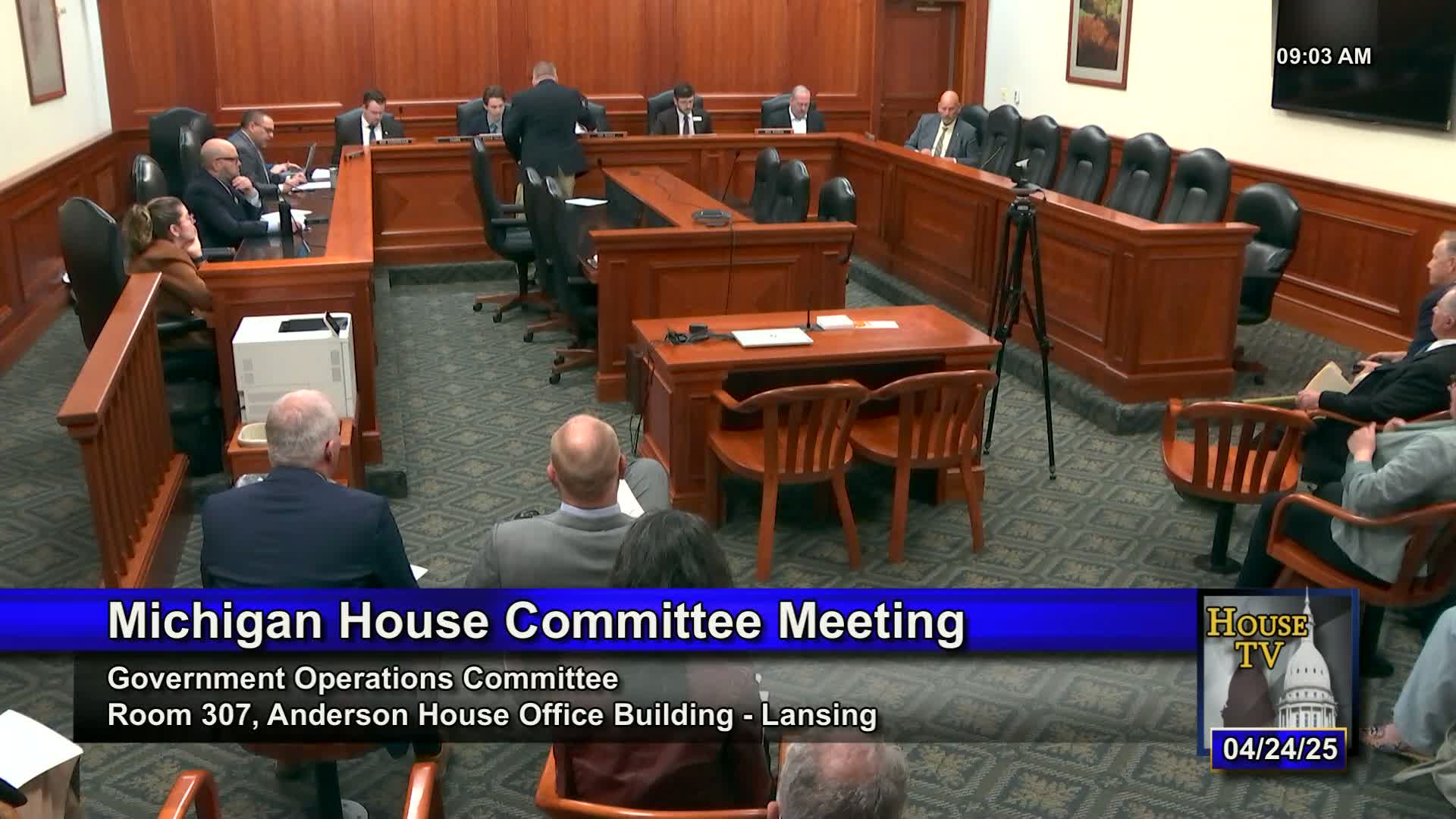
The House Committee on Government Operations on Oct. 12 reported House Bill 4244 with a recommendation after a 3‑2 roll call vote, sending the measure to the next stage of consideration.
The House Committee on Government Operations on Oct. 12 reported House Bill 4244 with a recommendation after a 3‑2 roll call vote, sending the measure to the next stage of consideration.
The bill, identified at the hearing as sponsored by Representative Baddock, would encourage state usage of the phrase “Gulf of America” (as presented at the hearing) in place of the Gulf of Mexico. Supporters who testified told the committee they view the change as a symbolic way to promote pride in veterans and the state; opponents and several committee members raised concerns about local costs, historic usage and the role of executive orders and federal or international geography.
Why it matters: The committee-level recommendation means the bill moves forward in the legislative process; if enacted, the change would affect how state communications and signage refer to a major body of water. Committee debate focused less on immediate regulatory details and more on symbolic, fiscal and jurisdictional implications.
The hearing record shows five amendments were offered and defeated before the committee voted to report the bill. Representative Fitzgerald offered an amendment to allow state officials, when communicating with non‑Michiganders, to use “Gulf of Mexico” or to treat “Gulf of America” as a voluntary alternate name; that amendment was defeated on a 2‑3 vote. Fitzgerald’s second amendment, to allow local public bodies to seek state reimbursement for costs of compliance, also failed 2‑3. Representative McFall offered several amendments — including language to make executive orders that had effected prior name changes unenforceable and to preserve use of “Gulf of Mexico” in historical contexts — and another to give public bodies discretion if compliance would raise costs; each of those amendments failed on 2‑3 votes.
The final committee roll call on the motion to report House Bill 4244 was recorded 3 ayes and 2 nays. The committee record shows the motion to approve the minutes earlier in the meeting and then the hearing and amendment votes on HB 4244 proceeded before the bill was reported.
Substantive details from the hearing include: - Number of amendments considered: 5 (all defeated). The amendment votes were recorded as two yays and three nays on each failed amendment motion. - Final committee action: Motion to report HB 4244 with recommendation passed 3 ayes, 2 nays.
Discussion vs. action: Much of the committee exchange on HB 4244 was discussion of symbolism, potential reputational effects in communications outside Michigan, and whether cost burdens could fall to local governments. The failed amendments attempted to limit enforcement to conflicts with federal law, to create reimbursement mechanisms, to protect historical usages, and to preserve local discretion for cost concerns. No amendment passed at the committee level; the committee did not adopt language changing existing executive orders or creating a state reimbursement program.
Public comment during the hearing touched tangentially on HB 4244. One commenter who identified as a tribal citizen said she did not “hate America” and described concerns about the rhetoric and language used in related bills. The committee did not take additional public‑comment votes specific to HB 4244 beyond the amendment and reporting votes.
Next steps: With the committee report, HB 4244 will proceed according to the House calendar and committee-referral process. Any future changes would occur in subsequent committee action or on the floor of the House.
The committee conducting the hearing was the House Committee on Government Operations.