Get Full Government Meeting Transcripts, Videos, & Alerts Forever!
Get email alerts on the Education topic
No spam. Unsubscribe anytime.
Committee hears wide-ranging testimony on bill to limit student cell phone use; pilots show academic and discipline gains
Summary
The House Education and Workforce Committee heard extended testimony on House Bill 4,141, which would limit student cell phone use in K-12 schools; supporters cited brain-development research and district-level pilot data, while school boards urged local flexibility and exceptions for medical and instructional needs.
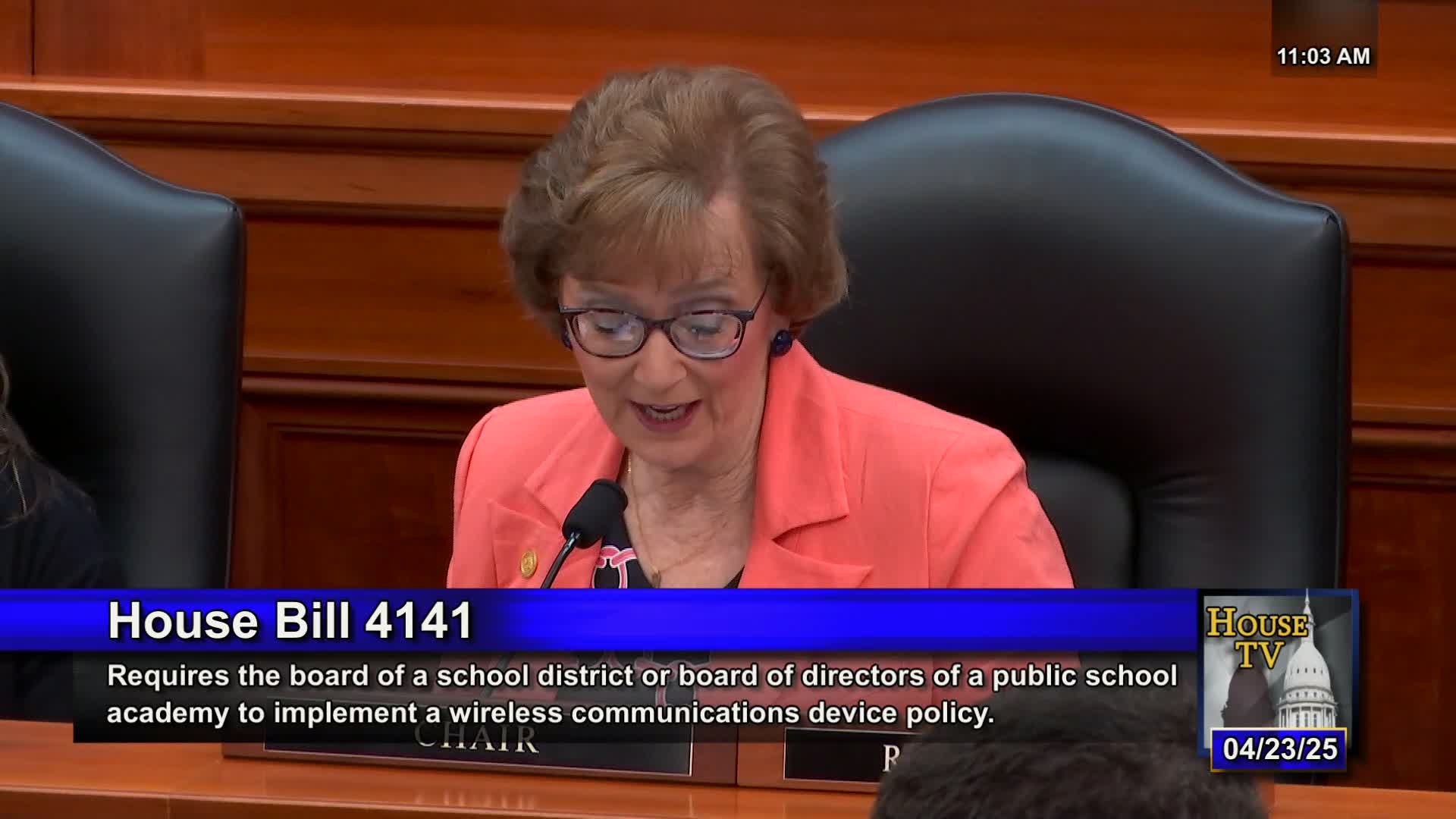
Representative Mark Tisdale presented House Bill 4,141 to the House Education and Workforce Committee, proposing state-level limits on student cell phone use in K-12 schools to reduce classroom distraction and support learning.
Multiple teachers, school leaders and researchers testified in support. Jennifer Wilson, a licensed counselor, described a body of research and her two decades of clinical and classroom experience linking unrestricted smartphone access to reduced attention, disrupted executive function and emotional stress in adolescents. "The constant digital distractions are stealing time from learning, building skills, connecting with others in real life," Wilson said, arguing that state-level policy would give educators a consistent framework and backing for enforcement.
Casey Nocci, a seventh- and eighth-grade teacher who said his school operates a "no phone zone," said student surveys showed striking perceptions: 80 percent of middle-school students said smartphones did not have a negative impact on themselves but 80 percent said their phones negatively impacted their friends. Nocci described cultural pressure that makes classroom-only teacher enforcement difficult and said his private-school policy—students check phones into the office—supports academic outcomes.
Administrators from districts that have already implemented policies described operational approaches and data. Andy Wares, associate principal at Traverse City West High School, described wall cubbies and daily envelopes for noncompliant students; he said the school saw a large drop in visible phone use and fewer unsupervised incidents once the policy was in place. Dr. James Schwartz, superintendent of Avondale Schools, and Principal Katie Gomez described a magnetic pouch system at Avondale Middle School and shared state-test outcome changes after implementation: Avondale reported its index score rose from 50.89 to 73, a growth index from 55 to 76, and a student success index increase from 51 to 81. Gomez told the committee the school saw a two-thirds reduction in fights and a substantial drop in phone-related violations.
Supporters said the policy helps social skills, reduces cyberbullying during the school day and eliminates a recurrent power struggle between teachers and students over phones. Several witnesses noted the policy does not ban technology for instruction; teachers retain discretion to incorporate devices in lessons when appropriate.
Not all witnesses supported a state-mandated, one-size-fits-all approach. Jennifer Smith, director of government relations for the Michigan Association of School Boards, told the committee MASB supports school-level phone policies but opposes the bill as drafted because it is "far too prescriptive" and may not fit local circumstances. She specifically flagged children who walk or bike to school and rely on devices for safety, the instructional use of phones in some classes, and the absence of explicit exceptions for students covered by 504 plans or individualized education programs. Smith said MASB favors an Ohio-style approach that requires districts to adopt a policy but allows local discretion for details.
Committee members asked about exemptions for medically necessary devices, school-issued devices and smartwatches. Representative Paquette and others pressed witnesses on whether flip phones or smartwatches would be exempt; several district witnesses said their local policies do not exempt smartwatches or flip phones. During questioning, a committee member noted an H-1 substitute had been drafted to clarify some points: it removes specific grade-number references, replaces them with elementary/middle/high school categories, and includes explicit language exempting medically necessary devices and school-issued devices used for instruction.
Association testimony filed for the record was mixed: the Michigan Association of Secondary School Principals submitted written support for the bill; the Michigan Association of School Boards filed opposition. The committee did not vote on HB 4,141 in this session. Members said they intended further drafting and that the bill's sponsors were working with intermediate school districts and superintendents to refine language and exemptions.