MDOT and rail industry outline freight-rail programs, safety data and grade‑separation needs
Loading...
Summary
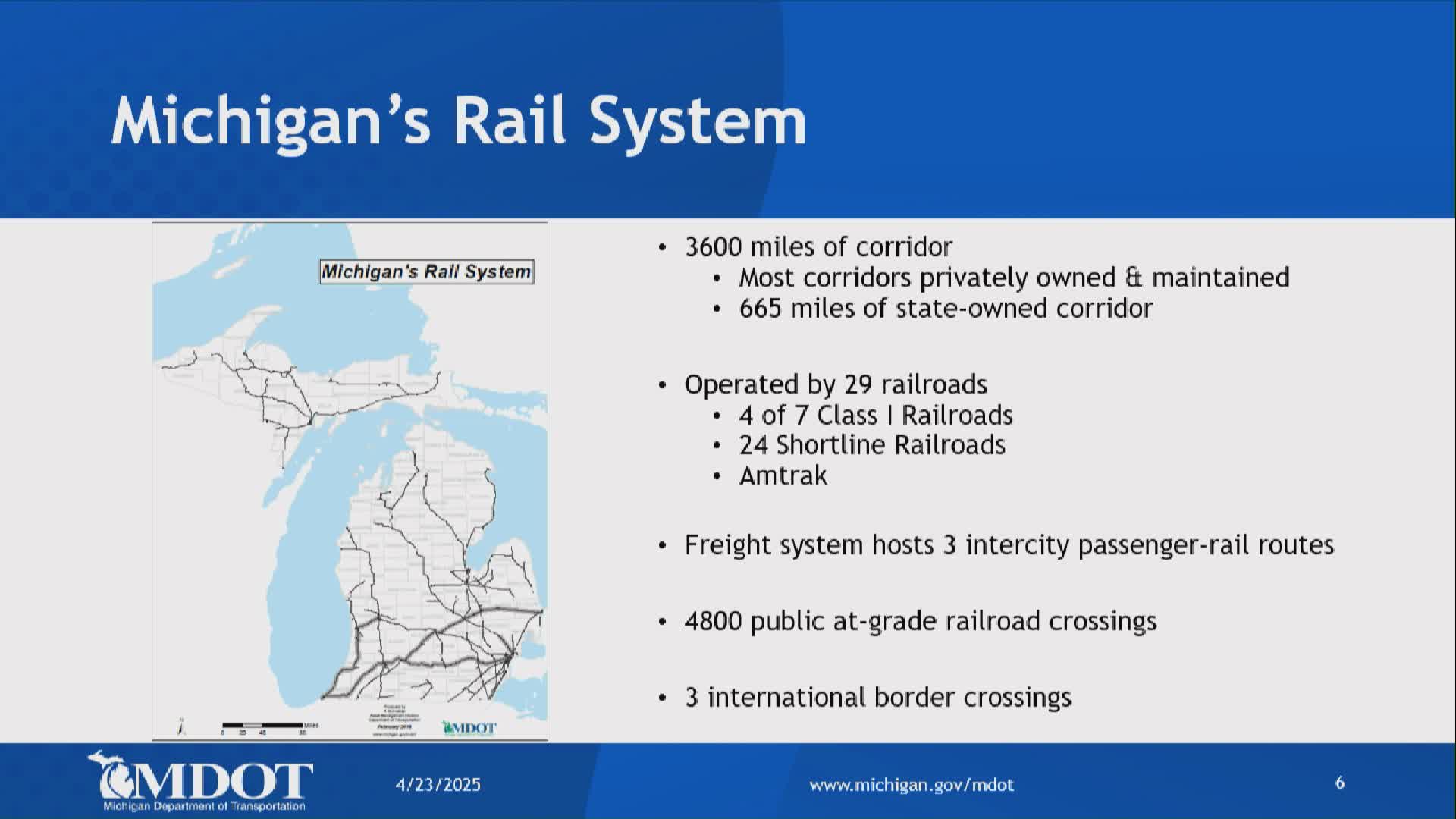
MDOT and the Michigan Railroads Association briefed the committee on the state's 3,600-mile freight network, grant programs (FEDP, Rail Enhancement), federal discretionary grants, safety trends and local-grade separation funding needs; MDOT said it owns about 665 miles of rail and the Office of Rail has authorization for 41 FTEs.
The Subcommittee on Appropriations — Transportation heard an overview of Michigan’s freight rail network and state grant programs on Oct. 12 from Peter Anister, director of rail at the Michigan Department of Transportation, and John Cool, president of the Michigan Railroads Association.
Anister said Michigan has about 3,600 miles of railroad track and that the state owns roughly 665 of those miles. “We have about 3,600 miles of rail in Michigan, and primarily that rail is owned by private railroads. Michigan, we do own about 665 miles of that 3,600 miles of rail,” Anister said.
Why it matters: Committee members heard that rail moves large tonnages of freight, serves auto manufacturers and other major industries, reduces truck traffic and that state and federal grant programs are central to improving rail capacity and safety.
Anister described two MDOT programs that provide state support: the Freight Economic Development Program (FEDP), which can fund up to 50% of shipper-side rail infrastructure such as turnouts and spurs and which MDOT said has supported about 40 projects since fiscal 2020 and generated an estimated 25,000 new carloads per year; and the Michigan Rail Enhancement Grant Program, launched with funding in FY 2023, which can cover up to 70% of project cost and had awarded 34 projects that leveraged about $87,000,000 in private investment.
Anister cited a recent FEDP example in Holland where a roughly $1,000,000 grant helped a box manufacturer install a direct rail connection, creating 58 jobs and about 450 new rail carloads per year. He said federal discretionary grants are also important; MDOT and private railroads have both successfully applied for competitive federal funding to support projects such as the Livernois Yard Enhancement in Detroit.
John Cool summarized safety trends and industry investments. Citing Federal Railroad Administration data, he said derailments per million train miles have fallen about 40% over 20 years and that hazmat accident rates have declined about 80% since 2005. “More than 99.99% of all hazmat carloads shipped in this country arrive accident release free,” Cool said.
Cool urged additional funding for two local programs discussed with the committee: the Surface Program for crossing repairs (historically funded at $3,000,000 per year, with a one-time $2,000,000 addition in the current budget to $5,000,000 total) and the grade-separation program established in law in recent years (he said $10,000,000 and $5,000,000 deposits have been made to that program). He asked lawmakers to consider continued state contributions to crossing and grade-separation projects that frequently require layered funding from local, state, federal and railroad sources.
Committee members asked several operational questions. Anister said the state’s owned corridors operate under agreements with private railroads that allow the railroad to operate and generate revenue while assuming maintenance responsibility; MDOT receives some compensation under those agreements. He also said the Office of Rail has budget authorization for 41 FTEs, although not all positions are filled, and that most rail program funding is supported from the Comprehensive Transportation Fund.
Ending: Members asked for ongoing collaboration among MDOT, railroads and local road authorities to prioritize crossings and separations. No legislative action was taken at the hearing; routine minutes were adopted by unanimous consent.