
Senate panel advances transportation omnibus after multiple technical and timing amendments
Get AI-powered insights, summaries, and transcripts
Subscribe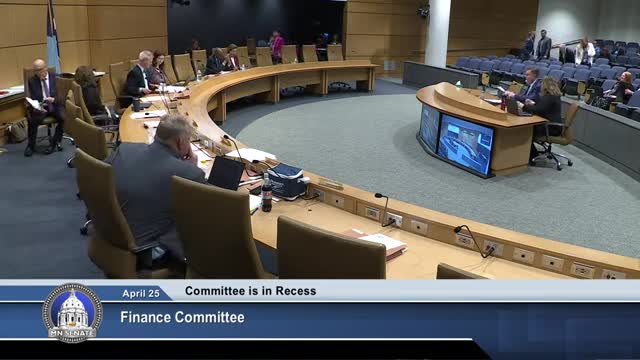
Summary
The Senate Finance Committee on April 25 recommended passage of Senate File 2082, the transportation omnibus bill, after approving a package of technical and policy amendments and resolving several fiscal riders.
The Senate Finance Committee on April 25 recommended passage of Senate File 2082, the transportation omnibus bill, after approving a package of technical and policy amendments and resolving several fiscal riders.
Committee members approved amendments that change effective dates, conform appropriations, and alter how certain revenue and bond-related provisions are handled. Senator Pappas moved Amendment A46, which Mr. Greenfield described as delaying the Asset Sustainability Ratio implementation "until the beginning of fiscal year 02/1930" to allow time to evaluate the policy's effects on the State Transportation Improvement Program and other MnDOT expenditures. The committee approved A46 by voice vote. Other amendments approved included A52 (removing language affecting US Highway 8 bonding), A51 (technical, a citation change offered as an amendment to A45), A45 (a technical/conforming amendment as amended by A51), A53 (authorizing leftover funds from a 2023 TMO study to be used toward implementation), and A49 (removing a micro-transit restriction so providers can use metro-area sales tax funds more flexibly).
The committee debated a high-profile provision that would change the statutory definition of "highway purposes." Senator Jasinski offered Amendment A50 to restore the narrower highway-purpose language; he argued that expanding the definition to include transit, active transportation and greenhouse-gas work would dilute constitutionally dedicated highway funding. Senator Dibble (bill author) defended the broader language as a policy choice to consider multimodal uses of highway corridors and resisted removing the change at committee. Senator Jasinski ultimately withdrew A50 after extended discussion.
Members also discussed a Metro Transit / MnDOT loan provision: the bill author and Metropolitan Council representative Judd Shetman described a proposal allowing Metro Transit to loan up to $250 million of metro area sales tax proceeds to MnDOT to synchronize corridor reconstruction on Trunk Highway 65 with planned bus-rapid-transit (F Line) work. Senator Pratt proposed and the committee accepted an oral amendment to require the loan be interest-free; Shetman said the Council had expected to negotiate repayment terms with MnDOT and that interest could be part of the loan arrangement absent the oral change. Senator Pratt's oral amendment was accepted as friendly to the bill.
The committee also approved a $9 million appropriation for the Washington Avenue pedestrian bridge safety work, directed to the University of Minnesota in the bill as written but with committee discussion acknowledging Hennepin County ownership and the potential for the university to pass funds to the county for construction and design control.
After the set of amendments, Senator Wicklund moved that Senate File 2082 as amended be recommended for passage and instruct staff to make technical and conforming changes. The motion carried by voice vote.
Votes at a glance - A46 (delay asset-sustainability provision): moved by Senator Pappas; approved by voice vote. (Outcome: approved) - A52 (remove US Highway 8 bonding language): moved by Senator Pappas; approved by voice vote. (Outcome: approved) - A51 (technical amendment to A45; citation change): moved by Senator Jasinski; approved by voice vote. (Outcome: approved) - A45 as amended (technical/conforming appropriation riders including EV surcharge flows): moved by Senator Jasinski; approved by voice vote. (Outcome: approved) - A53 (extend remaining $45,000 from 2023 TMO study to implementation): moved by Senator Jasinski; approved by voice vote. (Outcome: approved) - A49 (remove restrictive micro‑transit language so providers may use metro-area sales tax funds more flexibly): moved/endorsed in committee discussion; approved by voice vote. (Outcome: approved) - A47 (split of blackout-plate fee between DVS and HUTDF): moved by Senator Jasinski; failed on voice vote. (Outcome: failed) - A50 (narrow highway-purpose definition): offered by Senator Jasinski; withdrawn after discussion. (Outcome: withdrawn) - Final: Senate File 2082 as amended: moved by Senator Wicklund; approved by voice vote. (Outcome: approved)
Why it matters The committee kept the bill broadly intact while making timing and technical fixes intended to protect program budgets and give agencies more time to prepare. The delay to the asset-sustainability metric and the loan provision for Highway 65 are the most consequential policy moves in committee: one postpones a new performance requirement for MnDOT and the other creates a mechanism to coordinate roadway and bus rapid transit work on a major corridor. The debate over the statutory "highway purposes" definition illustrates a larger, ongoing policy choice about whether highway-dedicated funds should be used for broader multimodal projects.
What’s next The bill was recommended for passage by the Finance Committee and will move to the Senate floor; differences with the House and conference issues (notably the highway-purposes language and Metro loan mechanics) are likely to be negotiated later.