Get Full Government Meeting Transcripts, Videos, & Alerts Forever!
Get email alerts on the Mlcc Sips Replacement Licensing Revenue topic
No spam. Unsubscribe anytime.
Liquor Control Commission reports $10.5M cases sold, online renewals and SIPs replacement; seeks two funded FTEs
Summary
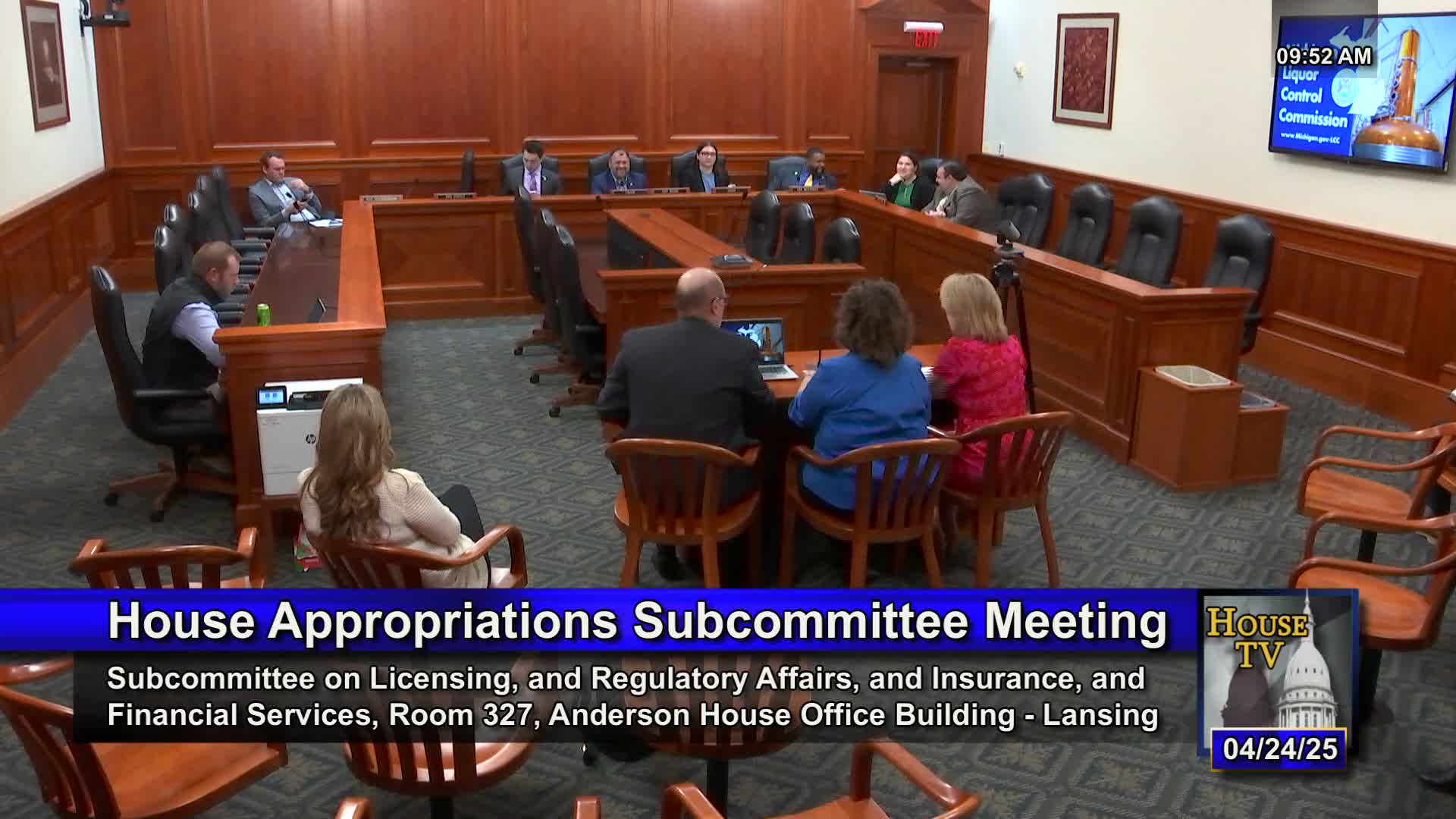
Michigan Liquor Control Commission Chair Kristen Belcher and staff told the same subcommittee the agency is replacing a 50‑year-old SIPS wholesale system, has processed more than 18,000 of 22,000 annual renewals online, and seeks funding to authorize two additional FTEs to reach a 150 FTE authorization.
Kristen Belcher, chair of the Michigan Liquor Control Commission, told the House Appropriations Subcommittee on Licensing and Regulatory Affairs, Insurance and Financial Services that the commission handled about 10.5 million cases of spirits in the most recent reporting period and oversees more than 14,000 spirit SKUs available to Michigan retailers.
Belcher and MLCC staff described an annual renewal cycle in which roughly 22,000 individual license renewals were due this year and the commission had processed over 18,000 renewals through an online system. Carrie Kron, MLCC business manager, and David Marvin, executive services director, outlined an ongoing IT project to replace the commission’s sales, inventory and purchasing system (SIPs), which staff said will modernize ordering and inventory reconciliation and is scheduled to go live in October 2025 after completion of end-to-end testing.
Why it matters: The MLCC both regulates alcohol sales and wholesales spirits to retailers in Michigan. The commission also collects and distributes taxes and fees to multiple state and local funds; the presenters showed an unaudited estimate of nearly $600 million returned to state accounts in the most recent fiscal year after sales and allocations.
Details and staffing: MLCC staff said the executive budget seeks authority for 150 FTEs but the department currently has funding for 148; actual personnel on staff numbered 131 at the time of the presentation, and the commission has approval to backfill eight positions. The commission said two FTEs are included as an executive‑budget request to fully fund the 150-FTE authorization.
SIPs replacement and testing timeline: David Marvin said functional testing of the SIPs replacement was complete and that the project is moving into end‑to‑end testing, with an October go‑live targeted for 2025. The new system will integrate ordering, sales, inventory and purchasing and will connect with the three authorized distribution agents (ADAs) that deliver spirits to licensees.
Revenue and distribution: Carrie Kron walked the committee through the commission’s revenue distribution: a portion of license fees and spirit sales are passed through to local governments, the School Aid Fund, the convention facility development fund and other accounts. MLCC staff said roughly $75.5 million went to the School Aid Fund and about $76 million to the convention facility development fund in the unaudited fiscal-year estimate.
Questions from representatives focused on practical impacts—how deposit/return legislation would affect retailers and distributors if enacted, the SIPs timeline and the qualified distiller registration process administered by the Department of Agriculture. Belcher said the commission is not the sponsor of container‑deposit proposals and will respond to any statutory changes the legislature enacts.
MLCC staff also described recent operational changes: a pilot separating licensing‑application investigations from regulatory enforcement investigators, a “MLCC On the Road” outreach program, a podcast series, licensing improvements such as online printing for licensees, and a delisting process to manage product selection.