Get Full Government Meeting Transcripts, Videos, & Alerts Forever!
Get email alerts on the Cannabis Regulatory Agency Lab And Enforcement topic
No spam. Unsubscribe anytime.
Cannabis regulator building reference lab, seeks stronger suspension rules as licensing explodes
Summary
CRA Executive Director Brian Hanna told the subcommittee the agency is converting unused space into a reference laboratory to speed investigations and testing, is updating rules to strengthen summary suspension authority after a 2024 legal challenge, and cited rapid license growth and enforcement workload.
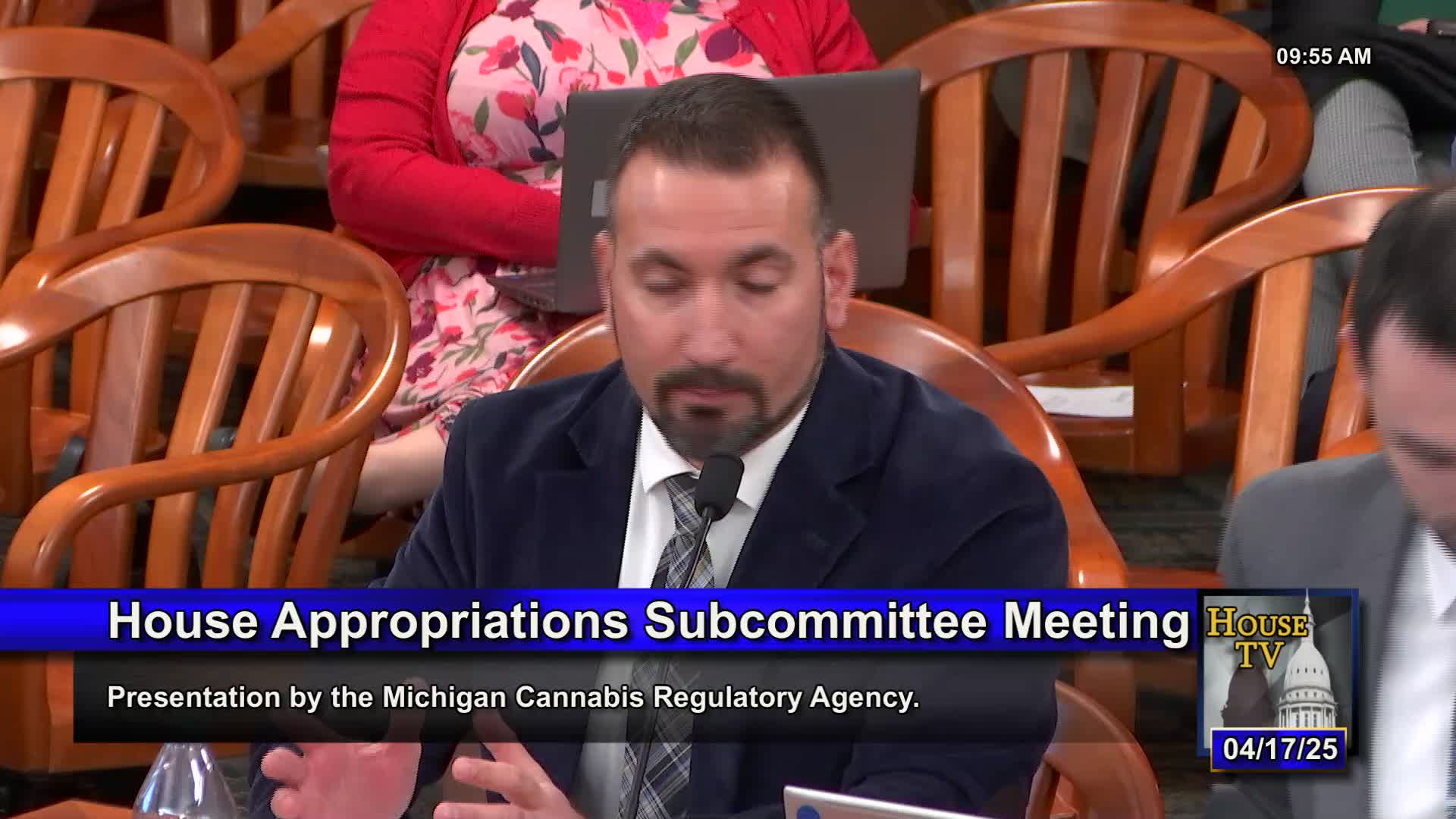
Executive Director Brian Hanna and Policy Assistant Derek Sova told the House Appropriations subcommittee on Licensing and Regulatory Affairs that the Cannabis Regulatory Agency is building an in‑house reference laboratory, tightening rules on summary suspensions and making other rule changes to support small businesses as marijuana license counts and complaints have surged.
Hanna said the CRA now regulates more than 4,000 business licenses after exponential growth since 2021 and that FY 2025 budget increases — including nine added FTEs — responded to both industry expansion and audit recommendations from the Attorney General’s office to speed disciplinary and inspection processes. "The solution in this space and you talk to other cannabis regulatory programs is you need a reference laboratory period you need to have that," Hanna told the subcommittee, arguing a state reference lab will reduce investigation time, remove the current need to ask licensed labs to test against other licensees and provide an objective standard for contested laboratory results.
Hanna described three enforcement and public‑safety priorities: 1) restoring effective summary suspension authority after a court challenge in 2024 limited the agency’s prior suspension practice; 2) combatting diversion and illicit product that undercuts regulated businesses and may pose health risks; and 3) addressing the impacts of federal changes to hemp rules that have allowed novel, intoxicating cannabinoids into commerce. He showed an example of an unregulated product sold at a Detroit liquor store that exceeded Michigan’s lawful potency limits and said federal loopholes have created interstate supply of unregulated, high‑potency products that may reach children.
The CRA emphasized that its operations are funded by restricted license and registry fees, not the general fund, and that staff have sought input from licensees and municipalities to reduce regulatory burdens on small operators. Recent rule changes cited include measures to support microbusinesses, reduce duplicative retail lobby requirements and clarify testing and labeling expectations.
Hanna said the CRA is constructing the reference laboratory using existing agency space to minimize costs, has ordered and staged equipment and aims to have staffing and accreditations in place before the lab opens. He said statutory language is still needed to ensure agency staff can lawfully possess and transport marijuana samples for testing; committee members were told draft legislation to clarify possession and chain‑of‑custody authority was expected to be reintroduced.
On enforcement metrics, the agency reported issuing 634 disciplinary actions in 2024 and 5,396 educational warnings; the CRA also said it has taken steps to return monitoring‑system fees to licensees. Members asked about lab staffing, the lab’s ability to detect contaminants such as fentanyl in illicit products, advertising and sign rules, and the interaction between ballot‑initiative language, rulemaking and statutory changes. Hanna and Sova said the CRA will work with lawmakers on statutory fixes where rulemaking authority is insufficient and that the reference lab can support law‑enforcement partners once operational.
The presentation concluded with the agency saying it would continue education sessions for stakeholders and support veteran‑focused initiatives and municipal outreach.