Get Full Government Meeting Transcripts, Videos, & Alerts Forever!
Get email alerts on the Drinking Water topic
No spam. Unsubscribe anytime.
EGLE officials tell appropriations subcommittee Michigan needs billions, more staff to speed lead-line replacements and inspections
Summary
Officials from Michigan’s Department of Environment, Great Lakes, and Energy told a House appropriations subcommittee that the state’s drinking-water program needs more staffing and more flexible state funding to pair with federal grants so communities can complete full infrastructure projects that include lead service line replacement.
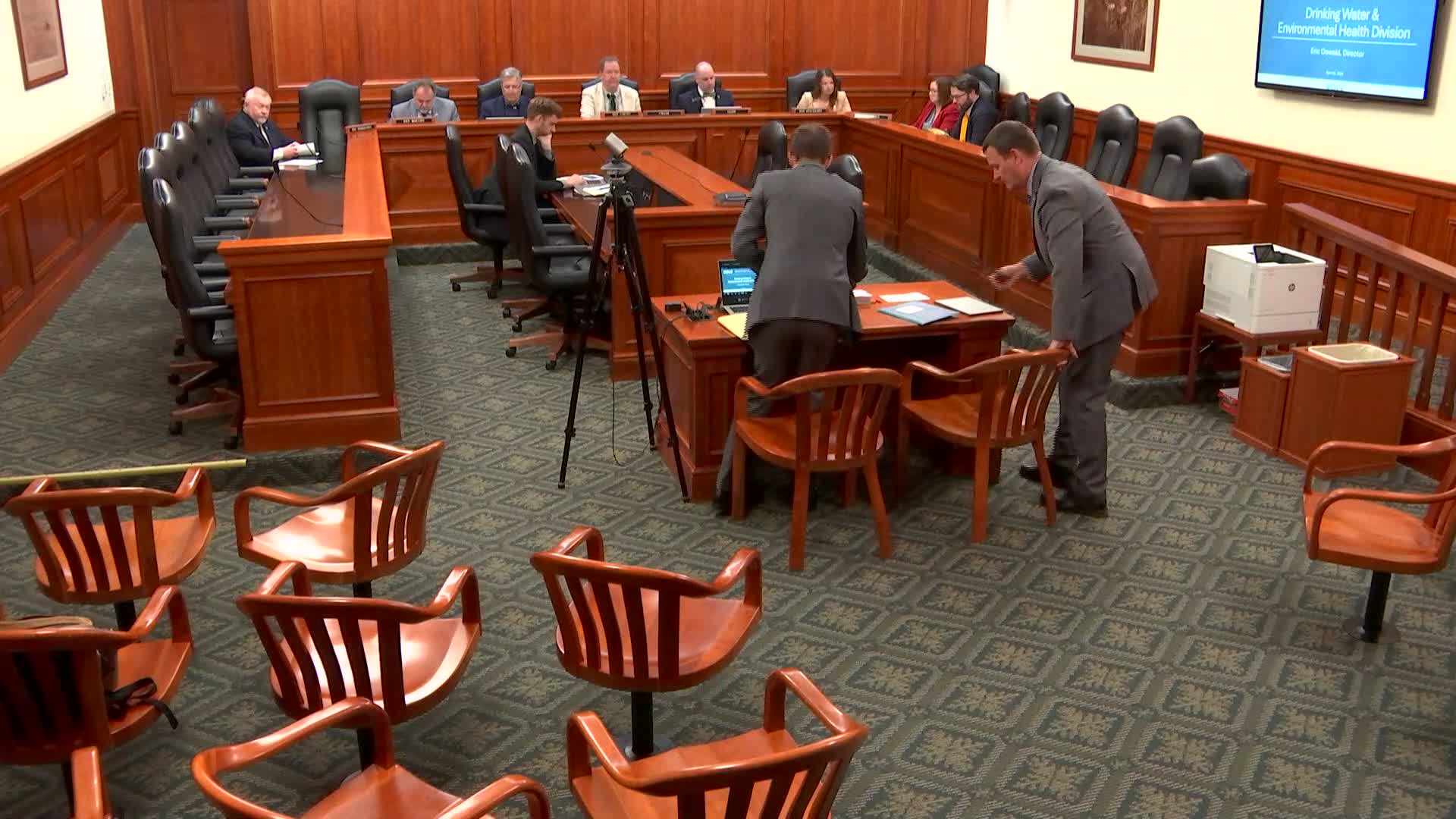
Director Eric Oswald of the Michigan Department of Environment, Great Lakes, and Energy’s (EGLE) Drinking Water and Environmental Health Division told the House Appropriations Subcommittee on Environment, Great Lakes, and Energy on Earth Day that the state’s drinking-water program needs more staff and more funding to meet inspection and lead service line replacement obligations.
“We are safeguarding Michigan’s drinking water and environmental health,” Oswald said, summarizing the division’s mission and its cooperative approach with the systems it regulates. He told members the division oversees more than 10,000 public water supplies and is 98% staffed, but remains under-resourced to complete federally required sanitary surveys and other duties.
The division asked for additional full-time equivalents in the governor’s budget and highlighted an item in that proposal: a request for $50 million one-time and $30 million ongoing to help communities replace lead service lines and associated drinking-water infrastructure. Travis Boskell, deputy director with EGLE, said the state proposal is intended to pair with federal funds from the Bipartisan Infrastructure Law and the State Revolving Fund to fund whole projects rather than only the portion of work federal rules allow.
“Those federal dollars can only be used on replacing the lead service line itself,” Boskell said. He said communities commonly package lead-line work with water-main, pump-station or transmission-main work, and that without additional state funds they cannot always advance complete projects.
Boskell and Oswald provided EGLE’s inventory-based estimates for the scope of the problem. The agency estimates roughly 300,000 lead service lines remain in Michigan, plus about 60,000 galvanized lines that were previously connected to lead and will likely require replacement, and said replacement has been proceeding at about 5% per year under Michigan’s Lead and Copper Rule. At an illustrative $10,000 per service line, officials said the remaining work could amount to roughly $3 billion.
Oswald said EGLE’s recent third-party staffing study found the division was significantly underfunded for Safe Drinking Water Act responsibilities and recommended roughly a 95% staff increase in some areas; the division currently employs about 200 people, up from roughly 120 in 2017. Oswald said the division has about 40 community water supplies for every engineer on staff and that the agency is hiring unlicensed engineers and assisting them to take the professional-engineer exam.
Committee members pressed officials about enforcement and cost burdens. Oswald said EGLE prefers cooperation — using compliance agreements and technical assistance — and that fines and stipulated penalties are reserved for systems that fail repeatedly or ignore requirements. He described an escalation process that typically begins with education or administrative consent agreements before fines would be assessed.
Members also asked about regionalization and operational capacity. Oswald said Michigan has “too many” public water systems — about 11,000 in total — and that consolidation or regional authorities could reduce overhead, lower rates and improve technical resilience. He described local political control and revenue concerns as barriers to consolidation and said EGLE seeks ways to support cooperative structures that preserve local input.
Oswald and Boskell described several existing programs and tools: operator certification and training (the state reported more than 4,700 recent exam takers), an emerging contaminants unit that expanded after PFAS responses, an area-wide optimization program for surface water plants, and an electronic permitting and reporting system called the Michigan Environmental Health and Drinking Water Information System (EDDI). Oswald said EDDI was expensive and more development remains needed but that it has reduced paperwork and made permit tracking easier.
The presentation closed with officials offering to take questions and asking legislators to consider the administration’s budget requests that would add staff and state-level funding to help communities complete bundled infrastructure projects that include lead-service-line replacement. No committee votes or formal actions were recorded during the presentation.