Get Full Government Meeting Transcripts, Videos, & Alerts Forever!
Get email alerts on the Conservation Districts topic
No spam. Unsubscribe anytime.
Michigan conservation districts ask appropriations subcommittee for $10 million boost to operations funding
Summary
Leaders of the Michigan Association of Conservation Districts told a House appropriations subcommittee that the stateoperational grant of $3 million—about $40,000 per district—is insufficient and asked legislators to pursue an additional $10 million to fund full-time managers and planners across 75 districts.
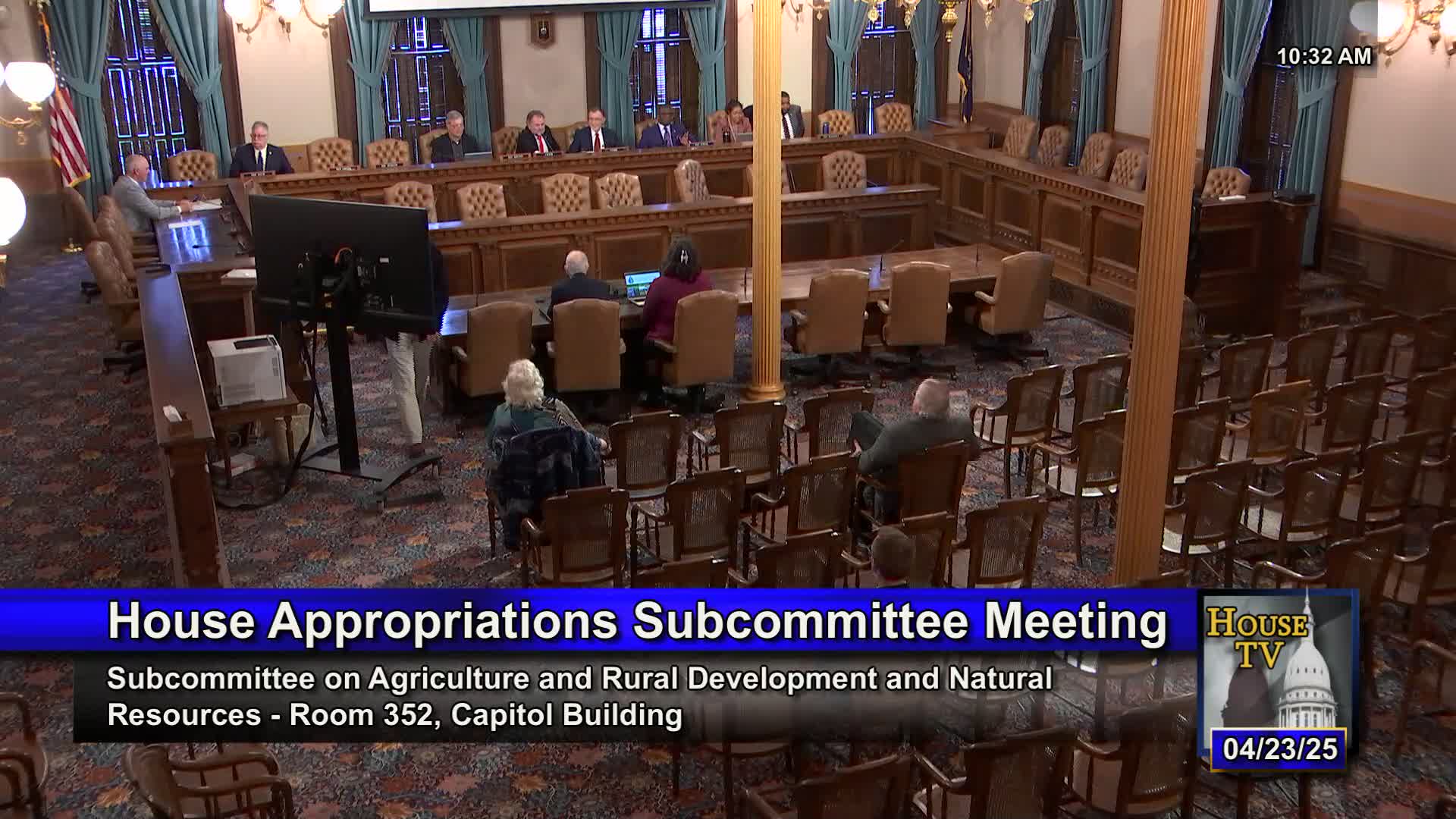
The House Appropriations Subcommittee on Agriculture, Rural Development and the Department of Natural Resources heard testimony April 16 from the Michigan Association of Conservation Districts (MACD), which asked the committee to increase state operational support from $3 million annually to $13 million, an additional $10 million, to allow each of Michigan's 75 conservation districts to hire full-time staff and expand technical assistance.
MACD Executive Director Rivka Hodgkinson told the committee that "conservation districts are 75 in the state covering all 83 counties, and they are the private land conservation delivery system natural resource management services." She said the districts provide nonregulatory, locally led technical assistance to private landowners, farmers and other land managers and cited state and federal partnerships that help districts deliver programs.
Why it matters: Hodgkinson and others argued state operational funding is the seed investment that allows districts to leverage other funds, win competitive grants and deliver federal conservation programs locally. "According to MDARD's estimates, every $1 in the state invested in conservation district operations leverages $5.10 from other sources," Hodgkinson said, and when federal farm program dollars are counted the return increases, she said, to as much as $43 for every $1 invested.
MACD President Jerry Miller and other association leaders described a wide range of programs implemented through districts, including the Conservation Stewardship Program (CSP), the Environmental Quality Incentives Program (EQIP), the Produce Safety Program, forestry assistance, Regional Conservation Partnership Program (RCPP) work, Cooperative Invasive Species Management Areas (CISMA) efforts, succession-planning programs such as My Farm Link, tree sales, workshops and local outreach. Hodgkinson told the subcommittee districts are authorized under older state law and carry responsibilities under state environmental statutes; she referred to Public Act 297 of 1937 (authorizing conservation districts) and to the Natural Resources and Environmental Protection Act (Public Act 451 of 1994) when describing mandated purposes such as technical assistance and watershed management.
MACD officials laid out specific program and capacity gaps the increase would address. Hodgkinson said additional funds would allow each district to hire a full-time district manager and a full-time conservation planner, provide consistent employee benefits to attract and retain staff, and expand services in under-resourced counties such as Wayne and Macomb. She asked the committee to also support renewal and enhancement of the Freshwater Protection Fund, which currently pays for several programs including the program MACD called the MEAT program and other MDARD-supported activities.
Committee members asked how the state might raise or reallocate funds to reach the $10 million target. Representative Green asked where a 300% increase would come from; Hodgkinson said funding sources are a legislative decision and gave examples used in other states, including acreage or development fees, portions of sales taxes and reallocation of existing fee revenue. She said MACD would work with legislators on specific proposals.
Members pressed MACD on governance and local accountability. Hodgkinson said conservation districts are led by five-member elected local boards, with elections held at each district's annual meeting rather than on the general ballot; directors are unpaid volunteers and districts must submit biannual audits and board-approved budgets to qualify for MDARD operational grants.
Several representatives expressed support. Representative McKinney described the districts' work as an efficient use of limited funds and urged the committee to consider options to increase support; Representative O'Neil recounted conversations with local conservation staff and said the current per-district amount is "pretty dismal." Hodgkinson provided one multi-year example: Ottawa County's district, she said, received initial county support that allowed it to grow grant-writing capacity and expand from near-closure to a multi-million-dollar annual operation with 16 technical staff.
No new appropriations were decided in the hearing. The committee approved minutes from its April 16 meeting "without objection" after a motion by Representative DeSina. The subcommittee adjourned after questions and discussion.
Votes at a glance
- Motion to approve minutes from April 16: moved by Representative DeSina; approved without objection (tally not specified in the record).
Ending
MACD said it will work with legislators on funding options and urged renewed investment in operational grants and the Freshwater Protection Fund to sustain local conservation services and to increase Michigan's capacity to capture federal conservation dollars. The subcommittee made no funding decision during this hearing.