Get Full Government Meeting Transcripts, Videos, & Alerts Forever!
Get email alerts on the Agriculture topic
No spam. Unsubscribe anytime.
Michigan soybean group pitches biodiesel tax credits to grow in-state market
Summary
Representatives of the Michigan Soybean Association told the House Agriculture Committee that a biodiesel tax-credit bill, modeled after Missouri law, would expand demand for Michigan soybean oil, reduce emissions and support local processing and jobs; sponsors plan to introduce the legislation next week.
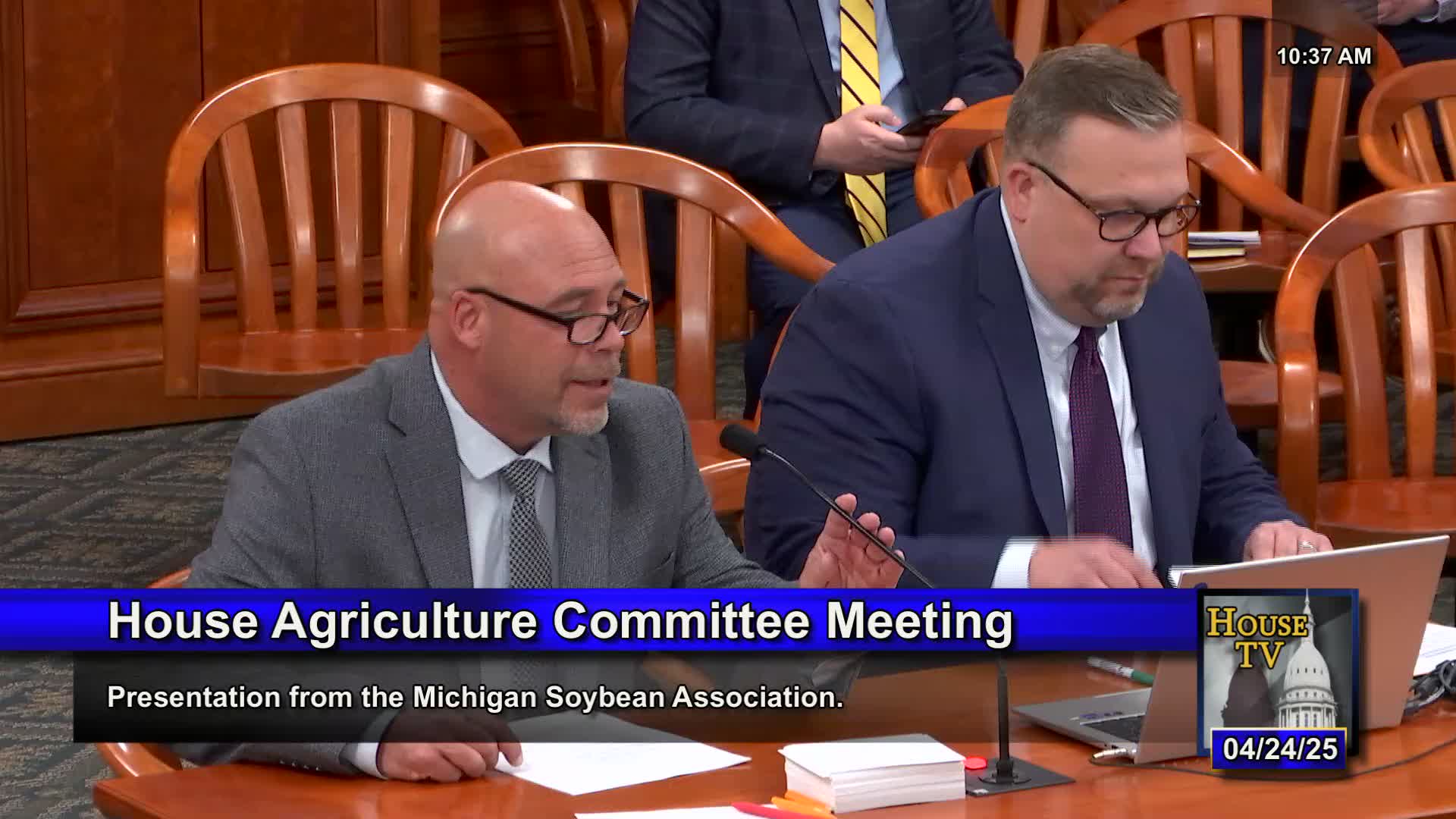
Larry Phelps, president of the Michigan Soybean Association, and Ben Steyer, the association’s chief executive officer, told the Michigan House Agriculture Committee that a pending bill to create retail and producer tax incentives for biodiesel would help build a local market for soybean oil and support rural economies.
Phelps said soybeans are used in food, feed and an expanding set of bio-based products. “Soybeans are used to make your seats in especially Ford vehicles. Soles on Sketchers shoes, basketballs, tires,” Phelps said. He added that when soybeans are processed “80% is primarily used in livestock feed and plant based foods” while the remaining 20% is oil “one of the most versatile natural oils.”
Steyer told the committee the Michigan Soybean Association’s top legislative priority this session is the biodiesel bill. “Our number 1 legislative priority for this session is this biodiesel bill,” he said, and he said the association will introduce the measure next week and seek bipartisan cosponsors.
According to the presentation, the bill’s structure would mirror incentives used in other Midwestern states. Retail tax credits proposed in the plan would be 2 cents per gallon for blends of B6–B9, 5 cents per gallon for B10–B19, and 7 cents per gallon for blends over B20. Producers in-state would be eligible for a 2-cent-per-gallon production credit. The proposal would include a six-year sunset and caps on program payouts: $16 million for retailers and $2 million for producers, the presenters said.
Steyer told the committee he expects the credits would expand retail availability. He cited a recent survey of roughly 250 retail fuel locations that found only three stations in Michigan carried blends in the B5–B20 range and said other states using incentives have substantially greater retail adoption.
Committee members asked about fuel quality, consumer cost and farm returns. Steyer and Phelps said modern production standards have addressed many early quality problems with biodiesel and argued competition from biodiesel could help stabilize or lower diesel prices at the pump. In response to questions about farm income, Steyer said the bill would not create direct payments to growers but that a stronger domestic crush and processing market would raise demand for Michigan soybeans and could improve commodity prices for farmers.
The presenters cited broader claims about the bioeconomy: the USDA study referenced in the presentation was described as finding large economic output and job counts tied to U.S. bioproducts, and the speakers said wider biodiesel use could lower greenhouse gas emissions in transportation and be a practical near-term option for maritime and heavy-duty fleets because it uses existing fuel infrastructure. One claim in the presentation said that if Michigan’s diesel use were blended to B20, annual diesel carbon emissions would fall by about 15%.
The association asked the committee to engage with the bill when it is introduced next week; Steyer said the group stands ready “to work with the committee to help grow domestic soybean demand and enhance Michigan sustainability and energy security.”
The transcript did not include the bill text or an official bill number for the biodiesel proposal; details above come from the association presentation and questions recorded during the committee hearing.