Get Full Government Meeting Transcripts, Videos, & Alerts Forever!
Get email alerts on the Municipal Budget topic
No spam. Unsubscribe anytime.
Baltimore City presents $4.68 billion preliminary fiscal 2026 budget; proposes fee increases, savings to close $85 million gap
Summary
Laura Larson, the city's budget director, briefed the Baltimore City Board of Estimates on the Administration’s preliminary fiscal 2026 spending plan, a proposal Larson said totals about $4,680,000,000 and would close an $85,000,000 shortfall without raising broad-based property or income tax rates.
Laura Larson, the city's budget director, briefed the Baltimore City Board of Estimates on the Administration’s preliminary fiscal 2026 spending plan, a proposal Larson said totals about $4,680,000,000 and would close an $85,000,000 shortfall without raising broad-based property or income tax rates.
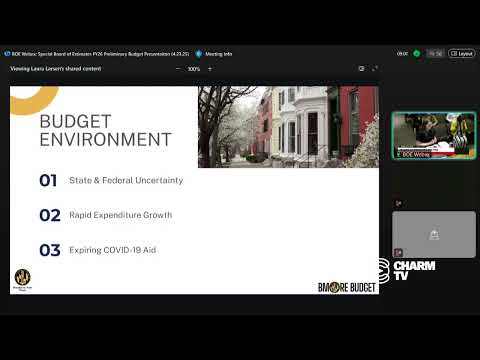
Larson said the city expects revenue growth of roughly 5.1% against expenditure growth of about 8.7%, and described a balancing strategy built from three approaches: new targeted revenue proposals, citywide cost optimizations and agency savings.
The proposal avoids a general property- or income-tax rate increase. Instead, Larson recommended a set of narrower revenue changes projected to produce about $26,400,000: raising the landfill tipping fee from $65 to $135 per ton (estimated $8,900,000), a 20% increase to the city EMS transport fee (about $5,500,000), a package of citywide fine-and-fee adjustments informed by a pending fee study (about $6,500,000), redeploying and annualizing traffic-camera revenue (about $3,400,000) and increasing the city’s taxi tax from $0.25 to $0.38 per ride (about $1,950,000). Larson said the fee study covers the city’s roughly 2,000 fees and groups about 300 fees for early review in areas such as fire, housing code enforcement and right-of-way permits.
On the savings side, Larson said the budget identifies roughly $43,700,000 in citywide savings driven by personnel and benefit adjustments ($20,900,000), reduced outside legal counsel ($3,000,000), efficiencies in agency charges (telephone, hardware and software: $2,300,000), one-time funding swaps for real estate projects ($11,600,000) and reductions to legacy items ($5,900,000). Agency-level changes total nearly $15,000,000 in savings, Larson said, including converting contractual work to permanent positions in Finance and IT, and police civilianization that will civilianize three additional units and return 15 sworn positions to patrol for a net annual savings of about $1,100,000. Larson also said remaining funding for the police mounted unit will be removed.
Larson described program-level investments embedded in the plan. The “Youth” pillar totals about $624,800,000 all funds, with the local share supporting a summer YouthWorks program expected to offer 8,500 slots at $15 an hour and a $13,000,000 temporary wages allocation (with $4,800,000 from the Children and Youth Fund and additional federal, state and special-fund contributions). The public-safety pillar is roughly $1.1 billion all funds and includes a $1,300,000 expansion of the group-violence reduction strategy and $5,200,000 from opioid restitution funds for EMS and population-health services. Clean-and-healthy-community investments include funding to add up to 15 solid-waste crews ($5,200,000) and $24,600,000 for homeless shelter operations; the budget also adds $2,000,000 annually to BARCS (animal-shelter funding) from $1,500,000.
Larson said the preliminary general fund is about $2.6 billion. Major revenue lines and changes she cited include: property tax (about 46% of the general fund; no rate change; owner-occupied rate described as just over $2 per $100 of assessed value; Group 1 reassessments showed ~17.4% growth overall with residential up about 21% and commercial about 11%), transfer and recordation taxes (about 4% of the general fund; projected +$12,700,000, ~14%), income tax (about 19.19% of general fund; projected +$33,100,000, ~7.1%; current local rate at the statewide maximum 3.2% and the administration is not proposing a local increase to 3.3%), highway user revenue (HUR, about 10% of the general fund; projected +$37,200,000; the city’s share rises to 12.2% of statewide collections under recent state legislation) and investment earnings (about 1% of the general fund; projected decline of ~$17,200,000, or 41%). Larson said the budget assumes continuation of several large state grant programs and called out uncertainty on the federal side as the biggest downside risk.
On capital, Larson said the 2026 capital spending plan is the largest locally backed capital budget in roughly 20 years and is supported by increased HUR allocation, an increase approved by voters in November that raises annual G.O. borrowing authority from $80,000,000 to $125,000,000, and one-time cash from FEMA COVID reimbursements. Capital highlights in her presentation included increases in school capital contributions (from $19,000,000 to $27,000,000), $21,000,000 for the first phase of an East Side transfer station, $18,000,000 for capital work on homeless-shelter facilities, $8,100,000 for HVAC at police district stations, $3,600,000 for CC Jackson Park improvements, and roughly $94,000,000 in transportation-related investment (including ADA improvements tied to a recently entered partial consent decree).
Larson and board members discussed contingency planning for federal grant cuts. Larson said the city is performing a comprehensive grants risk assessment, tracking drawdowns and focusing on programs with the highest risk of reduction, and that roughly $344,400,000 in state and federal grant dollars are reflected in the plan (Larson noted grant totals and the mix of state vs. federal funding as part of the briefing and said those amounts remain subject to change as Washington and Annapolis provide final guidance). She also noted ARPA-funded costs must be spent by December 2026, and FEMA pandemic aid had expired; both create multi-year structural pressures for sustaining programs currently supported by those sources.
Board members praised the emphasis on workforce investments, schools and recreation but repeatedly flagged sensitivity to fee increases because many residents face high household costs. The Board President and the Mayor asked about worst-case scenarios if federal grants are cut; Larson said the city could temporarily use reserves under the Board’s rainy-day policy but cautioned that drawdowns require repayment (the timeline discussed was three to five years) and that dipping reserves can affect bond-ratings and long-term capital plans. Larson reported a rainy-day fund balance in the roughly $170,000,000 range and that the administration had assigned an additional ~$255,000,000 toward specific risks in preparation for the budget year.
The director closed by noting the Board will return with final recommendations and the City Council will consider the ordinance of estimates; the Board President reminded residents that the Board of Estimates Taxpayer Night hearing would be held that day at 6 p.m. in the same room and online.