Get Full Government Meeting Transcripts, Videos, & Alerts Forever!
Get email alerts on the Budget Fy26 topic
No spam. Unsubscribe anytime.
Board of Estimates hears overview of mayor’s $4.69 billion preliminary FY26 spending plan
Summary
The Baltimore City Board of Estimates received a presentation on the mayor’s preliminary $4.69 billion fiscal 2026 spending plan, with officials detailing revenue projections, major program investments and a recommended $36.7 million allocation from the opioid restitution fund.
The Baltimore City Board of Estimates received a presentation on the mayor’s preliminary fiscal 2026 spending plan, which the administration described as a $4.69 billion combined operating and capital proposal.
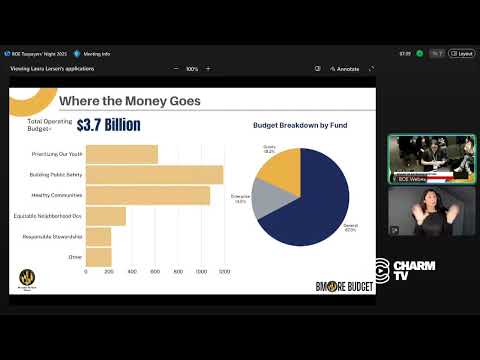
Laura Larson, director of the Bureau of Budget and Management Research, told the Board that the preliminary plan includes about $3.68 billion for operating expenditures and roughly $1.0 billion for capital spending. Larson said the operating budget is projected to grow 5.82% year over year while the capital budget is growing by 37.7%.
The budget director said the general fund in the preliminary plan is about $2.6 billion and that the largest general-fund revenue streams are property tax, income tax and highway-user revenue, which together make up nearly three-quarters of general-fund receipts. Larson said the administration projects property-tax revenue to rise about 4.9% (driven by building reassessments), income taxes about 7.1% and highway-user revenue nearly 19% as a result of statewide allocation changes. Transfer and recordation taxes were projected to rise about 13.8%.
Larson laid out the broad fund mix in the proposal: the general fund is roughly 67% of the total, grants account for about 18.2% (largely state and federal funds that must be spent per grant agreements) and enterprise funds — primarily the city’s water, wastewater and stormwater utilities — represent about 14.5%.
Larson highlighted several FY26 investments the administration included in the preliminary plan: school-related funding, the expansion of the group violence reduction strategy, expanded vacants remediation, targeted solid-waste investments and resources to overhaul the city’s permitting process (Be More Fast). She also said the plan recommends allocating $36.7 million from the opioid restitution fund, and that under the proposal roughly 52% of that allocation would be grants to nonprofit organizations, 41% would go to direct city services addressing the opioid crisis and about 5.9% would fund oversight, including the restitution advisory board.
Sarah Parnellum of the Baltimore City Department of Planning provided a brief overview of the capital improvement program that underlies the first year of the six-year plan and reiterated that much of the capital budget is restricted to utilities and state and federal programs; she noted larger locally flexible capital allocations for sidewalks, resurfacing, and recreation and parks projects.
City Council President and Board Chair Zeke Cohen, Mayor Brandon Scott and other members of the Board of Estimates presided over the presentation. Larson said the Board of Estimates is slated to vote on the fiscal 2026 ordinance in May and that the ordinance will be transmitted to the City Council the same month; the council must act on the budget no later than June 26.
The board’s representatives emphasized that the preliminary plan reflects a mix of proposed revenue increases and agency savings to close an $85 million projected shortfall, and that the administration is not proposing broad-based tax increases such as a rise in the city’s property or income tax rates in the preliminary plan.
Larson and Parnellum’s presentation provided a framework for the public testimony that followed at Taxpayer Night, and the Board recorded that the budget process will move next to council hearings and additional public vetting in May and June.