
SPOT review: toxicity screening highlights some persistently impacted sites, multiple endpoints add value
Get AI-powered insights, summaries, and transcripts
Subscribe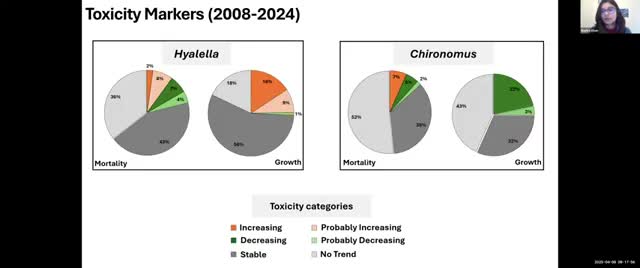
Summary
UC Davis and Granite Canyon staff reported 2008–2024 toxicity results for Hyalella and Chironomus tests, noting most sites are stable but multiple endpoints and growth measures expanded detection of toxic sites and improved prioritization.
Bushra Khan and Granite Canyon staff summarized SPOT toxicity results through 2024 and explained how toxicity findings feed site selection and NTA prioritization.
"Toxicity markers are excellent screening tools to prioritize monitoring at the sites with impacted marker response," Khan said, describing results from Hyalella (amphipod) survival and growth and Chironomus (midge) endpoints. She noted that Hyalella is measured at all 90 sites while Chironomus is measured at 60 sites.
Key findings: Using 2008–2024 data, most sites showed stable or no trend for the four toxicity markers, but several sites showed upward or downward trends. The addition of growth endpoints and the Chironomus species expanded the number of sites flagged as toxic: Khan reported that, in 2024, 9 sites were identified as toxic by Hyalella survival and that adding Hyalella growth increased the total number of unique toxic sites to 28 (with overlaps among endpoints). Chironomus added three unique sites as toxic in 2024 and overlapped with Hyalella toxicity at six sites.
Why it matters: Presenters and SRC members said the multiple endpoints improve sensitivity to different contaminant mixtures and support prioritizing sites for follow‑up investigations. UC Davis staff emphasized that overlapping positive results across organisms or endpoints suggest a complex contaminant mixture; unique identifications point to the value of adding endpoints or organisms.
Discussion and caveats: SRC members asked about variability in the growth endpoint for Hyalella and whether lab practices could influence year‑to‑year results. Khan defended the growth dataset and the laboratory’s checks on dry weight and standard deviations, while acknowledging that some variability exists in Chironomus endpoints. The SRC recommended continued attention to laboratory QA/QC and targeted follow‑up where endpoints consistently indicate toxicity.
Monitoring changes: For 2025 the SPOT design will continue Hyalella at 65 sites (40 core tier‑2 plus other rotated sites) and Chironomus at 60 sites. Khan said the program will also move some non‑toxic sites to an alternate‑year schedule and prioritize sites that show changing trends for more frequent testing.
Ending: SRC members and program staff agreed toxicity screening remains a primary tool for site prioritization and should remain central to SPOT’s monitoring design; they asked for clearer QA/QC documentation on variable endpoints and for targeted follow‑up on sites with rising toxicity signals.