Get Full Government Meeting Transcripts, Videos, & Alerts Forever!
Get email alerts on the State Budget topic
No spam. Unsubscribe anytime.
Legislature advances revenue bill LB650 after trimming incentives, preserves cell-tower tax treatment
Summary
The Nebraska Legislature advanced LB650, a revenue package that pares back recent business tax incentives to help close the state budget gap. Lawmakers adopted several amendments that changed scope and removed a proposed new tax on cell-tower lease payments.
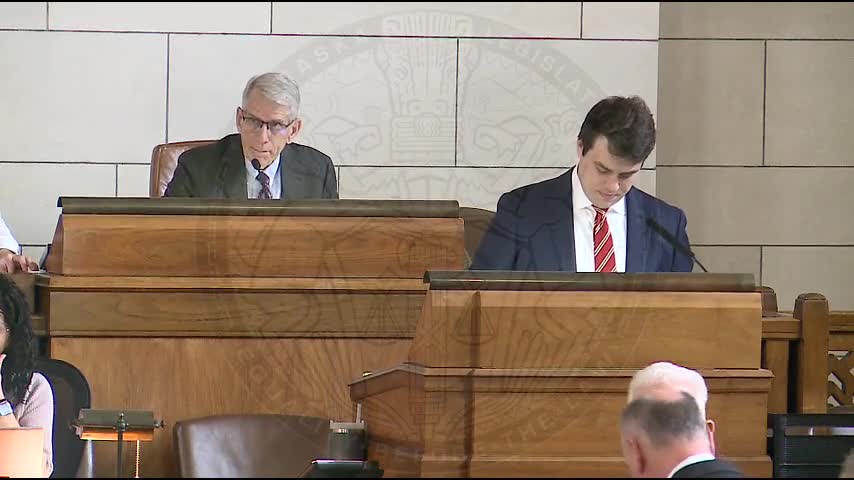
Senators in the Nebraska Legislature advanced LB650, a revenue bill designed to raise state receipts by rolling back recent business tax incentives, after a day of amendments and debate in the George W. Norris Legislative Chamber.
The bill, carried and explained on the floor by Senator John von Gillern, would reduce or suspend a set of more recently enacted business tax programs to help close a budget shortfall. "LB650 seeks to increase revenue to the state by pairing back tax programs and business incentives enacted over the past several years," von Gillern said as he opened debate and urged colleagues to support amendments he described as part of a pathway to a balanced budget.
Why it matters: Sponsors and the Appropriations Committee have included LB650 revenue estimates in the current budget plan. Supporters say rolling back some business incentives is preferable to broad-based tax increases; opponents warned the move could harm broadband deployment, small businesses and long-run economic development.
Most important actions and votes - The body adopted a set of technical and scope amendments, including AM 11-18 (adopted, recorded 28 ayes, 0 nays) and AM 11-32 (adopted, recorded 32 ayes, 0 nays). Those amendments adjusted enactment dates and clarified program caps, which sponsors said increased the bill's estimated biennial revenue impact from about $49 million to roughly $55 million in the committees' pathway. - Lawmakers debated and then adopted AM 10-66, which removes from LB650 a proposed change that would have allowed taxation of wireless tower lease payments (the effect of AM 10-66 was adoption by recorded vote: 30 ayes, 10 nays). Supporters of AM 10-66 said taxing tower leases would impose a new cost on broadband deployment and be passed to consumers; opponents said the item represented a modest revenue source. - A floor amendment that would have eased proposed cuts to the small-retailer sales tax collection allowance (FA 1-31) failed (16 ayes, 25 nays). Shortly afterward LB650 advanced to E & R for engrossing on a roll-call (34 ayes, 5 nays).
Debate highlights and context Supporters framed LB650 as a targeted way to raise revenue while protecting consumers. "We are duty bound by our constitution to pass a balanced budget," von Gillern said, describing a "last in, first out" approach that targets more recently enacted incentive programs.
Opponents warned the bill would undercut recent policy choices and risk longer-term harm. Senator Hallstrom urged retention of a statutory fix enacted earlier (stemming from LB182) that had kept wireless tower leases from being taxed; he described the change proposed in LB650 as effectively creating a new tax on an input that mobile providers rely on to expand rural broadband. "This is not just about dollars and cents. It's about competitiveness," Senator Hallstrom said.
Several senators pressed for nuance rather than an across-the-board approach. Senator John Kavanaugh and others objected to the LIFO (last-in, first-out) principle as an arbitrary cut method. Lawmakers also discussed manufacturing exemptions and a separate purchasing-agent fix that had been enacted previously (and that supporters said should be studied further rather than immediately repealed).
Fiscal numbers and tradeoffs - Floor discussion cited a committee fiscal note that initially estimated about $49 million in additional revenue for the current biennium, and sponsors said subsequent amendments pushed the estimated impact to roughly $55 million. Senate debate referenced an earlier, larger gubernatorial estimate of approximately $140 million that had been revised downward in committee work. - Sponsors and opponents traded estimates over the cost-to-consumer and the value of small offsets. For example, proponents of keeping a modest reduction in the sales-tax collection allowance argued savings materialize quickly when multiplied across many businesses; opponents said even small monthly amounts can matter to small retailers.
Next steps and open items LB650 moved forward after the floor votes. Senators also asked for follow-up work with stakeholders on narrow technical issues flagged during debate — particularly the manufacturer contractor "purchasing agent" question and the effect on broadband tower leases. The Appropriations Committee will incorporate LB650's revenue assumptions into its overall balancing plan.
Ending note: The debate left standing tensions about whether to prioritize revenue increases from targeted rollbacks of incentives or to look elsewhere — including program cuts or pauses to tax reductions — to mend the state budget.