Get Full Government Meeting Transcripts, Videos, & Alerts Forever!
Get email alerts on the Maternal Health topic
No spam. Unsubscribe anytime.
Long floor debate ends with committee package advancing midwifery, doula provisions to engrossing
Summary
After extensive floor debate and multiple amendments, the Legislature advanced a three-bill maternal-health package that expands CNM practice authority, considers licensure for direct-entry midwives, and begins planning Medicaid reimbursement for doula services.
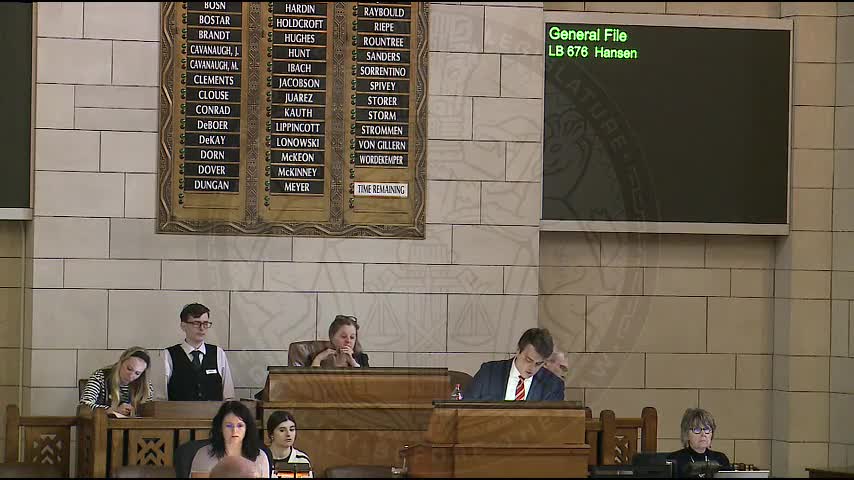
The Legislature advanced a three-part maternal-health package that included changes to certified nurse‑midwife practice (LB 6 76), a proposal to license certified professional midwives (LB 3 74), and a measure to pursue Medicaid reimbursement for doula services (LB 7 01). The package was debated for several hours, produced multiple floor amendments and intense questioning from members, and ultimately the underlying committee package was advanced to engrossing.
What the package contains: Sponsor Senator Mervin Hansen introduced LB 6 76 to give certified nurse midwives (CNMs) independent-practice authority and to remove location restrictions that previously barred CNMs from attending home births in Nebraska. The full committee package (AM655) combined language from LB 6 76, LB 3 74 (to create a separate licensure category for certified professional midwives, CPMs), and LB 7 01 (to create a work group and pursue a state-plan amendment for Medicaid reimbursement for doulas).
Committee amendment and floor debate: The Health and Human Services Committee advanced the package as AM655, but a separate white‑copy amendment (AM914) was filed on the floor by Senator John Frederickson to remove the CPM provisions from the package and to keep CNMs’ independent practice while adding several guardrails suggested by medical groups. Senator Frederickson argued CPMs’ direct-entry training pathways differ markedly from CNMs’ graduate nursing education and raised safety concerns. Senator Frederickson’s AM914 was later withdrawn after floor negotiation; Senator Frederickson pledged to reintroduce language on select file if negotiations did not produce agreement.
Hospital and medical association engagement: The Nebraska Hospital Association and the Nebraska Medical Association engaged extensively in floor-level negotiations. One hospital-requested change (later brought as AM1097) sought to clarify liability language for hospitals that accept transferred patients from midwives; proponents said the amendment provided hospitals a statutory safe-harbor from liability arising from an earlier out-of-hospital transfer, while opponents warned statutory immunity could not fully erase contract or malpractice exposure where negligence occurs.
Doulas and Medicaid: LB 7 01 — included in the committee package — directs a stakeholder work group to prepare a state‑plan amendment to the Medicaid program for limited doula reimbursement for Medicaid recipients. Supporters, including members who work with perinatal quality and managed‑care organizations, said pilot work in the state and national literature shows doula services can reduce cesarean and preterm birth rates and reduce costs; the committee package preserves a funding mechanism (Medicaid managed-care excess-profit fund) for a small pilot if approved.
Floor outcome: Several amendments aimed at tightening the statutory framework failed in recorded votes (AM1097 and AM1094 were debated and not adopted), but after lengthy debate the committee package (AM655) was approved in committee and then the chamber advanced LB 6 76 to E&R initial by recorded vote (clerk record: 40 ayes, 3 nays). Supporters urged continued work on implementation and liability language before final reading; opponents asked for stronger education and credential safeguards for direct‑entry midwives and for protections for hospitals.