Get Full Government Meeting Transcripts, Videos, & Alerts Forever!
Get email alerts on the Civil Rights topic
No spam. Unsubscribe anytime.
Senate passes broad "unlawful discrimination" measure after hours of floor debate
Summary
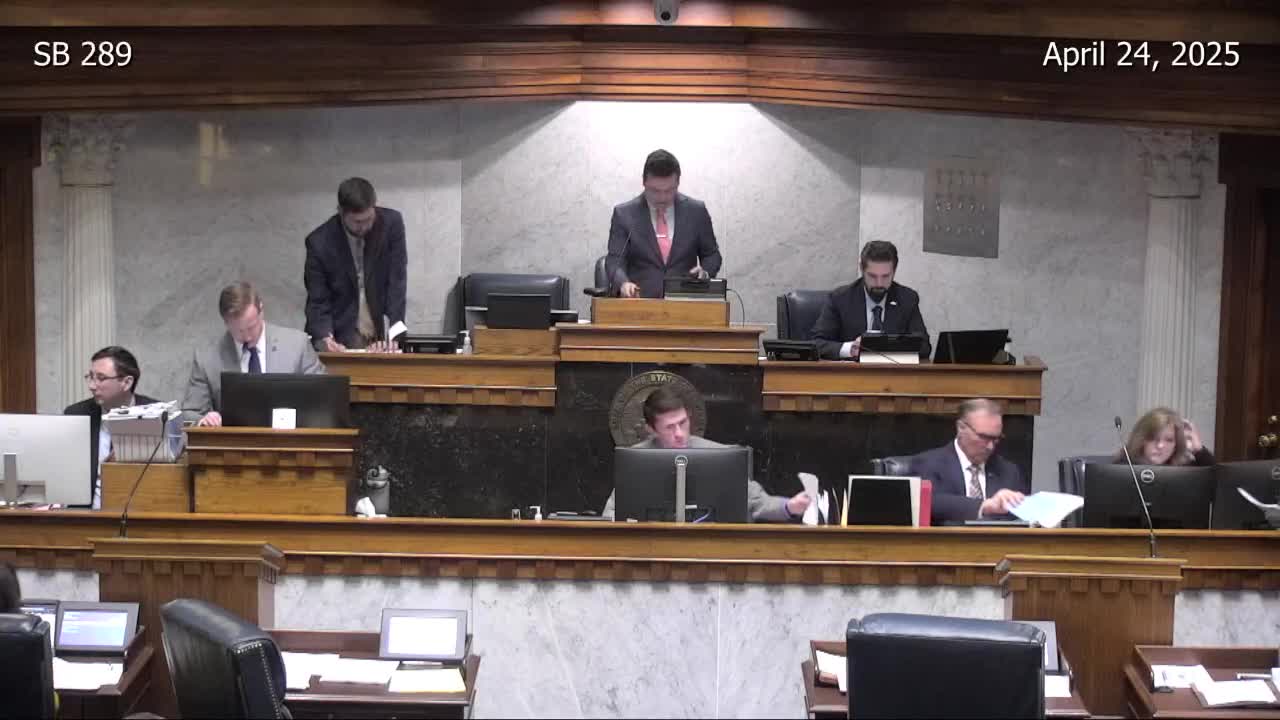
The Indiana Senate approved a conference committee report on Senate Bill 289 after several hours of extended floor debate over whether the measure restricts diversity- and equity-related training and programs in state institutions.
The Indiana Senate approved a conference committee report on Senate Bill 289 on Thursday after several hours of floor debate over language opponents called an attack on programs aimed at historically marginalized communities.
Senator Burns, the bill uthor, described the measure as a prohibition on government-required trainings and policies that ask employees or students to "affirm" propositions that treat people as inherently superior or inferior because of personal characteristics. "Government should not discriminate," he said on the floor, framing the bill as a narrow protection against compelled speech.
Opponents, including Senator Cadore, Senator Taylor and Senator Jackson, argued the bill erases longstanding race-conscious programs and ignores historical discrimination. Cadore urged colleagues to consider the history of legalized discrimination that persists in structures and called the measure harmful because it would "give a blind eye to historical injustices." Senator Jackson invoked constitutional amendments and said the bill runs counter to efforts to address racial inequities.
Part of the conference committee solution preserved several named teaching scholarships but changed eligibility from race-based criteria to residency in five "underserved" counties (Allen, Marion, Lake, St. Joseph and Vanderburgh) and a commitment to teach in one of those counties. Senator Burns said the change was negotiated in the House to preserve existing scholarship programs after potential legal risk; he said the five counties were chosen because they are short on teachers and the scholarships target teacher recruitment there.
Several senators pressed for precise definitions in the bill nd raised concerns about how the language would apply in ordinary educational contexts (for example, whether a school providing a prayer room or an accommodation for religious practice could run afoul of the new provisions). Senator Hundley and Senator Robert both described scenarios where the bill's sweeping language could preclude commonplace training or practices.
After extended debate and numerous points of personal privilege and questioning, the conference committee report was placed on passage and the Senate recorded a final roll call in which the measure passed (tally reported on the floor). The bill will be transmitted to the House and, if the conference report is concurred by the House, proceed to the governor.
Floor debate highlighted the bill's interaction with a wider national conversation about diversity, equity and inclusion policies in public institutions; members expressed sharply divergent interpretations of its effect on scholarships, hiring and training.
(Recorded roll-call tally reported on the floor.)