Get Full Government Meeting Transcripts, Videos, & Alerts Forever!
Get email alerts on the Health Care Pricing topic
No spam. Unsubscribe anytime.
House approves hospital assessment, PBM transparency and reporting changes in health-care package
Summary
The Indiana House adopted the conference committee report on House Bill 1004 late Thursday, approving new studies and reporting requirements aimed at increasing price transparency in hospitals and pharmacy benefit management.
The Indiana House adopted the conference committee report on House Bill 1004 late Thursday, approving changes the bill’s sponsor described as steps to lower health-care costs and increase price transparency.
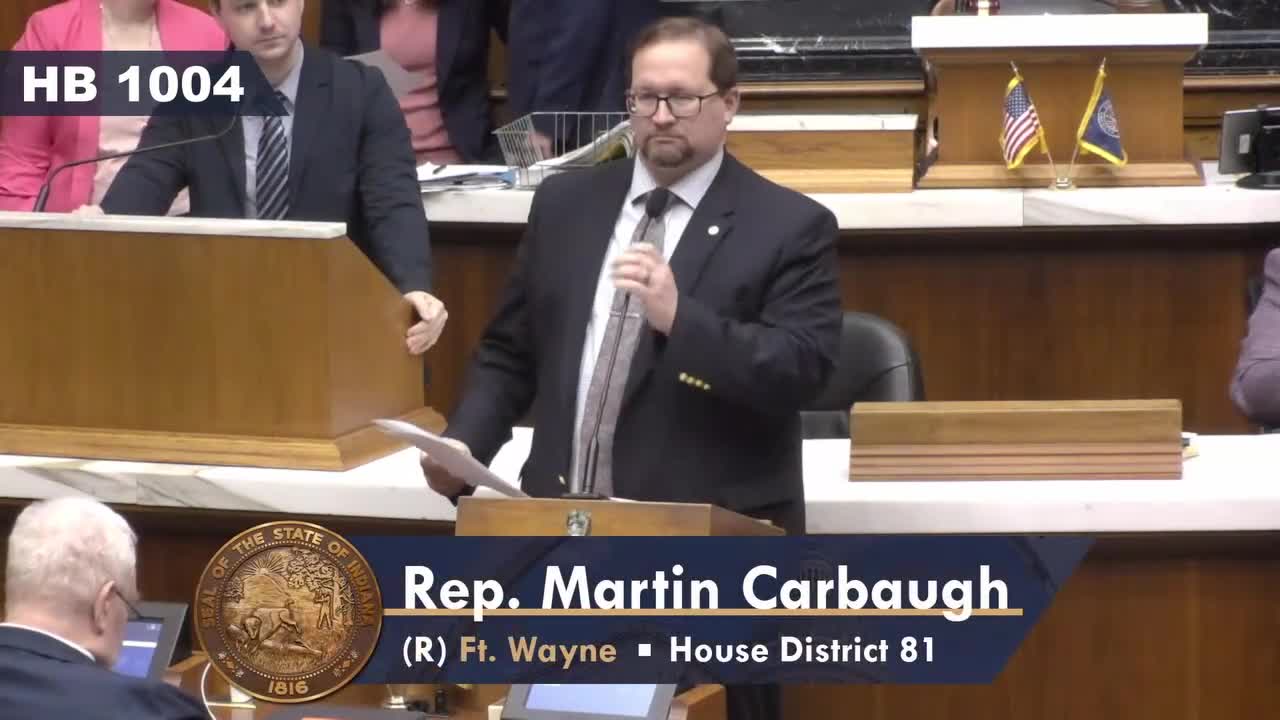
Representative Tom Carball, the bill’s presenter on the floor, said the final conference committee report removes an earlier price cap provision and instead orders a series of studies and reporting requirements designed to inform future policy. "We are asking OMB to develop and conduct a comprehensive study that will find the average hospital rate for these facility fees in Indiana," Carball said during floor debate, summarizing conference changes.
The nut graf: Supporters said the measure gives policymakers data and new reporting tools — including requiring hospitals to supply IRS Form 990 Schedule H details and PBMs to report negotiated rebates and acquisition costs — while opponents warned it could harm community hospitals and leave patients uncertain whether savings would reach consumers.
Most significant provisions adopted in the conference report include: - Direction for the Office of Management and Budget to study average in‑ and outpatient facility charges and physician fee schedules; reporting deadlines include a June 30, 2026 study milestone and a June 30, 2029 compliance check for the state’s five largest hospital systems. - A requirement that the five largest hospital systems offer a direct‑to‑employer narrow network option capped at no more than 260% of full Medicare rates for facility fees; other hospitals must offer similar options by September 2026. - New reporting by PBMs and health plans of negotiated rebates, explanations of how rebates accrue, and aggregate rebate amounts for drugs administered to covered individuals; health plans must also include commission and third‑party administrator compensation on group quotes and report commissions to the all‑payer claims database. - Removal of an automatic penalty that would have stripped nonprofit status if facility charges exceeded a statutory threshold; instead the bill conditions future nonprofit status on compliance with the OMB study results in 2029.
Representative Jason Shackleford, speaking for House Democrats, urged rejection of the conference report. "The loss of a nonprofit status to hospitals with certain revenue thresholds based on meeting an uncertain statewide average price in 2029 is very concerning," he said on the floor, arguing the change could reduce community benefit dollars that many nonprofits provide.
Other Democrats also criticized the measure’s potential to shift costs or increase administrative complexity. Supporters countered that the bill standardizes reporting and provides regulators and the Legislature with data to assess whether negotiated provider and facility prices are translating into lower premiums or out‑of‑pocket costs.
The bill also includes language to prohibit all‑or‑nothing contracting clauses and to require insurers to show how changes in hospital fees affect rates filed for Department of Insurance review. Carball said those reporting steps are intended to ensure any reduction in facility fees is traceable in insurer rate filings.
Outcome: The House adopted the conference committee report on HB1004 by a roll call of 67 ayes to 23 noes. The conference report will be transmitted as required to the Senate and then to the governor for signature or veto.
Background/context: HB1004 grew from earlier health‑care bills considered this session; the final text reflects negotiations with hospital systems, insurers and other stakeholders and pulls several reporting and study items into statute rather than imposing immediate, hard caps.
What’s next: The OMB study deadlines embedded in the law set a three‑year timeline for implementation checks in 2029; legislators signaled further review will follow once the OMB and budget committee have reviewed study methodology and results.