Get Full Government Meeting Transcripts, Videos, & Alerts Forever!
Get email alerts on the Traffic Calming Mashburn Road topic
No spam. Unsubscribe anytime.
NDOT proposes speed cushions, radar sign and bulb outs for Mashburn Road; project to go to neighborhood ballot
Summary
David Greaves, a traffic calming program staffer with the Nashville Department of Transportation, presented a concept design Wednesday for traffic calming on Mashburn Road and said the project will move to a mailed ballot if two-thirds of eligible abutting property owners vote to approve it.
David Greaves, a traffic calming program staffer with the Nashville Department of Transportation, presented a concept design Wednesday for traffic calming on Mashburn Road and said the project will move to a mailed ballot if two-thirds of eligible abutting property owners vote to approve it.
Greaves said the Neighborhood Street Traffic Calming (NSTC) project targets residential streets to reduce vehicle speeds. He told attendees the 85th-percentile speed on Mashburn — the speed at or below which 85% of vehicles travel — was 35 mph during NDOT’s measurements, while the posted speed limit is 25 mph. NDOT also recorded traffic volumes “over 1,800 vehicles per day.” NDOT selected Mashburn from a pool of more than 575 applicant streets and ranked it among the top 25 prioritized for traffic calming in August 2024.
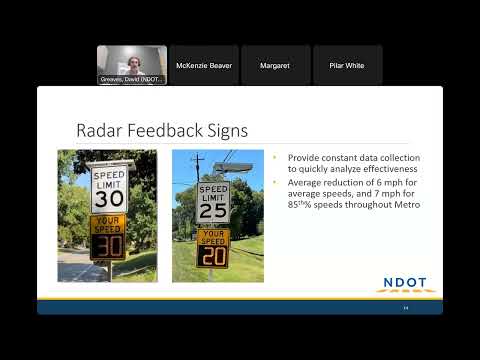
The project concept includes four sets of modular speed cushions spaced roughly 300–500 feet apart along the project segment from Thompson Lane north to Glen Rose Avenue, a radar feedback sign on the uphill approach to a hill where cushions could not be placed, and curb extensions (bulb outs) at the Ennis Road intersection. Greaves described cushion modules available in multiple lengths — 7 feet, 10.5 feet and 14 feet — and said NDOT most commonly uses 10.5-foot cushions to target a traversing speed of about 20–25 mph.
“One of the primary goals of the traffic calming program is speed reduction,” Greaves said, noting that speed is closely related to pedestrian and cyclist survivability in collisions and that the city is pursuing Vision Zero, the policy to eliminate traffic deaths and serious injuries. He cited results from a 2023 local study showing average speeds falling from about 31 mph to 22 mph and 85th-percentile speeds falling from about 37 mph to 25 mph after vertical measures were installed on comparable Nashville streets.
Residents asked questions during the virtual meeting. One attendee asked, “Will the radar feedback sign be permanent, or, like, just for a couple years?” A second resident asked whether calming Mashburn would push traffic onto nearby streets such as Ennis Road. Greaves replied that NDOT had not done extensive study on spillover effects yet but expected vertical measures to also remind drivers on nearby approaches to slow down and said the department plans to study effects on nearby streets over time.
Greaves described the program’s next steps: NDOT will perform site measurements and driveway coordination in a design phase, then either hold a second neighborhood meeting or post final plans online and move directly to a mailed ballot. The ballot will be sent to property owners of residential properties, churches and schools that abut the affected right of way; vacant parcels and operating businesses are ineligible. Each ballot will include a unique ID, the voting period will be approximately six weeks, and 66% approval from returned ballots is required to authorize construction. Greaves estimated an 8–10 month construction timeline after approval because crews are working through an existing backlog.
NDOT staff asked attendees whether they preferred a second neighborhood meeting; two attendees voiced a preference to proceed directly to the online ballot. One participant offered to help promote the ballot via neighborhood association social media and newsletters and said the association would likely host a social event in May where the ballot could be highlighted.
Greaves closed by giving contact information for NDOT’s traffic calming account and said the department will post plans online and on NDOT channels. He reiterated that final placement of cushions and other measures will be determined during the site-design phase and that some measures are not appropriate where steep grades or sight-line issues exist.
Planned next steps: NDOT will complete site visits and final design, post plans or convene a second meeting if requested, mail ballots to eligible abutting property owners, and proceed to construction only if at least 66% of returned ballots vote yes.