Get Full Government Meeting Transcripts, Videos, & Alerts Forever!
Get email alerts on the Community Development Quota topic
No spam. Unsubscribe anytime.
Alaska CDQ groups tell Senate Arctic Affairs of $80M–$100M annual in-region spending, urge science-driven response to salmon declines
Summary
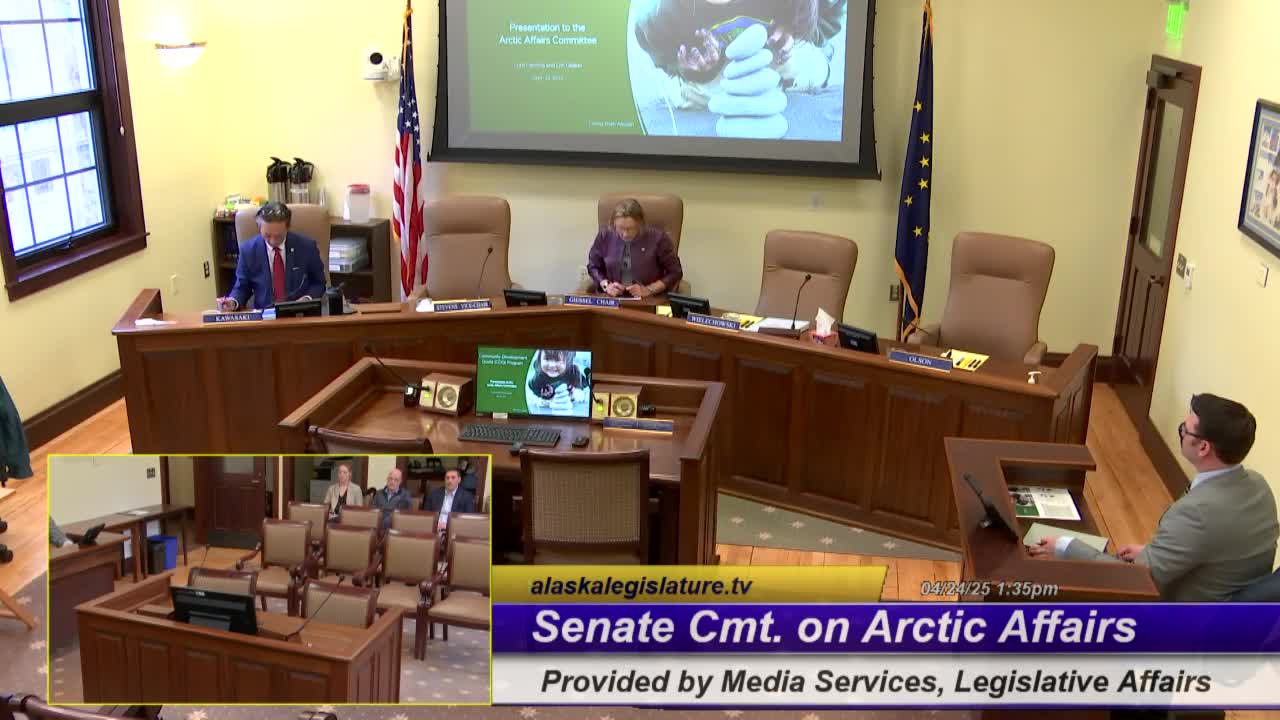
Representatives of Alaska’s six Community Development Quota groups briefed the Senate Arctic Affairs Committee on April 24, 2025, describing the program’s investments in jobs, scholarships, boats and local infrastructure across 65 Western Alaska communities, and urging continued science-based management amid market and salmon-stock pressures.
Representatives of Alaska’s six Community Development Quota groups told the Senate Arctic Affairs Committee on April 24, 2025, that the CDQ program directs roughly $80 million to $100 million a year in in-region spending and underpins jobs, scholarships and infrastructure across 65 Western Alaska communities.
The presentation, delivered by Luke Fanning, chief executive officer of the Aleutian Pribilof Island Community Development Association, and Eric Deacon, chief executive officer of Coastal Villages Region Fund, was introduced by Rachel Baker, Deputy Commissioner of the Alaska Department of Fish and Game, who said the state’s 2023 decennial review found that the six CDQ groups “maintained or improved their overall performance with respect to the program criteria.”
CDQ groups said the program began in 1992 with an initial 10% allocation of Bering Sea and Aleutian Islands fishing rights as a “springboard” to help eligible Western Alaska communities build fisheries-related assets and local economies. “In its simplest form, our job is to help the residents of the Bering Sea benefit from the substantial natural resource wealth of the fisheries that surround them,” said Luke Fanning, who described the program’s stated purposes as expanding community participation in fisheries, supporting economic development, alleviating poverty and promoting diversified, sustainable local economies.
Committee members heard quantitative examples the presenters said show the program’s reach: 65 communities and roughly 30,000 residents in the six-CDQ footprint; about 1,400 in-region jobs and roughly $20 million in direct annual wages attributed to CDQ investments (a 2020 third‑party study estimated the broader statewide multiplier at about 5,000 jobs and $260 million in annual wage income); average annual CDQ in-region spending of $80–$100 million; roughly $3 million a year on scholarships and training programs; and collective CDQ ownership of more than $1 billion in assets, including about 60 vessels.
The witnesses described how those expenditures are used: scholarships and internships at Alaska higher-education institutions, vocational and maritime training (often with AVTEC), revolving loans and gear grants, support for local boat-repair and mechanic shops, fish-processing and tender services, construction of community centers and tsunami shelters, fuel farms, small-harbor maintenance, and fisheries research partnerships such as the Bristol Bay Science and Research Institute. Eric Deacon said Coastal Villages leverages its program to support subsistence access by subsidizing purchases of skiffs, ATVs and other equipment and by building local capacity for repairs and warranty work.
Presenters emphasized that CDQ revenues come primarily from fisheries investments rather than recurring federal grants. “We are almost exclusively not funded by federal government grants,” Fanning said, explaining that most CDQ revenue is generated by quota holdings, royalties and commercial investments, with federal grants used only occasionally to unlock matching funds.
Committee members asked about local hiring and crew composition. Senator Sarika Kawasaki asked why many vessels employ nonresident crew and how to increase Alaska hires. Eric Deacon described maritime training programs and local hiring priorities but said many residents prefer subsistence lifestyles or other careers. “We do have people that have made the choice to have an at sea lifestyle and we have a lot of people that go through our maritime training program and get a chance to test it out,” Deacon said, adding that trainees who choose the at-sea life sometimes take permanent jobs while others return to subsistence priorities.
Officials told the committee CDQ groups are investing in workforce development but that partner training resources such as AVTEC have seen budget reductions that the groups said limit expansion of training pipelines. The witnesses also said commercial realities — aging vessels and plants, rising operating costs, weak markets and geopolitical factors — are compressing margins and threaten future community benefits if not addressed.
Several senators pressed presenters on salmon declines and the possible role of pelagic and trawl fisheries. Fanning and Deacon said CDQ groups support science-based management and are funding genetics, observer and hotspot programs intended to reduce bycatch of Western Alaska-origin salmon. Deacon described newer genetics work that aims to provide faster, in-season information on origin composition so fishing fleets can avoid areas with higher concentrations of fish destined for Western Alaska rivers. He also said genetic analyses show a substantial proportion of chums encountered in the Bering Sea are of hatchery origin from outside Western Alaska, a factor the witnesses said complicates attribution of stock declines.
No formal action was taken at the hearing. Committee members thanked the witnesses and the committee adjourned at 2:51 p.m.